Digital PR for fintech startups works best with credible evidence. Evaluate publishers, outreach methods and reporting before choosing an agency.
Fintech startup digital PR is evidence-led outreach that earns editorial coverage and backlinks with the aim of reaching relevant buyers and supporting organic search visibility. This 2026 guide explains how to choose credible stories, manage financial claims and evaluate an agency without confusing publicity with qualified demand.
- Digital PR for fintech startups should connect credible financial expertise with relevant publishers, backlinks and buyer-focused landing pages.
- Linkible suits fintech teams seeking agency-led link building alongside digital PR; evaluate publisher relevance, outreach methods and reporting.
- Choose original research, expert commentary or product news according to the evidence your startup can substantiate.
- Measure earned links and qualified enquiries separately; coverage alone does not prove commercial impact.
Why digital PR matters for fintech startups
Fintech communications must explain financial products without overstating what those products deliver. A payment workflow, lending criterion or security claim needs more precise wording than a general announcement. Journalists also need evidence they can inspect, not a founder's unsupported prediction.
Digital PR connects that evidence with publishers whose readers match your buyers. A finance publication reaching consumers serves a different purpose from a specialist payments publication reaching finance directors. Choose the audience before choosing the publication.
Backlinks belong within that decision, not outside it. The guide to link-building tactics for financial services brands provides a broader framework for assessing links alongside your PR activity.
For your 2026 plan, distinguish 3 outcomes: editorial coverage, relevant backlinks and qualified enquiries. Report them separately. A mention without a link is coverage; a backlink without buyer relevance is not evidence that your campaign reached prospective customers.
How to build a fintech digital PR programme
Start manually with a focused brief, a spreadsheet and direct research. Paid tools and agency support change how you execute the work; they do not replace evidence, publisher judgement or approval of financial claims.
Define outcomes
Choose the commercial problem before developing a story. A startup selling payment infrastructure to software companies needs different coverage from a consumer budgeting app. State the buyer, the problem and the destination page in plain language.
Select a primary outcome and supporting measures. If the purpose is link building, specify which existing pages deserve editorial citations and why. If the purpose is enquiries, ensure the destination explains the relevant use case rather than sending every reader to a general homepage.
Keep the brief narrow enough that an editor can understand its relevance without a product demonstration.
- Name the buyer's role and buying context.
- Identify the product question your story addresses.
- Select an existing, relevant destination page.
- Separate coverage, backlink and enquiry measures.
- Define what makes an enquiry commercially relevant.
Prepare evidence
Build an evidence pack before contacting journalists. Use information you can publish and explain: documented product changes, attributable expert analysis or research with a clear methodology. Internal transaction data requires permission and a privacy review before it becomes a public story.
Apply 3 evidence checks: provenance, methodology and permission. Know where the information came from, how you analysed it and whether you can disclose it. These checks are a working standard, not a claim that every dataset needs the same approval process.
For a 2026 research story, label the collection period explicitly. Do not present older observations as current behaviour or describe a narrow customer sample as representative of an entire market.
- Record the source and collection period.
- Explain sample selection and exclusions.
- Distinguish observations from interpretation.
- Remove confidential or identifiable customer information.
- Obtain approval for financial and product claims.
Choose approaches
Match the outreach method to the evidence. Expert commentary works when a qualified spokesperson can answer a specific question. Original research needs publishable findings and a defensible method. Product news needs a change that matters beyond your own business.
Run the initial selection manually. Review relevant coverage and identify which stories editors actually publish. Then decide whether you have the expertise and staff time to manage outreach internally or need agency support.
Linkible offers link building and digital PR for brands, including financial businesses. Linkible is best for fintech teams seeking agency-led link building alongside digital PR. That fit does not establish fintech-specific results or guarantee that publishers will cover your story; assess the proposed scope and evidence before appointing an agency.
- Use expert commentary for questions your spokesperson can substantiate.
- Use original research when the method supports the headline.
- Use product news when the change affects a defined audience.
- Keep blogger outreach distinct from independent news coverage.
- Ask an agency to explain deliverables and editorial dependencies.
Qualify publishers
Build a shortlist by reading recent articles, checking the intended audience and identifying the journalist responsible for the topic. A general finance label is insufficient. Consumer savings, business lending and payment infrastructure require different editorial contacts.
Review relevance at both publication and article level. An authoritative domain can still contain a page unrelated to your buyers. Domain-rating metrics help organise research, but they do not establish editorial quality, readership fit or commercial value by themselves.
For US, UK and Canadian audiences, check the market covered by the article. Do not pitch a jurisdiction-specific product claim as universally applicable.
- Check the publication's audience and subject coverage.
- Read the journalist's recent work before making contact.
- Identify an editorial reason to cite your evidence.
- Flag sponsored sections and paid placement arrangements.
- Exclude publishers built around unrelated commercial links.
Send pitches
Write a pitch around the finding, not your company description. Explain what changed, why the publication's readers should care and what evidence is available. Give the journalist enough information to decide whether the story deserves attention.
Manual outreach means researching the recipient and adapting the angle. It does not mean sending the same message individually to an unqualified list. Keep a shared record so colleagues and agencies do not approach the same journalist with conflicting claims.
Ask for a citation where your evidence supports it. Do not make coverage conditional on a keyword-rich anchor or imply that an editor owes you a followed link.
- Lead with the finding or relevant expert answer.
- Connect the story to the journalist's existing coverage.
- Provide an accessible source and named spokesperson.
- Record contact, response and approval status.
- Stop follow-ups when the recipient declines.
Measure results
Record each published result against the original brief. Separate a brand mention from a link, and inspect the destination, context and link attributes. A publication's headline authority score cannot tell you whether the reference is useful.
Use 4 reporting fields as a minimum: publication URL, destination URL, link attributes and relevance notes. Add referral sessions and qualified enquiries where your analytics setup supports them. Explain attribution limits rather than treating every later enquiry as a PR result.
Review your 2026 programme against a baseline that predates outreach. Search rankings and traffic change for multiple reasons, so a movement after publication does not prove the backlink caused it.
- Record live coverage and the date it appeared.
- Verify whether the mention contains a working link.
- Check destination relevance and link attributes.
- Track referral behaviour and qualified enquiries separately.
- Record corrections, removed links and material page changes.
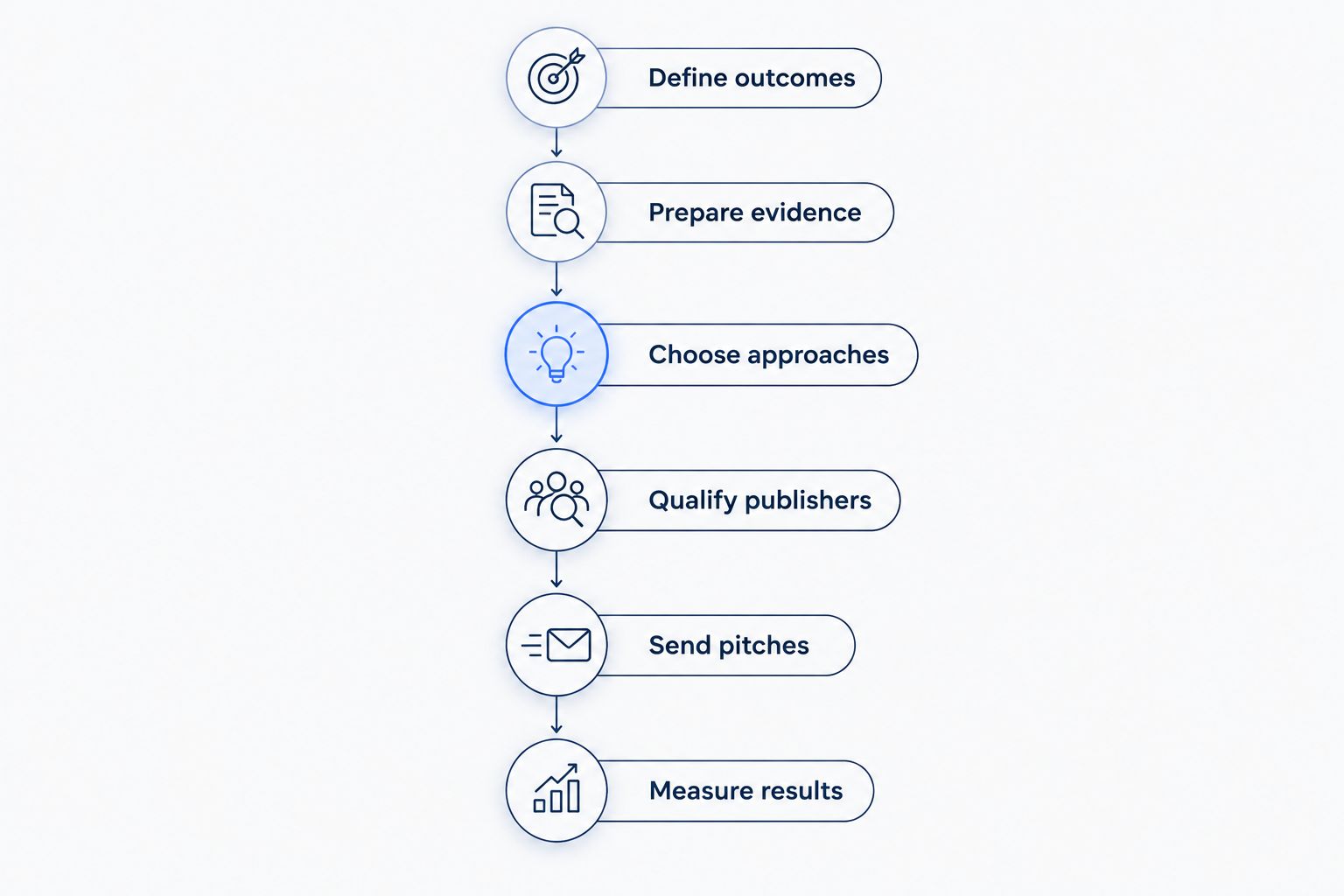
These stages form a sequence: define the outcome, validate the evidence, choose the method, qualify recipients, pitch and measure. Skipping evidence preparation leaves outreach dependent on claims that have not been checked.
Compare fintech digital PR options
Choose the approach your evidence and resources support. No option guarantees coverage, backlinks or rankings. The best choice depends on whether you need a specific expert contribution, a repeatable outreach process or a research-led story.
| Option | Best for | Main advantage | Key limitation |
|---|---|---|---|
| In-house manual outreach | Teams with an available expert and editorial capacity | Direct control over claims and journalist relationships | Research, pitching and follow-up require staff time |
| Expert commentary | Founders or specialists with relevant, attributable expertise | Answers a journalist's specific question without requiring a research campaign | Publication timing and inclusion remain editorial decisions |
| Original research | Startups with publishable data and a defensible methodology | Gives publishers evidence they can cite | Weak sampling or restricted data can undermine the story |
| Product-led news | Startups with a material, verifiable change | Connects coverage to an actual product development | Routine updates do not automatically justify coverage |
| Linkible link building and digital PR | Teams seeking external support across outreach and link acquisition | Brings these services into an agency engagement | Scope, reporting and fintech-specific experience require evaluation |
Use expert commentary when expertise is your strongest asset; use research when the evidence itself is the story. Do not commission a large research campaign merely because an outreach provider needs an angle.
Evaluate an agency before you appoint one
Ask for a proposed workflow rather than a promise about rankings. Your agency should explain how it selects publishers, researches contacts, handles claim approvals and reports live results. Assess those answers against your buyer and compliance requirements.
Request clarity on what counts as a deliverable. A pitch, a journalist response, a published mention and an editorial backlink are different outputs. Your agreement should distinguish work performed from outcomes controlled by publishers.
For a 2026 engagement, ask these questions before approving the scope:
- Which audiences and publication categories will the campaign target?
- How will outreach be researched and personalised?
- Who approves financial claims and spokesperson responses?
- How are sponsored placements distinguished from earned coverage?
- What happens when a published mention has no backlink?
- Which fields will appear in the reporting?
A useful proposal also states your responsibilities. If the agency needs data, spokesperson access or legal review, agree how those dependencies affect execution. Do not buy an outreach plan your team cannot support with timely, approved evidence.
Common mistakes fintech startups make
Treating funding as the whole story
A funding announcement describes your company's milestone. It does not automatically explain why a payments buyer, finance director or consumer should care. Connect the announcement to a verifiable development, and avoid turning future intentions into present capabilities.
Publishing financial claims without context
A savings claim means little without its calculation method and comparison basis. Likewise, security or regulatory language needs precise boundaries. Have the appropriate internal reviewer approve claims before journalists receive them, not after publication.
Selecting publishers by authority score alone
A high domain metric cannot repair a mismatch between the article and your buyer. Check topical relevance, editorial standards and the surrounding content. Reject placements whose main attraction is a metric rather than a credible reason to reference your business.
Demanding commercial anchor text
Independent editors choose how they reference a source. Requiring a sales phrase as the anchor can conflict with natural editorial attribution. Prioritise a relevant citation and suitable destination rather than forcing a keyword into every link.
Counting activity as commercial impact
A long outreach list shows activity, not demand. Published coverage also needs context before it becomes evidence of business value. Report relevant links, referral engagement and qualified enquiries separately, with attribution limits clearly stated.
FAQ
What's the best digital PR approach for a fintech startup?
The best approach matches the evidence your startup can substantiate. Choose expert commentary for attributable expertise, original research for defensible findings, or product news for a material change relevant to a publication's readers.
Is digital PR better than link building for fintech?
Digital PR and link building serve overlapping but different purposes. Digital PR seeks editorial attention around a story or expert contribution, while link building focuses on acquiring relevant backlinks; evaluate each against your campaign objective.
Can a fintech startup run digital PR without an agency?
A fintech startup can run digital PR internally if it can research publishers, prepare evidence, manage approvals and handle outreach. Start with a focused story and a manually researched contact list before adding tools or external support.
What should a fintech startup check before publishing research?
Check provenance, methodology and permission before publishing research. Explain the collection period and sample limitations, and obtain approval before disclosing customer information or making financial claims.
Can a digital PR agency guarantee backlinks or rankings?
An agency cannot control independent editorial decisions or guarantee search rankings. Require a clear distinction between contracted outreach work, published coverage and backlinks that depend on publisher decisions.
Which metrics should fintech digital PR reports include?
Reports should identify the publication URL, destination URL, link attributes and relevance of each placement. Track referral activity and qualified enquiries separately where measurement supports them, without assuming that later search changes were caused by PR.
Should fintech startups target only financial publications?
Fintech startups should target publications that reach their intended buyers, not only those labelled financial. A specialist software or industry publication can be relevant when its readers face the problem your evidence addresses.
One last thing
Your strongest link target is not always a sales page. A clearly documented research page can give a journalist a better reason to cite your startup, while a relevant product page serves readers who want to evaluate the solution. Decide which role each page serves before outreach begins.
For your 2026 brief, write down the buyer, proposed story, available evidence and internal approver. Then contact Linkible to discuss whether link building and digital PR fit that brief, and ask for a scope covering publisher selection, manual outreach and reporting.