The best link building tactics for financial services brands start with editorial outreach. Compare six approaches, risks and agency reporting requirements.
Best overall: editorial resource outreach. Best for original research: data-led digital PR. Best for limited content capacity: expert commentary outreach. These are the best link building tactics for financial services brands in 2026; Linkible is an agency option for financial services brands seeking outreach-led link building.
- The best link building tactics for financial services brands start with relevant publishers and useful, verifiable source material.
- Choose editorial resource outreach for evergreen assets, digital PR for original research, and expert commentary for specialist insight.
- Linkible offers financial services brands outreach, digital PR and niche edits; assess publisher relevance and reporting before choosing support.
- Reject paid placements that promise ranking credit; Google requires paid links to be appropriately qualified.
Why this matters
A financial services backlink needs a defensible editorial reason to exist. A publisher citing your mortgage methodology is different from an unrelated article inserting a commercial anchor.
Financial topics also need careful claims management. Your outreach should make evidence, limitations and spokesperson approval easy to check, rather than leaving a journalist to interpret product claims.
For your 2026 plan, choose tactics around assets and expertise you actually possess. A payments provider with original transaction research needs a different campaign from an adviser with strong subject knowledge but no publishable dataset.
What makes the best financial services link building tactic?
Use these criteria before comparing tactics or agency proposals:
- Publisher relevance: The publication and linking article address a subject connected to your customers, expertise or product.
- Editorial justification: The link supplies evidence, attribution or useful context. It does not exist solely to insert an anchor.
- Evidence quality: Financial claims have identifiable sources, clear definitions and an appropriate review process.
- Delivery fit: Your team can supply the research, expert access or content the tactic requires.
- Reporting clarity: Each placement can be inspected, including its destination, anchor text and link attributes.
- Repeatability: The approach creates useful relationships or reusable assets without recycling unsupported claims.
Choose relevance before a third-party authority score. A score does not explain why a publisher's audience needs your page.
Financial services link building tactics at a glance
| Tactic | Best for | Standout feature | Key limitation |
|---|---|---|---|
| Editorial resource outreach | Evergreen educational resources | Gives publishers a useful reference to cite | Requires a resource that improves their article |
| Data-led digital PR | Brands with publishable original research | Creates a distinct evidence source | Needs defensible methodology and media interest |
| Expert commentary outreach | Brands with accessible specialists | Matches expertise to a journalist's question | Links and publication remain editorial decisions |
| Specialist guest contributions | Brands with practical subject expertise | Explains a narrow problem in depth | Requires substantial editorial work |
| Unlinked mention reclamation | Brands already receiving coverage | Connects existing attribution to its source | Depends on relevant mentions already existing |
| Editorial niche edits | Existing articles missing useful context | Adds a source where readers already need it | Easily becomes paid link insertion without editorial standards |
1. Editorial resource outreach: best for evergreen education
Editorial resource outreach earns consideration when your site answers a specific financial question better than the source an editor currently uses. Suitable assets include a clearly sourced explainer, an accessible glossary or a calculator with documented assumptions.
Build the resource around a reader's problem, not around a target anchor. Explain what the asset covers, where its information comes from and when it needs review.
Editorial resource outreach pros:
- Gives an editor a concrete reason to reference your site.
- Supports educational pages beyond your homepage.
- Creates an asset you can update and reuse in relevant outreach.
Editorial resource outreach cons:
- A generic article gives publishers little reason to change their references.
- Financial information needs maintenance when underlying rules or assumptions change.
Best for: Brands with useful educational material and an owner responsible for keeping it accurate.
Pitch the exact section your resource improves. A short explanation of the missing information is stronger than a request for a backlink.
Verdict: Buy into this tactic when you can offer a genuinely useful reference.
2. Data-led digital PR: best for original financial research
Data-led digital PR turns publishable research into a story that journalists can examine and cite. The starting point is the finding, not a campaign headline written before the analysis.
Suitable inputs include permissioned aggregate business data, a properly designed survey or analysis of an identified public dataset. Explain the scope, exclusions and limitations before outreach begins.
Data-led digital PR pros:
- Gives coverage an identifiable original source.
- Supports stories beyond product announcements.
- Creates material for charts, commentary and follow-up analysis.
Data-led digital PR cons:
- Weak samples or unclear definitions undermine the pitch.
- Publication and backlinks are not guaranteed, even when the research is sound.
Best for: Financial services brands with publishable evidence and access to research review.
In 2026, put the methodology beside the findings rather than behind an enquiry form. Never publish customer-level financial information to make a campaign more interesting.
Verdict: Buy when the evidence is defensible; hold when the story outruns the data.
3. Expert commentary outreach: best for specialist-led brands
Expert commentary outreach matches an identifiable specialist with a journalist's question. The answer should address the question directly, explain relevant limits and avoid turning a requested explanation into a product pitch.
Agree on approved subjects and spokesperson availability before responding to requests. Confirm the journalist's deadline and publication context through the original request.
Expert commentary outreach pros:
- Uses expertise without requiring a new research report.
- Lets a specialist explain a precise financial issue.
- Can establish useful editorial relationships through relevant responses.
Expert commentary outreach cons:
- Tight deadlines conflict with slow approval processes.
- A journalist can use commentary without including a link.
Best for: Brands with available, appropriately qualified specialists and a clear approval route.
Evaluate journalist-request channels by the relevance and authenticity of their opportunities, not by the number of requests received. Keep the response specific enough that the publication has a reason to use it.
Verdict: Buy when expert access and approvals can meet editorial deadlines.
4. Specialist guest contributions: best for practical expertise
A specialist guest contribution explains a narrow problem for another publication's audience. A payments specialist might explain reconciliation challenges; an investment specialist might explain how to read a methodology statement.
Those are topic examples, not claims about any provider's capabilities. Choose subjects your actual contributor can support with experience and evidence.
Specialist guest contribution pros:
- Provides room for a complete, useful explanation.
- Allows the publisher to assess the contributor's expertise.
- Supports contextual references when they help the argument.
Specialist guest contribution cons:
- Requires original writing and editorial revisions.
- Becomes a link scheme when payment or scale replaces editorial purpose.
Best for: Brands whose specialists can teach something useful to a relevant professional audience.
Ask about editorial standards before drafting. If the publisher's main offer is an exact-match anchor on an unrelated site, reject the placement rather than improving the pitch.
Verdict: Buy for editorial contribution; skip guest-post packages built around ranking credit.
5. Unlinked mention reclamation: best for existing coverage
Mention reclamation asks a publisher to link an existing reference to the most useful original source. It fits articles that already name your company, cite your research or refer to an asset without connecting readers to it.
Check the context before contacting the editor. A passing mention does not automatically need a link, and criticism is not an invitation to negotiate attribution.
Unlinked mention reclamation pros:
- Starts with an existing editorial reference.
- Makes the proposed change easy to explain.
- Can connect readers directly to cited evidence.
Unlinked mention reclamation cons:
- Offers little scope when relevant mentions are scarce.
- Publishers can decline or apply their own linking policies.
Best for: Financial services brands already receiving relevant editorial coverage.
Request the original research page when research is cited, rather than defaulting to the homepage. Keep the message focused on helping readers verify the reference.
Verdict: Buy as a maintenance tactic; skip it as your only acquisition strategy.
6. Editorial niche edits: best for missing source context
An editorial niche edit adds a useful reference to an existing article. The defensible version corrects an omission, supplies evidence or helps readers understand an existing point.
The risky version sells an insertion because the page has attractive authority metrics. An old article is not automatically a suitable placement.
Editorial niche edit pros:
- Targets a specific gap in an existing explanation.
- Avoids creating a new article solely for a link.
- Can connect a relevant claim to its supporting source.
Editorial niche edit cons:
- Placement sellers can disguise paid links as editorial recommendations.
- Publisher relevance and the surrounding passage still require review.
Best for: Brands with a source that materially improves an existing article.
Google Search Central's link spam guidance identifies buying links for ranking purposes as link spam. Paid placements need appropriate qualification, such as rel="sponsored"; do not buy them on a promise of ranking credit.
Verdict: Hold until the editorial reason is clear; skip paid ranking-link insertions.
How these tactics rank
This 2026 ranking prioritises publisher relevance, editorial justification and delivery fit. It is a buyer decision framework, not a claim that one tactic produces a measured number of links or ranking gains.
Editorial resource outreach takes the default position because it starts with a useful reference. Original research moves ahead when you have strong evidence; expert commentary moves ahead when specialist access is your strongest asset.
Check the agency's process before you commit
Linkible offers outreach, niche edits and digital PR for financial services and other brands. Assess the proposed delivery process against the same standards you apply to any agency: relevant publishers, manual outreach and transparent placement reporting.
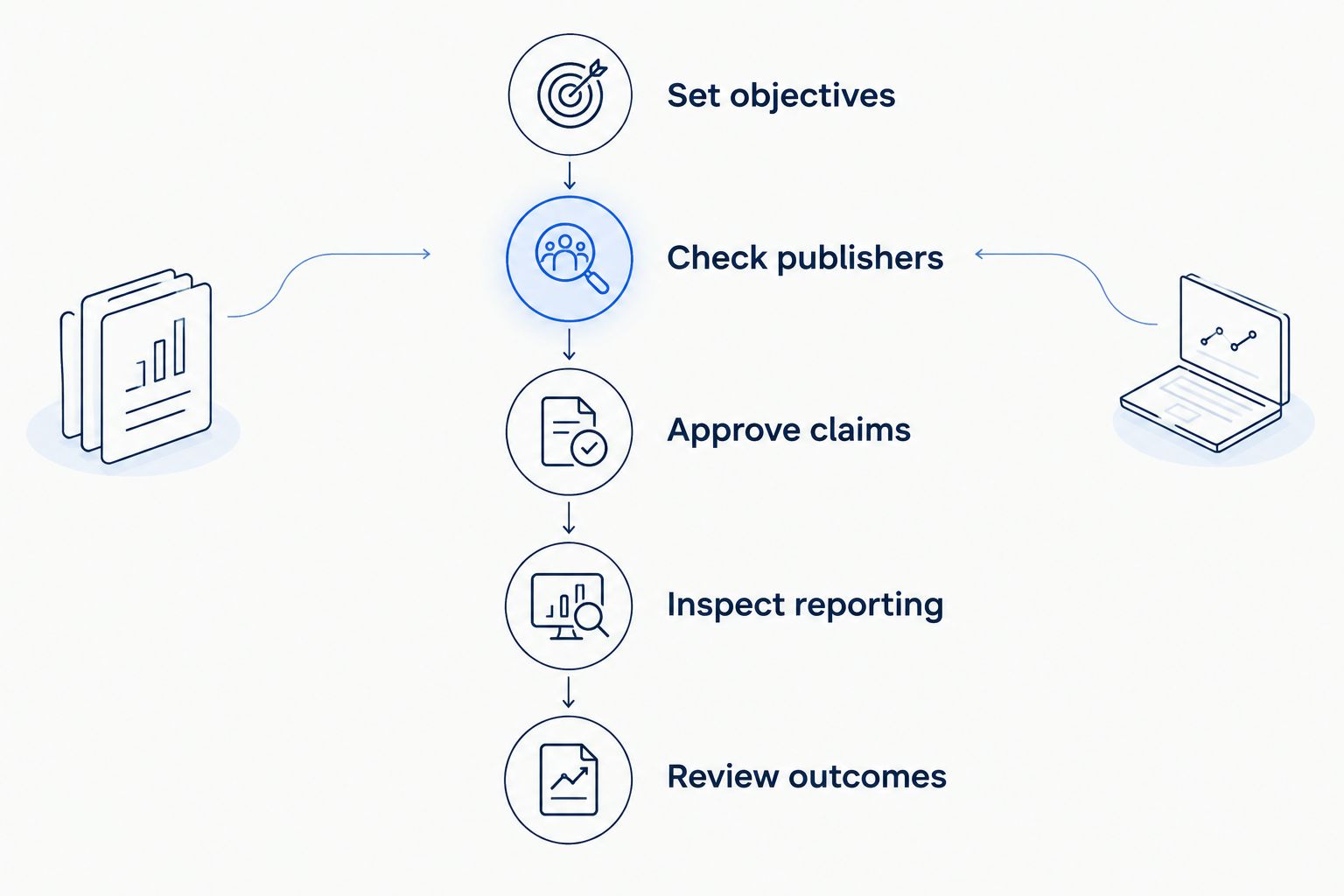
Use this sequence to evaluate a 2026 proposal:
- Set objectives: Choose 1 priority destination page and explain its role in your customer journey. Confirm that the page is useful before seeking links.
- Check publishers: Ask how the agency evaluates topical relevance, editorial standards and suspicious placement patterns. A domain score alone is not an answer.
- Approve claims: Identify who reviews financial statements, research limitations and spokesperson comments. Define what requires approval before outreach.
- Inspect reporting: Request 5 placement fields: source URL, destination URL, anchor text, link attribute and publication date.
- Review outcomes: Separate delivered placements from referral visits, enquiries and changes in search performance. A placement report does not prove business impact.
The sequence prevents a common buying mistake: agreeing to a link quantity before agreeing what a suitable link looks like. Ask for the acceptance criteria in writing.
Which tactic should you choose?
Start with editorial resource outreach unless your strongest asset points elsewhere. Choose data-led digital PR for original findings, expert commentary for accessible specialists, and guest contributions for detailed practical knowledge.
Use reclamation to support existing coverage. Treat niche edits as individual editorial decisions, not a shortcut around building a useful source.
Before signing, ask 3 questions: Why would this publisher cite us? Which page deserves the reference? What evidence will show that the agreed work was delivered?
FAQ
What's the best link building tactic for a financial services brand?
Editorial resource outreach is the strongest default when your brand has useful, well-sourced educational content. Choose original research or expert commentary instead when those are your stronger assets.
Is digital PR better than guest posting for financial services?
Digital PR fits original research; guest contributions fit detailed practical expertise. Choose according to the evidence and specialist access you can supply, rather than assuming either format always wins.
Can financial services brands buy backlinks safely?
Buying links to pass ranking credit conflicts with Google's link spam policies. Paid advertising placements need appropriate link qualification and should be assessed as advertising, not promised ranking gains.
What should a link building agency report?
A placement report should identify the source URL, destination URL, anchor text, link attribute and publication date. Assess business outcomes separately so delivered links are not presented as proof of revenue impact.
Should every backlink point to a product page?
No. The destination should match the editorial reference, whether that is research, an educational resource or a relevant product explanation. Forcing every citation onto a commercial page weakens that match.
Does expert commentary guarantee a backlink?
No. Journalists decide whether to publish a response and whether to include a link. Evaluate commentary opportunities for relevance and editorial value rather than a guaranteed placement.
Are niche edits suitable for financial services websites?
Editorial niche edits fit when your source genuinely improves an existing article. Reject insertions sold principally on ranking credit, unrelated anchors or authority metrics without editorial context.
One last thing
Your strongest outreach asset is not necessarily your most commercial page. An explanation with clear assumptions can give a publisher a better citation destination than a sales page.
For your 2026 brief, choose the evidence first and the tactic second. Take that brief to Linkible's existing website enquiry route: specify your priority page, target readers, available experts and publisher acceptance criteria before requesting a proposal.