Product Hunt launch backlink coverage needs more than a listing. Build a verified press brief, pitch relevant publishers and track live editorial links.
Instead of manually chasing mentions after launch day, build a Product Hunt launch backlink coverage workflow that connects your launch brief, publisher outreach and live-link checks. Treat the Product Hunt listing as launch context, then give relevant writers a separate reason to cover—and cite—your product.
- Product Hunt launch backlink coverage requires a newsworthy angle, relevant publisher outreach and verified editorial links.
- Linkible offers link building and digital PR services for brands seeking agency support.
- Separate launch activity, published coverage and backlinks in your reporting.
- Pitch evidence and reader value, not requests for keyword-rich anchor text.
Why this matters
A Product Hunt launch and an editorial backlink are different outcomes. Publishing a launch listing does not establish that an independent publisher has reviewed your product, written about it or linked to your website.
For your 2026 campaign, separate launch participation from earned coverage. Your outreach needs an identifiable audience, a defensible story and a destination that supports the writer’s reporting.
Linkible is a link building agency for SaaS and ecommerce brands seeking outreach support. Evaluate Linkible’s services against the same requirements you would set for an internal campaign: relevant publishers, documented outreach and transparent placement reporting.
The workflow below uses a shared tracker rather than assuming a particular software integration. Its advantage is visibility; its limitation is that someone must maintain the records and inspect the published pages.
Before you start
- Accounts and access: Have access to the Product Hunt account responsible for your launch, your outreach mailbox and the website destination you intend to pitch. Assign someone who can approve factual claims.
- Approved materials: Prepare a product description, screenshots, a working demonstration and evidence for each claim. Supply only customer names, quotations and results you have permission to publish.
- The gotcha: Launch attention is not a substitute for a story. Agree on your editorial angle and destination before outreach; otherwise, you risk pitching a listing when a writer needs evidence about a reader’s problem.
Use a 2026 launch brief as the source of truth. Keep internal notes separate from approved material so nobody copies an unverified claim into an email.
Launch brief configuration
Create these tracker field names yourself; they are workflow labels, not Product Hunt interface settings. Keep the brief accessible to everyone approving or sending outreach.
- Define the audience. Add Reader, Problem and Product role fields. Describe who benefits and what the product actually changes, without unsupported comparisons.
- Choose the destination. Add Target URL and Citation reason. Select a stable page that substantiates the story, rather than automatically sending every writer to the launch listing.
- Record the evidence. Add Claim, Evidence source, Approval owner and Approval status. Mark a claim approved only after the responsible person checks its wording and scope.
- Prepare 3 pitch angles. Draft a product announcement, a problem-led explanation and an evidence-led story. These are planning options, not a requirement to manufacture news where none exists.
- Set a factual boundary. List claims you cannot support, confidential details and unavailable spokesperson topics. Include the campaign year, 2026, so reused material does not silently become outdated.
A launch announcement says what happened. A stronger editorial angle explains why a particular publication’s readers should care. For SaaS, that distinction often means replacing a feature list with a clear explanation of the workflow the product addresses.
Expected result: You have 1 approved brief, a defensible destination and pitch angles that the evidence supports. Anyone handling outreach can distinguish publishable facts from internal assumptions.
Publisher qualification
Build your prospect list around editorial relevance, not a domain metric alone. A publisher belongs in the campaign because its readers have a reason to care about the story.
- Create the prospect record. Add Publisher, Article URL, Writer, Reader fit, Pitch angle and Contact source. Record a recent relevant article as evidence of fit.
- Inspect the publication. Read its coverage and submission guidance. Confirm that the proposed story matches the topics, format and audience it actually serves.
- Check the contact. Use a publicly provided professional contact or submission route. Record where you found it, and do not treat a guessed address as verified.
- Assign ownership. Add Campaign owner, Outreach status, Last contact and Next action. Check existing records before assigning the publisher to avoid duplicate pitches.
- Exclude unsuitable targets. Reject publications selected solely for an authority score, unrelated sites and offers that make a link conditional on payment while presenting it as independent editorial coverage.
For US, UK and Canadian publications, confirm the geographic relevance of your evidence. A product being accessible in a market does not, by itself, make its launch a local business story.
Expected result: Every retained prospect has a documented reader fit, a suitable angle and an accountable outreach owner. Your list is ready for individual pitches, not an undifferentiated email blast.
Outreach queue configuration
Use a controlled sequence: approve, send, record the response, then decide the next action. Automating an unqualified list only repeats the targeting mistake faster.
- Draft the subject. State the actual story. Do not imply a journalist has already expressed interest or that Product Hunt has endorsed your claims.
- Write the opening. Connect the pitch to the publication’s audience or a relevant article. Explain the connection rather than inserting a generic compliment.
- Present the evidence. Describe the problem, the product’s role and the material available for verification. Keep the launch announcement separate from any claimed customer outcome.
- Make a reporting request. Offer a demonstration, approved comment or supporting evidence. Ask whether the story fits the writer’s coverage; do not demand a backlink or prescribed anchor text.
- Set a follow-up rule. As a campaign limit, allow 1 follow-up after 5 working days unless the writer requests a different schedule. Stop after a decline or an instruction not to contact again.
These intervals are operating choices for this workflow, not claims about the best-performing email schedule. Adjust them to explicit publication guidance and agreed deadlines.
For your 2026 outreach queue, record Sent date, Response, Requested material and Next action date. Keep opt-outs visible so a later campaign does not restart an unwanted conversation.
Expected result: Each pitch has a clear editorial purpose and a recorded next action. No response is treated as permission for an indefinite follow-up sequence.
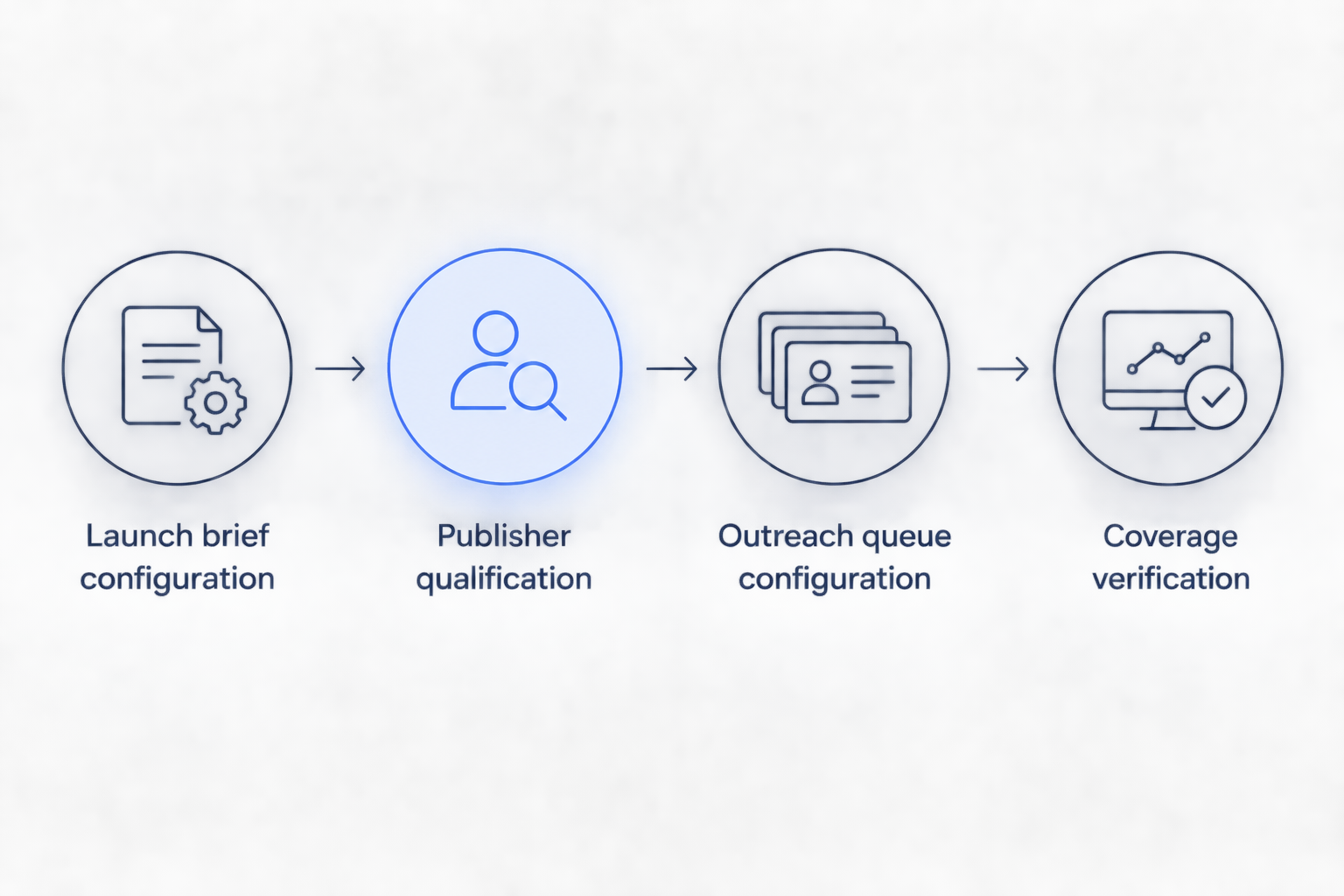
Coverage verification
A writer’s positive reply is progress, not a backlink. Close the placement record only after inspecting the published page and recording what is actually there.
- Capture the article. Add Published URL, Publication date, Publisher and Story angle. Confirm that the page discusses your product accurately.
- Inspect the link. Record Linked destination, Anchor text and Link attribute. Use the page source or your browser’s inspection function to check the link rather than relying on its appearance.
- Test the destination. Open the link and check where it resolves. Flag broken destinations, incorrect pages and tracking redirects that obscure the intended citation.
- Classify the outcome. Use separate statuses for Coverage with link, Unlinked mention, Syndicated copy and Declined. Count unique referring domains separately from article URLs.
- Record the next check. Assign an owner to unresolved errors and later link checks. Do not label a page indexed simply because it is accessible in a browser.
Google’s published guidance distinguishes link attributes including nofollow, sponsored and ugc. Record the attribute without promising a fixed ranking effect from it; an editorial mention and a ranking improvement are not interchangeable evidence.
For the 2026 report, separate outreach activity, coverage and search performance. Record relevant search changes without attributing every movement to the launch campaign.
Expected result: Your report distinguishes a verified backlink from a reply, mention or duplicate article. Every claimed placement has a page-level evidence record.
Second variant: outreach after a product update
Use the same workflow when an existing product gains a substantiated update. Best for: teams with a genuine change to explain after launch, rather than teams looking for a reason to resend the original announcement.
Replace the launch event with the update’s reader impact. Keep the publisher history, but reassess fit: a writer who covered the original launch does not owe the update coverage.
| Workflow | Best for | Strength | Limitation |
|---|---|---|---|
| Launch-led outreach | A new product with an approved story | Gives writers a clear announcement event | The announcement alone does not establish reader value |
| Update-led outreach | An existing product with a substantiated change | Adds evidence or context beyond the original launch | A minor change does not justify repeating the same pitch |
For geographic campaigns, securing small business news coverage depends on a relevant business story, not merely adding a country to the subject line. When securing small business news coverage in India is part of your campaign, substantiate the connection to that audience rather than recycling a US-focused pitch unchanged.
Reset Claim, Evidence source and Approval status for each update. Preserve previous outreach history and explain what is new in the first substantive sentence.
Expected result: The update earns consideration on its own evidence, while your records prevent repeated launch pitches to the same writer.
Troubleshooting
Writers reply, but no coverage appears
A reply is not a publication commitment. Check whether the writer requested evidence, a demonstration or an interview, then supply the requested material without adding unsupported claims. Record an agreed deadline only when the writer provides one.
Coverage appears without a backlink
Classify the article as an unlinked mention. If a source link would help readers verify a specific statement, send a brief editorial correction request explaining that purpose. Do not present the omission as a broken promise unless a documented agreement supports that claim.
Several articles repeat the same announcement
Check whether the pages are syndicated copies rather than independently reported stories. Report distribution separately from original editorial coverage, and distinguish article count from unique referring domains. Repetition does not establish multiple independent endorsements.
The article links to the wrong page
Confirm the intended destination works before contacting the publisher. Request the correction with the exact destination and a factual explanation. Do not combine an error correction with a demand for commercial anchor text.
Outreach produces little relevant interest
Recheck reader fit and evidence before increasing send volume. Compare the pitch with the publication’s actual coverage: if the only story is that your company launched, rebuild the angle or pause outreach. More follow-ups do not repair a weak editorial premise.
Customise your workflow
For a founder-led team, keep approvals and outreach in one shared tracker. For a larger team, separate factual approval, publisher qualification and placement verification so each hand-off has an owner.
When evaluating Linkible or another agency, request the proposed publisher criteria, outreach approach and reporting fields before approving work. Ask how the agency distinguishes earned editorial coverage from paid placements, syndicated announcements and unlinked mentions.
Judge the deliverable by verifiable relevance and placement evidence—not a promise of rankings. Linkible offers link building and digital PR services; your brief should specify which work you need and how you will assess delivery.
FAQ
Does a Product Hunt launch automatically generate backlinks?
No. A Product Hunt launch does not establish that independent publishers have covered or linked to your product. Track the listing, external coverage and verified backlinks as separate outcomes.
What is the best workflow for Product Hunt launch backlink coverage?
Use an approved launch brief, a qualified publisher list, a controlled outreach queue and page-level coverage verification. Assign an owner to each hand-off and record the evidence behind every claimed placement.
Should I ask journalists to link to my Product Hunt listing?
Choose the destination that best supports the story. A product page, demonstration or evidence page can be more relevant than the launch listing when readers need to verify a claim.
Can I automate the entire launch outreach process?
Keep claim approval, publisher qualification and editorial judgement under human control. Record-keeping can be systematised, but a status change should not automatically trigger an unreviewed pitch.
Is an unlinked brand mention a backlink?
No. An unlinked mention names your brand without providing a clickable link to your website. Report it as coverage and consider a correction request only when a citation would serve the reader.
Can Linkible support a SaaS launch outreach campaign?
Linkible offers white-hat outreach, link building and digital PR services for SaaS and other brands. Discuss the launch story, target audience and required reporting before agreeing the scope.
One last thing
Check the destination before you chase the citation. A persuasive pitch loses its supporting evidence when the linked page is broken, inaccessible or inconsistent with the approved story.
Before starting your 2026 campaign, assign someone to inspect the destination after material website changes. Then contact Linkible with your launch brief, audience and coverage requirements to discuss the work required.