Compare link building cost by scope, publisher relevance and reporting. Learn what to ask agencies before choosing outreach for your SaaS or ecommerce brand.
Link building cost in 2026 depends on the work you commission: publisher research, outreach, content production, placement checks and reporting. Compare the full scope rather than a headline rate, because content, internal review and campaign management can sit outside the quoted fee. Buy a defined outreach process and clear deliverables—not a backlink count without quality criteria.
- Compare link building cost by scope, publisher relevance and acceptance criteria—not backlink volume alone.
- Linkible suits SaaS and ecommerce buyers seeking agency-led link building and outreach.
- Separate content, outreach and reporting responsibilities before comparing proposals.
- Require placement-level evidence; domain authority alone does not explain a backlink’s relevance.
Why this matters
A link-building proposal is difficult to assess when it bundles different jobs under the same label. Researching relevant publishers, preparing useful content and managing editorial conversations are separate responsibilities. Your comparison needs to show who owns each one.
For a current commercial reference, review Linkible’s pricing, then assess the scope against your target pages and publisher requirements. Treat any proposal as an agreement about work and acceptance criteria, not a promise of ranking improvements.
How much does link building cost in 2026?
Your link building cost is the agreed service fee plus any separately scoped content, tools and internal work. A useful quote makes those components explicit and explains whether you are buying ongoing activity, individual deliverables or a defined campaign.
Request 3 quotes against the same brief. This is a buying checklist, not a market benchmark: matching the brief lets you compare responsibilities instead of trying to interpret different package names.
Use this breakdown when reviewing each proposal:
| Component | What the proposal should define | What to clarify before signing |
|---|---|---|
| Strategy | Target pages, audiences and campaign priorities | Whether existing content needs changes |
| Publisher research | Relevance checks and exclusion criteria | Who approves prospects and rejects unsuitable sites |
| Outreach | Pitching, follow-ups and editorial communication | Whether the agency performs outreach or only supplies contacts |
| Content | Research, drafting, editing and revisions | Whether content is included or separately scoped |
| Placement checks | Destination, anchor text, context and link attributes | What counts as an accepted deliverable |
| Reporting | Published URLs, work completed and unresolved issues | Whether reporting covers activity as well as live links |
Do not treat every line as a mandatory separate charge. The purpose is to identify responsibility and exclusions, whether an agency bundles the work or itemises it.
What should your initial brief contain?
Name your target market, priority pages and intended customers. A SaaS integration page needs publishers whose readers understand that integration; an ecommerce category page needs a credible connection to the products and buying context.
Start with 1 target page when testing whether competing proposals are comparable. Ask each provider to explain the relevant publisher audience, proposed content angle and acceptance criteria for that page. Expand the brief once those choices are clear.
Which link-building engagement fits your needs?
The engagement model changes what you pay for and what remains your responsibility. Choose the model around your team’s capacity and the work required, rather than assuming a larger commitment produces better links.
| Engagement | Best for | Main benefit | Main limitation |
|---|---|---|---|
| Ongoing outreach retainer | Teams with continuing priorities and review capacity | Keeps research, outreach and reporting within an ongoing brief | Requires clear activity reporting when editorial decisions delay publication |
| Per-deliverable engagement | Buyers with explicit placement acceptance criteria | Makes the contracted output easier to inspect | A live link alone does not establish relevance or usefulness |
| Defined outreach campaign | Teams promoting a particular resource or topic | Concentrates work around a clear editorial angle | The campaign does not automatically cover continuing outreach needs |
| In-house programme | Teams with dedicated outreach and editorial staff | Keeps publisher conversations and approvals within the business | Your team owns recruitment, tools, content and follow-up work |
Ongoing outreach retainer
An ongoing retainer suits a team with a continuing pipeline of pages and content worth promoting. Specify the reporting cadence, approval process and treatment of unfinished work so that an ongoing fee does not become an undefined commitment.
The trade-off is oversight. You still need someone internally to review strategy, answer questions and assess whether the campaign supports commercial priorities.
Per-deliverable engagement
A per-deliverable agreement suits buyers who can define an acceptable placement before work starts. Put publisher relevance, destination URL, editorial context and link attributes into the acceptance criteria.
Its limitation is the temptation to optimise for completed placements rather than useful coverage. Reject a proposal that explains link volume in detail but leaves publisher standards vague.
Defined outreach campaign
A defined campaign suits a research asset, useful resource or focused editorial story. Agree on what the agency will research, create, pitch and report, including what happens when publishers decline the story.
Editorial coverage is not a controllable output in the same way as producing a draft. Keep the distinction between commissioned work and third-party publication decisions explicit.
Why link building cost varies
Different proposals involve different work. For your 2026 shortlist, ask providers to connect each scope difference to an identifiable task or requirement.
- Publisher relevance: Narrow audience requirements change which publications qualify. Ask how the agency assesses the publication and the specific linking page.
- Content requirements: An existing resource and an original research-led article require different preparation. Assign drafting, fact-checking and revision responsibilities before outreach starts.
- Outreach scope: Prospect research, individual pitches, follow-ups and editorial coordination are distinct tasks. Confirm which tasks the proposal includes.
- Target-page readiness: A page without a useful reason to reference needs attention before promotion. Decide whether improvements belong in the outreach agreement or with your internal team.
- Approval requirements: Legal, financial and technical claims need appropriate review. Identify reviewers and approval responsibilities in the brief.
- Reporting and remediation: Placement verification, unresolved issues and agreed responses to changed links need a defined owner. Read the terms rather than assuming continuing support.
Do not accept domain authority as the entire explanation for a proposal. Third-party authority metrics describe a domain through a particular provider’s model; they do not replace checking the audience, article and reason for the link.
How do outreach methods change the scope?
Manual outreach, niche edits and digital PR involve different editorial requests. Compare their work requirements before treating them as interchangeable deliverables.
| Method | Best for | Work to include | Limitation to assess |
|---|---|---|---|
| Blogger outreach | Useful contributions to relevant publications | Prospect research, pitching, content and editorial coordination | Content approval and publication remain publisher decisions |
| Niche edits | Existing articles with a genuine reason to reference your page | Article assessment, outreach and contextual placement review | An existing article is not automatically relevant or maintained |
| Digital PR | Stories, expertise or resources with editorial interest | Story development, supporting evidence and media outreach | Coverage does not necessarily include a backlink |
| Expert-response outreach | Teams able to provide relevant, attributable expertise | Opportunity screening, expert input and response preparation | A submitted response does not guarantee inclusion |
Choose the method that fits the editorial reason to link. Do not buy niche edits solely because an article already exists, or digital PR solely because a publication is recognisable.
For SaaS buyers, explain the use case and intended reader behind each priority page. For ecommerce buyers, distinguish product promotion from a resource that helps a publisher’s audience. These details give an agency something substantive to pitch.
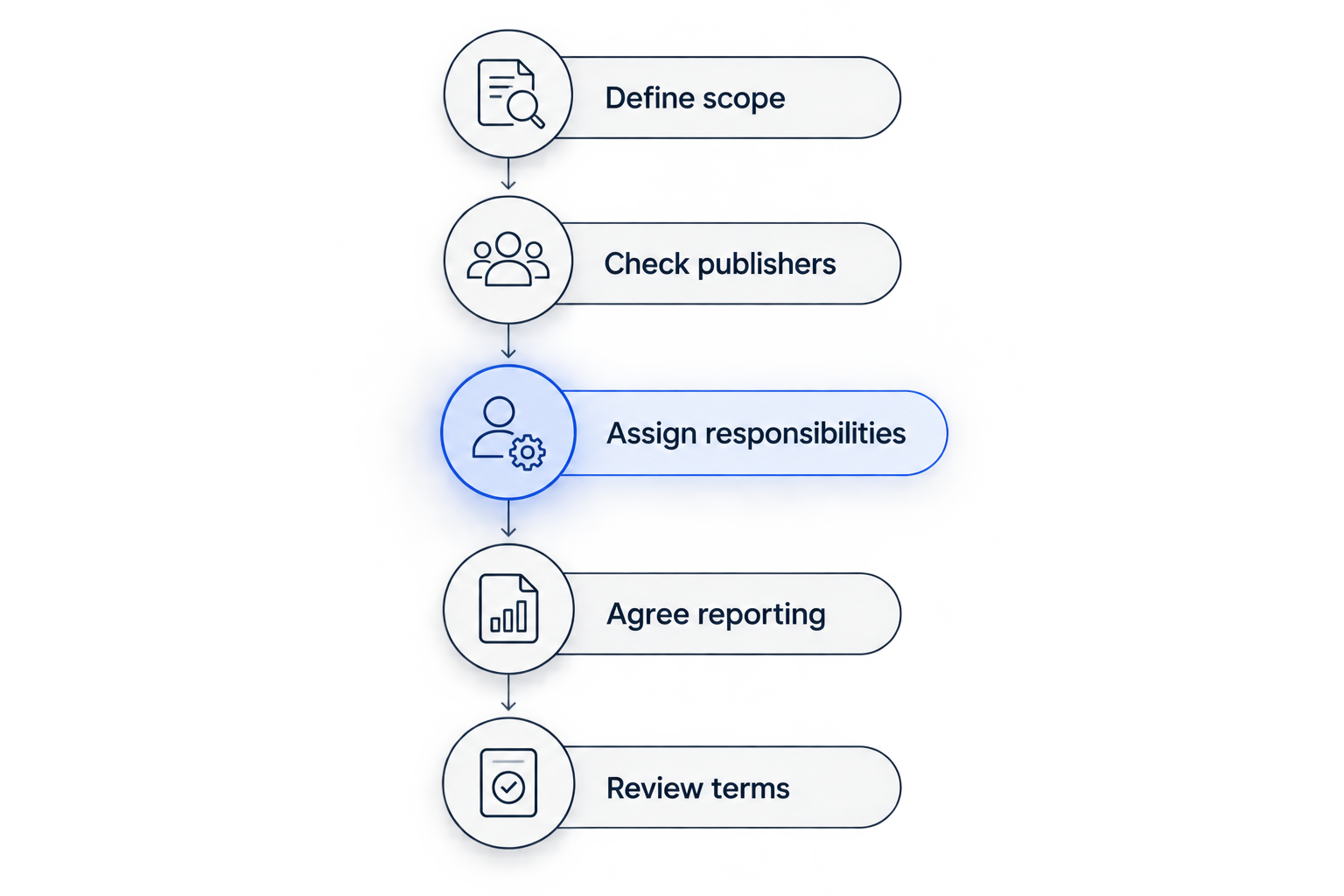
How should you compare link-building proposals?
Use the same review sequence for every provider. A well-presented proposal still needs to pass relevance, scope and reporting checks before you commit.
- Define scope. List the pages, audiences, markets and work you want covered. Separate essential requirements from preferences.
- Check publishers. Ask for examples that demonstrate the proposed selection criteria. Inspect the relationship between the article’s subject and the destination page.
- Assign responsibilities. Identify who supplies expertise, writes content, approves pitches and handles revisions. Record exclusions beside each task.
- Agree reporting. Specify what evidence you receive and how unresolved work is explained. Distinguish outreach activity from published results.
- Review terms. Read cancellation, acceptance and remediation terms. Ask what happens when a placement changes or a publisher declines the work.
Ask for a sample report with 5 placement fields: published URL, target URL, anchor text, link attributes and publication date. These fields are a practical inspection checklist, not proof that every reported link is valuable.
Add written context explaining why each publisher and article fits your audience. A report should let you inspect the work without making you reconstruct the campaign from a spreadsheet of domain metrics.
Is cheap link building worth it?
A smaller scope is worth considering when it preserves publisher relevance and clear acceptance criteria. A proposal that removes research, editorial checks or meaningful reporting is a different service—not simply a more efficient version of the same work.
For a constrained 2026 budget, narrow the campaign before weakening the standards. Focus on a defined audience and useful destination rather than spreading outreach across unrelated pages.
Check the method as well. Google’s spam policies identify buying or selling links for ranking purposes as link spam; paid advertising links require appropriate qualification. An agency’s use of the phrase white-hat does not remove your responsibility to understand the proposed approach.
Should you hire an agency or build links in-house?
Hire an agency when you want external responsibility for a defined outreach scope. Keep the programme in-house when your team has the editorial expertise, publisher research capacity and time to manage outreach consistently.
Linkible is best suited to SaaS and ecommerce teams seeking agency-led link building and outreach. Its stated services include white-hat outreach, niche edits, digital PR and HARO link building; choose the service around your brief rather than assuming you need every method.
The agency model does not remove internal work. Your team still needs to provide accurate expertise, approve relevant claims and decide which commercial pages deserve attention. Ask Linkible to explain proposed publisher relevance, outreach responsibilities and reporting in the proposal; do not assume those details from a service label.
FAQ
How do I work out my link building cost in 2026?
Work out your link building cost from the agreed service scope plus separately assigned content, tools and internal work. Compare proposals against the same pages, audiences and acceptance criteria.
Should I pay per backlink or use a retainer?
Use a per-deliverable agreement when you can define acceptable placements; consider a retainer when you need continuing outreach work. Neither model removes the need to inspect publisher relevance and reporting.
Does a higher domain authority make a backlink worth more?
Higher domain authority alone does not establish a backlink’s relevance to your business. Check the publication, linking article, audience and editorial reason for referencing your page.
What should a link-building proposal include?
A link-building proposal should define target pages, publisher criteria, outreach responsibilities, content requirements, reporting and acceptance terms. It should also identify exclusions and explain how unresolved work is handled.
Can a link-building agency guarantee rankings?
A link-building agency cannot control search rankings. Assess contractual deliverables separately from ranking goals, and reject language that treats a placement as a guaranteed search outcome.
Is Linkible relevant for SaaS and ecommerce link building?
Linkible offers link-building services for SaaS and ecommerce brands, alongside other sectors. Use your enquiry to establish the proposed outreach method, deliverables and reporting for your particular brief.
One last thing
A link can meet a delivery definition and still fail your business brief. That is why acceptance criteria belong before the campaign, not in a disagreement after publication.
For your 2026 enquiry, prepare your priority pages, target customers, existing content and internal approval constraints. Use the contact page to request a scoped proposal that separates outreach work, content responsibilities, deliverables and reporting.