How long does link building take to show results? No fixed deadline applies. Learn what to measure, when to review progress and what to ask an agency.
Link building has no fixed deadline for ranking or enquiry growth: publishing a backlink, having Google process it and seeing a commercial result are separate events. In 2026, judge progress against those milestones rather than a promised ranking date; a live link does not guarantee better positions, traffic or sales.
- How long does link building take to show results? Separate outreach delivery, search visibility and qualified enquiries.
- Linkible suits SaaS and ecommerce brands evaluating outsourced link building and outreach services.
- Use scheduled reviews to diagnose progress, not to promise rankings by a deadline.
- Judge backlinks by publisher relevance, placement context and destination quality, not domain authority alone.
How long does link building take to show results?
There is no dependable campaign-wide countdown from backlink publication to ranking improvement. Your starting position, target page, search competition and the links themselves all affect the outcome. When evaluating Linkible’s link building services, separate the delivery commitment from the search outcome: an agency controls its outreach work, not Google’s ranking decisions.
Use this sequence to evaluate progress:
- Establish the baseline. Record target-page visibility, organic visits and relevant conversions before outreach starts.
- Verify delivery. Confirm that agreed placements exist and point to the intended pages.
- Assess search movement. Compare relevant queries and landing pages against the baseline.
- Check commercial impact. Look for qualified enquiries, trials or purchases rather than traffic alone.
These are evaluation stages, not guaranteed waiting periods. An outreach campaign can deliver its agreed work without producing the commercial result you need.
Why this matters
A timeline without a defined result is not useful. An agency might mean a published placement, while your founder means qualified pipeline or ecommerce revenue.
For your 2026 campaign brief, define success before discussing speed. Specify the pages you want to support, the buyers those pages serve and the action those buyers should take. This prevents a report full of new backlinks from becoming a substitute for business progress.
The distinction also protects good decisions. Rejecting a campaign before placements are published measures impatience, not effectiveness; continuing a campaign indefinitely because links keep arriving measures activity, not value.
Which result should you measure first?
Measure delivery first, visibility next and commercial outcomes separately. Each answers a different question, and none proves the next stage has happened.
| Milestone | Evidence to request | Best for assessing | Limitation |
|---|---|---|---|
| Outreach progress | Relevant prospects, outreach status and editorial responses | Whether work is advancing | Responses are not published backlinks |
| Published backlinks | Live source URL, destination, anchor text and link attributes | Whether agreed placements were delivered | Publication does not prove ranking impact |
| Search visibility | Target-page impressions, clicks and query positions | Whether relevant search exposure changed | Other site and search changes affect these metrics |
| Commercial outcomes | Qualified enquiries, trials, purchases or attributable revenue | Whether organic visits support business goals | Attribution does not isolate the effect of one backlink |
A SaaS comparison page and an ecommerce category page need different conversion measures. Select the measure that matches the destination instead of applying one reporting template to every page.
Keep branded and non-branded queries separate where possible. A rise in searches for your company name does not establish that your target category terms improved.
Why link building timelines vary
These factors explain why a universal deadline is unreliable. Use them to question an agency’s forecast, not to excuse an undefined process.
- Publisher decisions. Editors control acceptance, revisions and publication. An unanswered pitch is not a placement commitment.
- Page accessibility. Google needs access to the destination, and an unintended indexing restriction undermines the campaign’s objective.
- Search intent and content. A backlink does not fix a page that fails to answer the searcher’s question or present the right offer.
- Publisher and placement relevance. Assess the source article, audience and surrounding text, not just a site-wide authority score.
- Competitive conditions. Rankings are relative. Your page competes with other pages whose content and backlink profiles also change.
- Concurrent changes. Migrations, internal linking edits, content updates and tracking changes complicate before-and-after comparisons.
Ask which factor is delaying which milestone. “SEO takes time” is not an adequate explanation for missing outreach records, incorrect destination URLs or unresolved technical problems.
Set a review schedule, not a ranking deadline
Use the following checkpoints as a management framework for a new engagement in 2026. The intervals are recommended review dates, not estimates of how quickly backlinks produce results.
At 30 days: check campaign readiness and delivery
At 30 days, review the baseline, target-page selection, prospect criteria and outreach records. Verify any reported live placements rather than treating a spreadsheet status as proof.
Your agency should explain what is complete, what is awaiting a publisher decision and what needs your approval. If a campaign depends on original content or subject-matter input, identify who owns those dependencies.
Do not use this checkpoint to demand a predetermined ranking increase. Use it to identify preventable delivery problems while they are still actionable.
At 60 days: inspect placement quality and page alignment
At 60 days, review the published work alongside target-page performance. Inspect the actual articles: does the link help a reader, fit the topic and point to the intended destination?
Compare delivered placements with the agreed criteria. A campaign aimed at SaaS decision-makers should not drift into unrelated publisher categories simply to fill a report.
For ecommerce, check that promoted pages remain useful destinations. A changed category structure or redirected page needs attention before more outreach points readers to it.
At 90 days: make a documented decision
At 90 days, assess the evidence accumulated since the baseline and decide whether to continue, revise or pause. This is a decision checkpoint, not a promise that rankings or revenue must improve within that period.
Document the reasoning. Separate missed deliverables, weak publisher relevance, target-page problems and a lack of measurable search movement; each calls for a different response.
A useful decision names the next action and its owner. “Continue and monitor” is incomplete unless it specifies what you are testing and what would change the decision.
What should an outreach timeline actually include?
An outreach schedule should describe work and dependencies, not just a final placement target. Ask for the process from prospect selection through editorial acceptance and publication.
The guest post pitch to live placement workflow separates pitching from the published result. That distinction matters when you assess whether a delay sits with prospecting, content preparation, editorial review or publication.
Require clear definitions for these stages:
- Prospect approval: the publisher meets your audience and relevance criteria.
- Outreach: a relevant pitch has been sent and its status recorded.
- Editorial acceptance: the publisher has agreed to consider or publish the contribution under stated conditions.
- Live placement: the published article contains the intended link.
- Verification: the destination, anchor text, context and attributes have been checked.
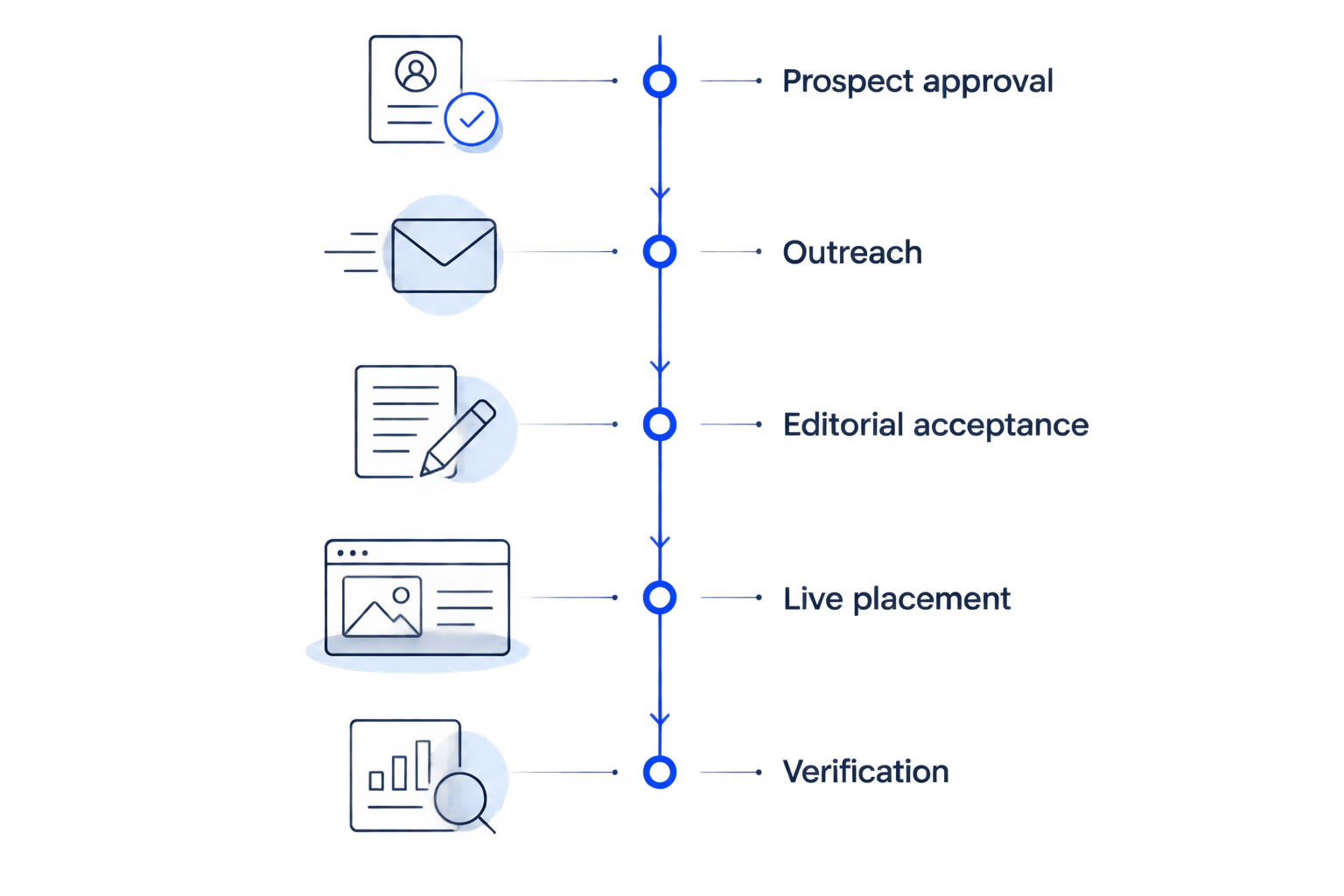
Manual outreach gives you a process to inspect, but it does not remove publisher discretion. Relevant publishers still decide whether a contribution fits their audience. Treat that dependency as part of planning, not as a reason to accept untraceable activity.
How do you connect backlinks to qualified enquiries?
Start with the destination and its conversion path. A relevant backlink can support a page’s search objectives, but the page still needs to explain the offer and make the next action clear.
The question of how long SEO takes becomes a measurement problem when enquiry growth depends on content, technical accessibility and conversion tracking as well as backlinks. Keep those dependencies visible rather than attributing every improvement or decline to outreach.
For SaaS, distinguish an organic visit from a qualified trial or sales enquiry. For ecommerce, distinguish informational visits from category visits and purchases. These distinctions stop broad traffic gains from masking weak buyer relevance.
For a 2026 performance review, ask for:
- Target-page results rather than site-wide totals alone.
- Relevant query groups rather than isolated ranking screenshots.
- Conversion definitions that match your sales process.
- Annotations for content, technical and tracking changes.
- Separate records for referral visits from placements and organic search visits.
Timing alone does not prove causation. If rankings improve after publication, record the sequence without claiming that one backlink caused the entire change.
What should a link building agency report?
A useful report connects the agreed brief to the work delivered and the outcomes observed. Linkible is best suited to SaaS and ecommerce buyers seeking outsourced link building and outreach services. Evaluate that fit through the proposed publisher criteria, manual outreach process and reporting detail, not a promised ranking date.
Request the following before signing:
- Scope: target pages, audiences, markets and excluded publisher categories.
- Deliverables: what counts as completed work and how it will be verified.
- Placement records: source URLs, destination URLs, anchors, publication dates and link attributes.
- Progress reporting: outreach stages, dependencies and decisions needed from your team.
- Performance reporting: relevant page and query movement alongside commercial measures.
- Remediation terms: the agreed response to incorrect, removed or materially changed placements.
Outsourcing gives your team external delivery support. The trade-off is that you still need to supply business context, approve priorities and assess whether the work serves your objectives.
Do not confuse a third-party domain authority score with a business outcome. Use such metrics as screening inputs, then inspect the publisher, article and destination directly.
When should you change or pause the campaign?
Change the plan when the evidence identifies a problem, not simply because a calendar date arrives. Waiting longer does not correct irrelevant placements or an unsuitable destination page.
Pause new outreach to a page if you discover an unintended indexing restriction, a broken conversion route or a substantial mismatch with search intent. Resolve the destination problem before directing more effort towards it.
Revisit publisher selection when placements repeatedly miss the agreed audience or context. Revisit the agency relationship when delivered work cannot be verified or reporting obscures missed commitments.
Continue only with a clear rationale. Relevant placements, a sound destination and an agreed measurement plan support a reasoned review; they still do not guarantee future rankings.
Can backlinks improve rankings immediately?
Publication does not guarantee immediate ranking improvement. Google must discover and process the relevant pages, and the ranking outcome also depends on other signals.
Does a higher domain authority score mean the campaign worked?
A higher domain authority score does not establish that qualified traffic or revenue improved. Check the target pages, relevant queries and conversion outcomes before judging success.
FAQ
How long does link building take to show results in 2026?
Link building has no fixed deadline for ranking or commercial results in 2026. Separate published placements from search visibility and qualified enquiries, then review each against a documented baseline.
Should I expect better rankings after 30 days?
30 days is a delivery-review checkpoint, not a ranking promise. Check campaign readiness, outreach progress and any published placements before drawing performance conclusions.
What should I review after 60 days of link building?
60 days is a recommended checkpoint for inspecting placement quality and target-page alignment. Compare the published work with the agreed publisher criteria and review page-level search performance.
Should I stop link building if nothing changes after 90 days?
90 days should trigger a documented decision, not an automatic cancellation. Identify whether the issue is delivery, placement relevance, the destination page or an absence of measurable search movement.
Will more backlinks make results happen faster?
More backlinks do not establish a faster ranking timeline. Assess publisher relevance, editorial context and destination quality rather than using link count as a shortcut.
Can an agency guarantee when backlinks will improve rankings?
An agency cannot control when Google changes rankings. Ask for clear delivery commitments, verification records and review dates instead of a guaranteed ranking deadline.
How do I tell whether link building is generating enquiries?
Track qualified enquiries from organic landing pages alongside the placement record and other site changes. Keep referral visits separate and do not attribute every conversion change to backlinks.
One last thing
The most useful timeline question is not just when rankings will move. Ask: what evidence will make us change the plan at the next review? That question makes delivery, relevance and commercial accountability harder to avoid.
For your 2026 brief, bring your target pages, priority markets and definition of a qualified conversion to contact Linkible. Ask for the proposed outreach scope, publisher criteria and reporting checkpoints before agreeing to the engagement.