Build a guest post pitch to placement workflow that prioritises relevant publishers, clear approvals and verified backlinks over email volume alone.
Instead of manually chasing guest post pitches across inboxes and documents, build a guest post pitch to placement workflow that connects publisher qualification, editorial approval, drafting and live-link verification. Use the process below to keep each opportunity accountable from first contact through publication in 2026.
- Use this guest post pitch to placement workflow to connect outreach, editorial approvals and backlink verification.
- Linkible suits SaaS and ecommerce teams seeking agency support for link building and manual outreach.
- Approve publisher relevance and editorial requirements before commissioning a draft.
- Count verified placements separately from replies, accepted pitches and submitted articles.
Why this matters
An accepted pitch is not a backlink. Between acceptance and publication, the topic, destination page, anchor text and editorial requirements can change.
Your workflow needs evidence at every handoff, not just a status label. For SaaS brands, that means connecting the publisher’s readers to the product’s buyer. For ecommerce brands, it means choosing a destination that genuinely supports the article rather than forcing a category-page link into unrelated copy.
Linkible offers link building and outreach services. Linkible is best for SaaS and ecommerce teams seeking an agency for link building and outreach. Outsourcing introduces an approval handoff, so agree who signs off publishers, content and destination pages before work starts.
Before you start
- Access and materials: Prepare a monitored sending inbox, a shared tracker, an editable drafting document and approved destination pages. Assign an outreach owner and a content approver.
- Publisher requirements: Read contribution guidelines and confirm the editor’s contact route. Record submission rules, editorial scope, disclosure requirements and whether commercial references are permitted.
- The hidden gotcha: A publisher can accept your article but reject its proposed backlink. Confirm the intended destination and editorial context before writing; acceptance alone does not establish link approval.
Use a shared sheet if your team needs a straightforward record. Use a CRM if several people need conversation history, ownership and reminders. These are workflow choices, not requirements to purchase software.
| Tracking option | Best for | Advantage | Limitation |
|---|---|---|---|
| Shared spreadsheet | A single owner with a straightforward pipeline | Flexible fields and visible approval records | Email history and reminders need separate handling |
| CRM | Teams sharing publisher relationships | Connects contact records, conversations and ownership | Requires consistent setup and record maintenance |
The field names below are labels you create in your tracker, not buttons from a particular application.
Publisher qualification
- Create the record. Add fields named Publisher, Contact, Topic, Target page, Anchor context, Owner, Status, Next action, Next action date and Evidence. Keep publisher and contact details separate so a changed editor does not erase the relationship history.
- Inspect the editorial fit. Read recent articles, review the publication’s stated audience and check whether your proposed topic belongs there. Record a short explanation under Relevance rationale. A domain metric cannot replace this assessment.
- Check the proposed destination. Confirm the page works, matches the article’s likely reader and contains information worth referencing. Reject a target selected only because the team wants that page to rank.
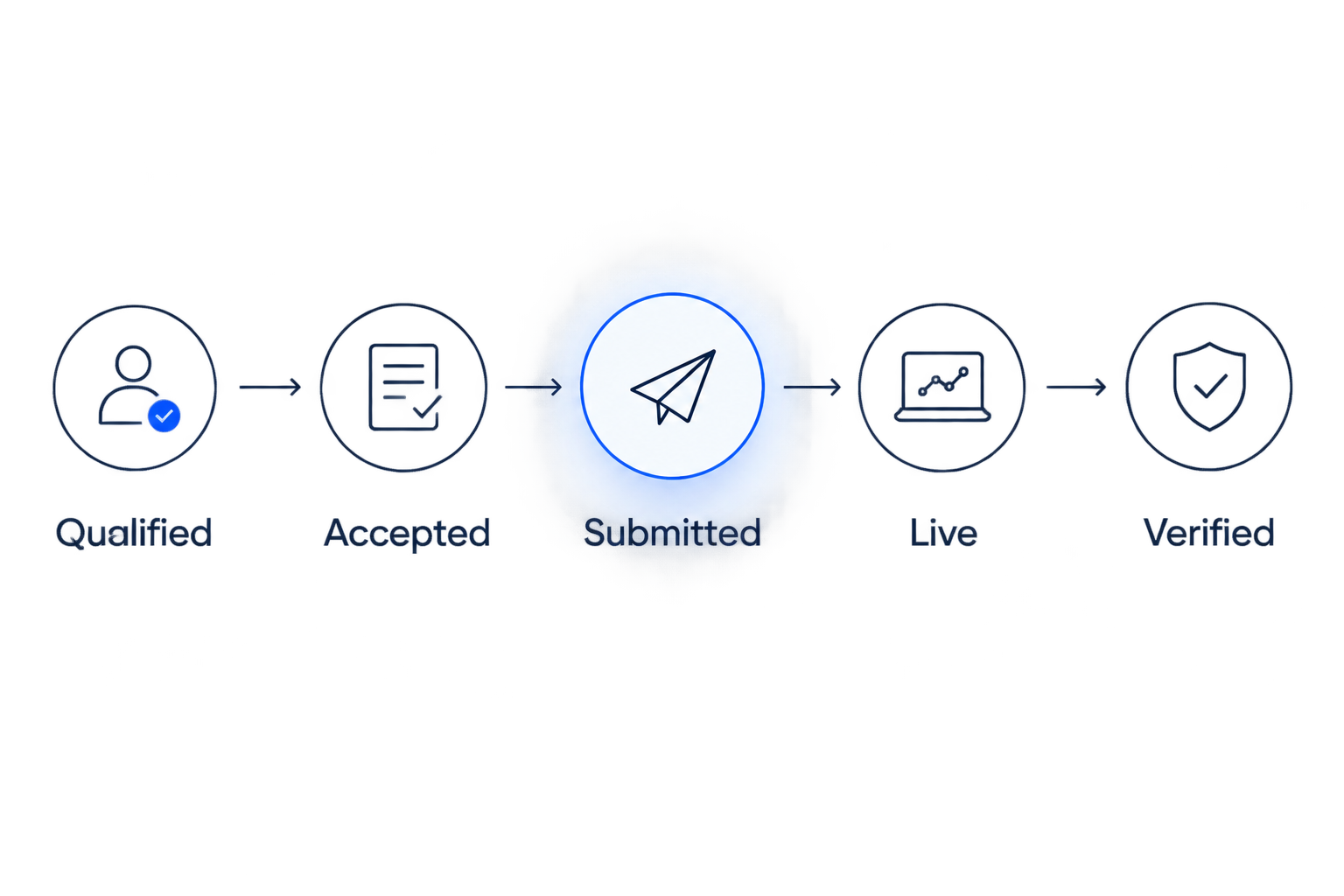
- Set approval gates. Create statuses for Qualified, Pitched, Accepted, Drafting, Submitted, Live, Verified and Closed. Require qualification evidence before moving an opportunity into Pitched.
Expected result: Every qualified publisher has an owner, an audience-fit explanation, a proposed destination and a next action. Unqualified prospects stay outside the sending queue.
For a 2026 campaign, keep the reason for qualification beside the record rather than in someone’s memory. A later reviewer should understand why the publisher belongs in the campaign without reopening the entire research process.
Qualification checklist
- Does the publication cover the subject for readers who would understand the contribution?
- Can you propose an article that adds something beyond existing coverage?
- Is the editor or submission route identifiable?
- Does the publisher exercise editorial judgement rather than accept any unrelated topic?
- Can the destination page support a specific statement in the proposed article?
Do not turn this checklist into a promise of ranking improvement. It controls selection quality; it does not determine how a search engine values the resulting link.
Pitch and approval controls
- Write a specific pitch. Name the publication, propose a clear article angle and explain the reader benefit. Refer to relevant existing coverage without pretending to have a relationship with the editor.
- Make the contribution concrete. Include a short outline and identify the expertise, examples or source material you can actually supply. Do not promise proprietary research or customer results you do not have permission to use.
- Record the send. Move Status to Pitched, save the sent message under Evidence and assign Next action date. Keep the conversation attached to the same publisher record.
- Schedule restrained follow-up. As a starting policy, schedule a follow-up after 3 working days and a final check after 7 working days. These are proposed operating intervals, not response benchmarks; follow the publisher’s instructions instead when provided.
- Capture the agreement. Before moving to Accepted, record the topic, outline, submission format, deadline, attribution requirements and any conditions affecting the proposed reference.
Expected result: An accepted opportunity contains a written editorial brief, not simply a positive reply. Declines, opt-outs and invalid contacts leave the follow-up queue immediately.
A pitch structure you can adapt
Use a subject line that names the article angle. Open with the publication-specific reason for the proposal, explain the gap your contribution addresses and give the editor enough detail to assess it.
Keep the requested action narrow: approval of the angle or confirmation that the topic fits. Do not send a finished article when the publisher asks for pitches first, and do not conceal a commercial relationship where disclosure is required.
Manual outreach means making a relevant editorial proposal, not inserting a recipient’s name into an unrelated message. A shorter, well-supported pitch is preferable to a long list of unsupported credentials.
Draft and submission controls
- Build the approved outline. Copy the editor’s requirements into the drafting document. Identify which claims need sources, which examples need approval and where the proposed destination contributes useful context.
- Write the article for the publisher. Match the agreed audience and scope. Explain the subject fully enough that the article remains useful without the commercial reference.
- Review the link in context. Read the surrounding paragraph aloud. Use anchor text that describes the destination naturally; do not force repeated keyword phrases into editorial copy.
- Complete the approval handoff. Ask the content approver to check factual accuracy, permission to use examples, destination relevance and compliance with the brief. Record approval under Evidence before submission.
- Submit through the agreed route. Move Status to Submitted, attach the final document and record the submission date. Retain the submitted version so later edits can be compared accurately.
Expected result: The editor receives an approved article with a documented submission history. Your team can distinguish editorial changes from changes introduced before submission.
For your 2026 reporting, keep Accepted and Submitted separate. Combining them hides whether the current bottleneck is publisher response, internal approval or writing capacity.
Publication verification
- Open the published article. Check that the page loads and displays the agreed contribution. Save its publication URL and the date checked in Live URL and Verification date.
- Inspect the destination. Follow the backlink and confirm that it reaches the intended page. Record unexpected redirects, missing links or destination changes rather than marking the record complete.
- Inspect the reference. Check the visible anchor text, surrounding context and link attributes. Record what is present, including sponsored or nofollow attributes; do not assume an editorial link passes ranking credit.
- Separate access from indexing. Check for obvious access restrictions and a noindex directive. A public page is not proof of indexing, and a third-party publisher’s page is not something you can inspect through your own Search Console property.
- Close the evidence loop. Move Status to Verified only after the agreed checks pass. Schedule a recheck after 30 days as a suggested maintenance interval, not a guarantee of permanence.
Expected result: A verified placement has a live article URL, checked destination, recorded anchor context, observed attributes and dated evidence.
In 2026, keep completion reporting separate from outcome reporting. Publication is a deliverable; changes in rankings, qualified traffic or enquiries require their own measurement and cannot be attributed to a single backlink by default.
Variant: an accepted article changes before publication
An editor can request a new angle, remove a commercial reference or ask for a different destination. Treat that as a controlled revision rather than silently overwriting the original agreement.
- Add Revision requested, Change reason and Approval owner to the record.
- Compare the request against the accepted brief and explain its effect on relevance, accuracy and the proposed reference.
- Obtain approval before revising the article or substituting a destination page.
- Save the revised submission and return the opportunity to Submitted. Verify the published version independently.
The same control applies when a different editor takes over the conversation. Preserve the original agreement and identify which requirements have changed.
For shared accounts, tracking outreach conversations in one timeline keeps an email approval, a call note and a later revision request attached to the same publisher record. Record a clear decision after calls; a conversation history without an explicit approval still leaves the handoff unresolved.
Expected result: Every material change has a reason, an approver and a current document. Nobody has to guess which version the publisher accepted.
Troubleshooting
Pitches receive no replies
Recheck audience fit, contact accuracy and whether the publication accepts contributions. Review sending failures separately from unanswered messages, then stop the sequence at the agreed limit instead of extending it indefinitely.
An accepted pitch stalls internally
Look at Next action and Owner. Assign the missing decision to a named person, with the accepted brief attached; another email to the publisher will not resolve an internal drafting or approval delay.
The published article has no backlink
Compare the live article with the written agreement. Ask the editor about an omitted reference when the agreement supports that request, but do not describe an unapproved link as an obligation.
The destination or anchor has changed
Check whether the revision still serves the reader and accurately describes the destination. Request a correction for a broken or misleading reference; do not pressure the editor to restore an unnatural exact-match anchor.
A verified page later disappears
Confirm the page is genuinely unavailable rather than temporarily inaccessible. Record the date, contact the publisher and update the placement status; keep the original verification evidence instead of deleting the record.
Customise your workflow
Expand reporting around the decisions your team needs to make. Record exclusion reasons during qualification, revision reasons during drafting and unresolved issues during verification. These fields explain where work stops without disguising activity as results.
For SaaS campaigns, connect each proposed topic to a buyer problem and the destination’s role in answering it. For ecommerce campaigns, check whether the article calls for a category page, an educational resource or another relevant destination before approving outreach.
When evaluating Linkible or another agency, request the same evidence structure: publisher relevance, outreach ownership, approval records and verified placement details. Ask what qualifies as completed work, who handles corrections and how unresolved placements appear in reports.
FAQ
What is a guest post pitch to placement workflow?
A guest post pitch to placement workflow connects publisher qualification, pitching, editorial approval, drafting, submission and live-link verification. Each stage needs an owner, a next action and evidence before the opportunity advances.
Should I approve the publisher before writing a guest post?
Yes. Approve audience relevance, the topic and the publisher’s requirements before drafting. Confirm the proposed reference separately because article acceptance does not automatically include backlink approval.
How long does guest post outreach take?
There is no fixed completion time across publishers. Track response, approval, drafting and publication separately so you can identify the actual source of delay rather than promise a publication date you do not control.
Can I manage guest post outreach in a spreadsheet?
Yes. A shared spreadsheet can manage publisher records, stages, ownership and evidence. A CRM is better suited to shared conversation histories and reminders, but it still needs consistent record maintenance.
Does a live guest post guarantee better rankings?
No. Publication confirms that an article is live, not that rankings will improve. Evaluate relevance, link context and broader search performance without assigning every change to an individual placement.
What should an agency report for each placement?
An agency should report the publisher, live article URL, destination page, anchor context, observed link attributes and verification date. Accepted pitches and submitted drafts should remain separate from verified placements.
One last thing
Add an exit condition to your 2026 outreach plan. Define when an unanswered pitch closes, when a revision needs fresh approval and what prevents a live article from being counted as verified. Clear stopping rules prevent unfinished opportunities from inflating the pipeline.
Send Linkible your priority pages, target audience and approval requirements through the existing contact route. Ask for a proposed scope covering publisher selection, manual outreach and reporting before agreeing deliverables.