Are affordable link building services worth it? Yes, with relevant publishers and clear reporting. Use these checks to assess outreach before you commit.
Affordable link building services are worth it when they earn relevant, editorially justified backlinks and show you exactly what was delivered. In 2026, judge the service by publisher relevance, outreach methods and reporting—not a low fee or a promised link count; your team still needs to review targets, supply expertise and measure results.
- Are affordable link building services worth it? Yes, when relevance, editorial standards and verifiable deliverables justify the engagement.
- Linkible offers link building and outreach services; assess service fit against your target pages and publisher requirements.
- Choose fewer defensible placements over bulk backlinks selected only by authority scores.
- Require live URLs, target pages, anchor text and link attributes in placement reports.
Are affordable link building services worth it in 2026?
Yes—if the service removes outreach work without removing editorial judgement. You are buying research, publisher communication and placement management, not a guaranteed movement in search rankings.
Start by comparing the proposed method. Different approaches need different inputs, and each has a limitation that belongs in the buying decision.
| Approach | Best for | Main advantage | Main limitation |
|---|---|---|---|
| Blogger outreach and contributed articles | Brands with useful expertise to share | Connects a relevant topic with an appropriate publisher | Requires useful content and editorial acceptance |
| Niche edits | Brands with a resource that improves an existing article | Places a reference within established context | An unrelated or paid ranking-focused insertion creates risk |
| Digital PR | Brands with a newsworthy story or original evidence | Gives journalists a reason to reference the business | Coverage and backlinks remain editorial decisions |
| Journalist-request outreach | Brands with qualified subject-matter experts | Matches expertise to an active reporting need | A submitted response does not guarantee publication or a link |
Choose the method that fits your evidence and target pages, not the package with the longest deliverables list. Linkible is best suited to SaaS and ecommerce teams seeking outsourced link building rather than outreach software. Review Linkible against the same publisher, outreach and reporting requirements you would apply to any agency.
Why this matters
A backlink is not automatically a useful recommendation. A placement on an unrelated page, a forced anchor or a publisher created primarily to sell links is a different proposition from a relevant editorial reference.
For your 2026 buying decision, separate delivery from outcomes. A live backlink proves that a placement exists; it does not prove that the link caused additional traffic, enquiries or sales.
SaaS teams should connect outreach to pages that explain the product, solve buyer problems or support evaluation. Ecommerce teams should identify whether a category page, buying guide or reference resource gives publishers a credible reason to link. Do not send every prospect to the homepage by default.
Blogger outreach: best for useful contributed expertise
Blogger outreach fits brands that can contribute something a publisher's audience needs. For SaaS, that might be a detailed explanation of a workflow; for ecommerce, it might be practical product-selection knowledge.
The benefit is contextual fit: the article and destination page can address related needs. The drawback is the work required to develop a useful angle, create content and handle editorial changes.
Ask whether the agency selects publishers first and develops suitable ideas, or simply distributes the same article across an existing list. Choose blogger outreach when your expertise improves the proposed article; reject placements where the link is the only reason the content exists.
Niche edits: best for improving an existing reference
A niche edit adds a link to an existing page. The defensible case is straightforward: your destination supplies a missing explanation, evidence source or useful resource.
The advantage is an existing editorial context. The limitation is that an old article is not automatically relevant, trustworthy or valuable simply because it already exists.
Read the surrounding paragraph before approving an insertion. If the sentence becomes less useful after adding your link, reject it. Ask how the publisher approves changes and whether payment is involved; paid placements require appropriate link qualification under Google's guidance.
Digital PR: best for newsworthy evidence
Digital PR fits brands with something reportable: original research, a substantiated finding or expert commentary connected to a real story. Its strength is the reason it gives a publication to cover your business.
The limitation is editorial independence. A publication can cover the story without including a backlink, and a campaign proposal cannot guarantee that journalists will respond.
Choose digital PR when you have a credible story, not simply because you want a high-authority domain in a report. Confirm whether the agency reports coverage separately from linked coverage so the deliverables remain clear.
Why link building service value varies
Two proposals can describe the same number of placements while covering very different work. In 2026, compare these scope drivers before deciding which service represents better value:
- Publisher relevance: Finding publications that match your subject and audience requires different research from selecting sites by a score alone.
- Editorial requirements: Expert review, original writing and revisions change the work needed to secure a suitable contribution.
- Outreach ownership: Establish whether the provider researches and contacts publishers directly or purchases placements through intermediaries.
- Destination readiness: A useful reference page gives outreach a clearer justification than an incomplete or unrelated landing page.
- Reporting scope: Placement records, link checks and explanations of rejected targets make the service easier to assess.
- Your team's involvement: Expert interviews, evidence checks and approvals remain internal work unless the agreement explicitly assigns them elsewhere.
Ask each provider to describe these responsibilities in writing. A proposal that leaves them undefined is difficult to compare, regardless of the headline offer.
How do you check an affordable link building proposal?
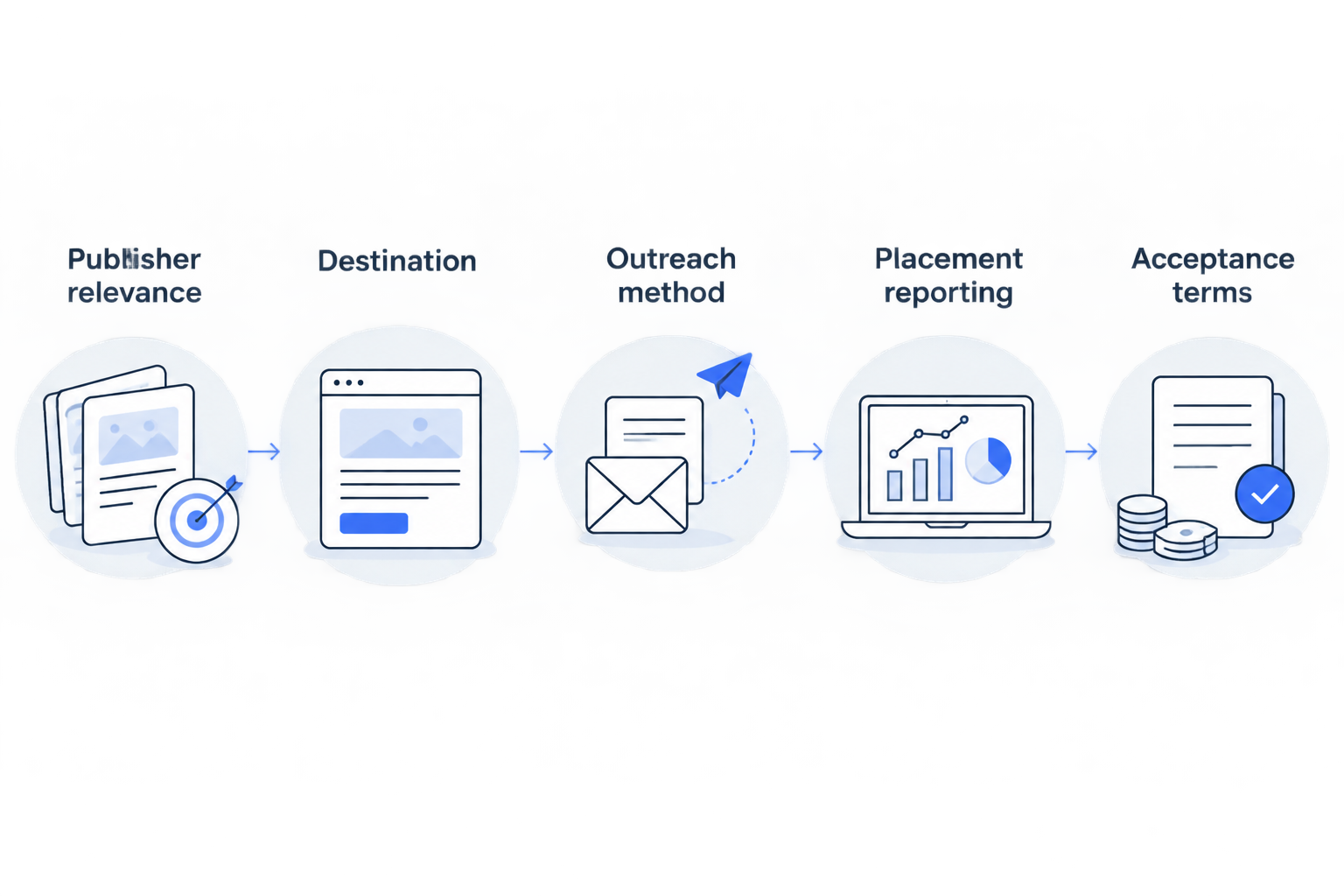
Use these 5 checks before approving outreach. They turn a broad promise into requirements your team can inspect.
1. Check publisher relevance
Ask for representative publisher examples and read their actual articles. Look for subject consistency, identifiable editorial responsibility and a credible reason for your audience to use the publication.
Do not treat domain rating or domain authority as a pass mark. These are third-party metrics, not Google scores, and they do not establish whether an individual placement makes sense.
2. Check the destination
Choose 1 target page for the initial brief and explain why an outside publisher would reference it. The explanation should describe reader value, not your desired keyword.
If that explanation is weak, improve the destination before expanding outreach. A technically accessible page still needs useful content and a clear purpose.
3. Check the outreach method
Request a plain description of prospect selection, personalisation and publisher communication. Manual outreach is a process description, not proof of quality; the actual targets and proposed angles still need scrutiny.
Ask whether placements involve payment, reciprocal arrangements or a publisher network. Google's spam policies identify links created primarily to manipulate rankings as link spam; paying an agency does not exempt the resulting placements from those rules.
4. Check placement reporting
Require each delivered placement to show the live publisher URL, destination URL, anchor text, publication date and observed link attributes. Ask the provider to flag redirects and subsequent removals rather than silently substituting another placement.
A summary dashboard is useful for orientation. It is not a replacement for a placement-level record your team can verify.
5. Check acceptance terms
Define what counts as an accepted placement before work begins. Record relevance requirements, prohibited publisher categories, approval responsibilities and the process for handling a placement that fails the agreed specification.
Do not assume replacement terms or monitoring are included. Ask for the actual scope and assess the answer before signing.
How do you measure whether the service was worth it?
Keep 3 measurement layers separate: delivery, search performance and business outcomes. Combining them into a single authority score hides the distinction between completed work and commercial value.
- Delivery: Verify the agreed placements, publisher relevance, destinations, anchors and link attributes.
- Search performance: Track the target pages' impressions, clicks and relevant query visibility in Google Search Console.
- Business outcomes: Review qualified enquiries, assisted conversions or sales associated with the pages and referral visits where tracking permits.
Record a baseline before the campaign starts and annotate other changes, including content updates, migrations and internal linking work. Those changes complicate attribution; do not credit every movement to backlinks.
For a 2026 evaluation, compare reports with the original brief. A provider can fulfil a placement agreement without producing a measurable commercial gain, just as a traffic increase does not prove every delivered link was useful.
Is a smaller outreach campaign better than bulk backlinks?
A smaller outreach campaign is the better choice when its placements meet your relevance and editorial requirements and the bulk offer does not. Volume alone does not establish value.
Ask the bulk provider to explain its publisher selection and acceptance criteria. Reject any proposal whose only defensible advantage is the number of links promised.
Should you build links before improving your content?
Improve the target content first when it lacks a credible reason for another publisher to reference it. Outreach cannot make an incomplete explanation or unsupported claim more useful to readers.
That does not mean every destination needs original research. A clear, accurate resource that answers a relevant question can give outreach a sound starting point.
Can an agency guarantee ranking improvements?
An agency cannot control Google's ranking decisions or competing websites. Judge a guarantee by its exact contractual meaning rather than treating the word as evidence of future search performance.
Require the provider to distinguish controllable commitments, such as agreed reporting, from outcomes outside its control. Keep ranking promises out of your acceptance criteria.
FAQ
Are affordable link building services worth it for a small SaaS company?
Affordable link building services are worth considering when a SaaS company has useful target pages and a clear publisher-relevance brief. Prioritise contextual fit and verifiable delivery over link volume or authority scores alone.
What should I ask a link building agency before signing?
Ask how the agency selects publishers, conducts outreach, handles paid placements and reports completed work. Get acceptance requirements and responsibilities in writing before outreach starts.
Is blogger outreach better than buying bulk backlinks?
Blogger outreach is the better choice when it produces relevant, editorially justified contributions that the bulk offer cannot demonstrate. The method's label is not enough; inspect publisher examples and the proposed content.
Does a high domain rating mean a backlink is good?
A high domain rating does not establish that a backlink is relevant or useful. Assess the publication, linking page, surrounding text and destination alongside any third-party metric.
Are niche edits automatically against Google's rules?
Niche edits are not automatically prohibited merely because they update existing content. The purpose and arrangement matter: manipulative placements create risk, and paid links require appropriate qualification under Google's guidance.
What should a link building report include?
A link building report should include live placement URLs, destination pages, anchor text, publication dates and observed link attributes. Your team should be able to inspect each placement rather than relying only on a summary score.
Is Linkible a link building tool or an agency?
Linkible is a link building agency offering outreach, niche edits, digital PR and HARO link building. It is relevant to brands evaluating an outsourced service rather than software for running outreach themselves.
One last thing
The most useful question is not how many backlinks you receive, but which proposed placements you should reject. Ask a provider to describe an unsuitable publisher and explain why it would refuse that placement. The answer reveals its selection criteria more clearly than a list of impressive domains.
Before your next enquiry, prepare your target page, intended audience, priority market and publisher exclusions. Those details give an agency something specific to assess.
Discuss your outreach brief
For your 2026 shortlist, ask Linkible to explain how its proposed link building service would address your target pages, publisher requirements and reporting needs. Use the existing enquiry route and request a scope you can compare against these checks.
Discuss your link building brief
Share your target pages, audience and publisher requirements for a service discussion.