Link building tactics ranked by turnaround time: start with existing mentions. Compare editorial steps, limitations and agency checks before choosing.
Best overall for an established brand: unlinked mention outreach. Best for restoring lost authority signals: link reclamation. Best for avoiding new article production: relevant niche edits. These link building tactics ranked by turnaround time follow the work required before publication—not promised delivery dates or measured industry averages.
- Link building tactics ranked by turnaround time should reflect publishing dependencies, not promised ranking dates.
- Start with unlinked mentions or lost backlinks when a relevant opportunity already exists.
- Niche edits avoid new article production but still require editorial approval.
- Guest posts and original research add production work before outreach can produce a live backlink.
- Linkible offers link building and outreach services for SaaS and ecommerce brands evaluating agency support.
Why turnaround time matters in 2026
A backlink deadline is not a ranking deadline. Securing editorial approval, publishing a link, having Google discover it and seeing any search impact are separate events. Buying the first does not guarantee the last.
For SaaS and ecommerce teams comparing link building services, the useful question is what must happen before a relevant backlink goes live. An existing mention needs a different workflow from a research-led campaign that has not yet produced its source material.
Linkible is best for SaaS and ecommerce brands seeking agency support across link building and outreach tactics. Choose the tactic around your available assets, target pages and publisher relevance—not a delivery claim detached from the work.
What makes the best link building tactic for turnaround time?
Use these criteria before comparing proposals:
- Existing opportunity: A lost backlink or published brand mention gives outreach a specific starting point. Without either, prospecting comes first.
- Content readiness: An existing article removes the need to commission a new one. It does not remove editorial review.
- Editorial dependencies: Count the approvals, revisions and publishing steps between outreach and a live placement.
- Publisher relevance: A quick backlink on an unrelated page is not a useful substitute for a relevant editorial placement.
- Reporting clarity: Separate outreach activity, accepted pitches and live links. They are different deliverables.
- Repeatability: A fast first placement does not prove that the same tactic can sustain your campaign.
The ranking below assumes the necessary opportunity or asset exists. If it does not, move that tactic down your shortlist rather than treating its position as a delivery forecast.
Link building tactics at a glance
This 2026 comparison ranks tactics by workflow readiness and publishing dependencies. It does not assign elapsed-time estimates because publisher response and approval dates are not controlled by your agency.
| Rank | Tactic | Best for | Turnaround advantage | Key limitation |
|---|---|---|---|---|
| 1 | Unlinked mention outreach | Established brands with relevant mentions | The brand already appears in published content | A mention does not entitle you to a backlink |
| 2 | Link reclamation | Sites with lost or broken backlinks | A previous link provides a concrete correction request | The publisher must still want the reference |
| 3 | Niche edits | Brands with useful, publication-ready destination pages | No new standalone article is required | The link must genuinely improve the existing page |
| 4 | Broken link outreach | Brands with a close replacement resource | A broken reference creates a specific editorial reason to respond | Finding a relevant replacement match adds work |
| 5 | Journalist request outreach | Brands with an available subject-matter expert | An active request supplies the topic and editorial need | Selection, attribution and publication remain uncertain |
| 6 | Guest posting | Brands needing control over a proposed topic | An agreed brief gives content production a defined direction | Drafting, revisions and scheduling add dependencies |
| 7 | Research-led digital PR | Brands with original evidence to publish | A reusable research asset supports multiple pitches | Research and asset production precede publication |
1. Unlinked mention outreach: best for established brand coverage
Unlinked mention outreach asks a publisher to add a relevant link where your brand already appears. The editorial context exists, so your request can focus on whether a link helps readers verify the reference or find the source.
This is the default starting point when relevant mentions already exist. It is not a shortcut for a new brand with little published coverage.
Unlinked mention outreach pros:
- Starts from a specific published reference.
- Avoids writing a new article.
- Gives the outreach email a clear, verifiable reason.
Unlinked mention outreach cons:
- Opportunity volume depends on existing mentions.
- Some references do not need a link.
- Publishers can decline or ignore the request.
Best for: SaaS and ecommerce brands already discussed by relevant publishers.
Verdict: Buy the outreach support when qualified mentions exist; skip a volume commitment before the opportunity audit.
2. Link reclamation: best for recovering lost backlinks
Link reclamation addresses a backlink that disappeared or now points to an unsuitable destination. Check the cause before contacting the publisher: a broken destination on your own site calls for technical correction, not automatically an outreach campaign.
A previous reference gives you a concrete conversation starter. It does not prove the publisher will restore the link or accept a different target page.
Link reclamation pros:
- Focuses on an identifiable problem.
- Can preserve an existing editorial relationship.
- Separates technical fixes from new placement work.
Link reclamation cons:
- Deleted or substantially revised content can end the opportunity.
- An unrelated replacement page weakens the request.
- Recoverable links are a finite pool.
Best for: Brands with a documented history of relevant backlinks, including sites reviewing migrations or removed pages.
Verdict: Buy a diagnostic audit first; proceed with outreach only where restoration still serves readers.
3. Niche edits: best for avoiding new article production
A niche edit adds a relevant reference to an existing article. Its turnaround advantage is structural: the article is already published, so a new manuscript is not a prerequisite.
For a 2026 campaign, assess the actual paragraph and destination page before approving a placement. A relevant domain does not make every article on that domain a sensible match.
Niche edit pros:
- Removes standalone article production from the workflow.
- Allows evaluation of the existing editorial context.
- Can connect an established explanation with a useful source.
Niche edit cons:
- Forced anchors can damage sentence quality.
- Publisher approval remains necessary.
- Paid links intended to pass ranking credit create Google link-spam policy risk.
Best for: Brands with useful destination pages that directly support an existing article.
Verdict: Buy relevance-led outreach; skip insertions sold primarily on speed or domain metrics.
4. Broken link outreach: best for strong replacement resources
Broken link outreach identifies a dead reference and proposes a useful replacement. The replacement must fulfil the original reference's purpose; a loosely related product page is not automatically suitable.
The opportunity creates a reason to contact the editor, but prospecting and resource matching add work. Move this tactic higher only when you already have both a qualified broken link and a close replacement.
Broken link outreach pros:
- Gives the publisher a specific issue to assess.
- Centres the pitch on reader usefulness.
- Can use an existing resource rather than new content.
Broken link outreach cons:
- A broken link does not guarantee replacement demand.
- Finding a close topical match takes research.
- Rebuilding an inadequate resource adds production steps.
Best for: SaaS educational resources and ecommerce guides that replace a missing source directly.
Verdict: Buy when the replacement fit is clear; hold when the resource still needs substantial work.
5. Journalist request outreach: best for available experts
Journalist request outreach responds to a reporter's need for expertise, commentary or evidence. An active editorial request gives you a topic and deadline, but the publication decision remains with the journalist.
This tactic can move ahead of other approaches when your expert is ready and the request fits exactly. Do not confuse a response deadline with a guaranteed publication date.
Journalist request outreach pros:
- Starts with an expressed editorial need.
- Gives subject-matter expertise a specific use.
- Avoids producing a complete guest article.
Journalist request outreach cons:
- A submitted response may not be selected.
- Coverage does not guarantee a backlink.
- Expert review can become an internal bottleneck.
Best for: Brands with named experts who can supply original, attributable answers promptly.
Verdict: Buy the process when expert access is reliable; skip promises of guaranteed editorial links.
6. Guest posting: best for a defined editorial topic
Guest posting contributes an original article to another publisher. It adds briefing, drafting, revision and scheduling to the outreach workflow, which places it below ready-made editorial opportunities in this ranking.
For SaaS brands, the proposed topic should address a problem the publisher's audience recognises. For ecommerce brands, product knowledge must support an editorial article rather than turn it into a sales page.
Guest posting pros:
- Supports a focused topic and useful explanation.
- Creates room for genuine subject expertise.
- Lets you assess the brief before drafting.
Guest posting cons:
- Revisions add production dependencies.
- Acceptance does not guarantee immediate publication.
- A link requirement can conflict with editorial judgement.
Best for: Brands prepared to contribute useful content to a closely matched publication.
Verdict: Buy topic-led outreach with clear editorial responsibilities; hold if content approval has no owner.
7. Research-led digital PR: best for original evidence
Research-led digital PR packages original findings into material journalists and publishers can reference. Its prerequisites include a defensible methodology, a published source and a relevant outreach angle.
An existing research asset changes the starting position substantially. This ranking places research-led digital PR last only when the evidence and supporting page still need production—not because every PR campaign takes longer than every guest post.
Research-led digital PR pros:
- Gives outreach an original source to pitch.
- Supports multiple relevant editorial angles.
- Produces an asset your brand can reference beyond outreach.
Research-led digital PR cons:
- Methodology and approvals require preparation.
- Coverage and backlinks are separate outcomes.
- A weak finding cannot be fixed by more pitches.
Best for: Brands with credible original evidence and the capacity to prepare it for publication.
Verdict: Buy when the evidence supports the story; wait when the campaign has only a headline.
How the turnaround ranking works
The ranking prioritises an existing editorial opportunity over new production. It then considers the work required to make the proposed reference publishable. It is a decision framework, not a benchmark study or a claim about average agency delivery.
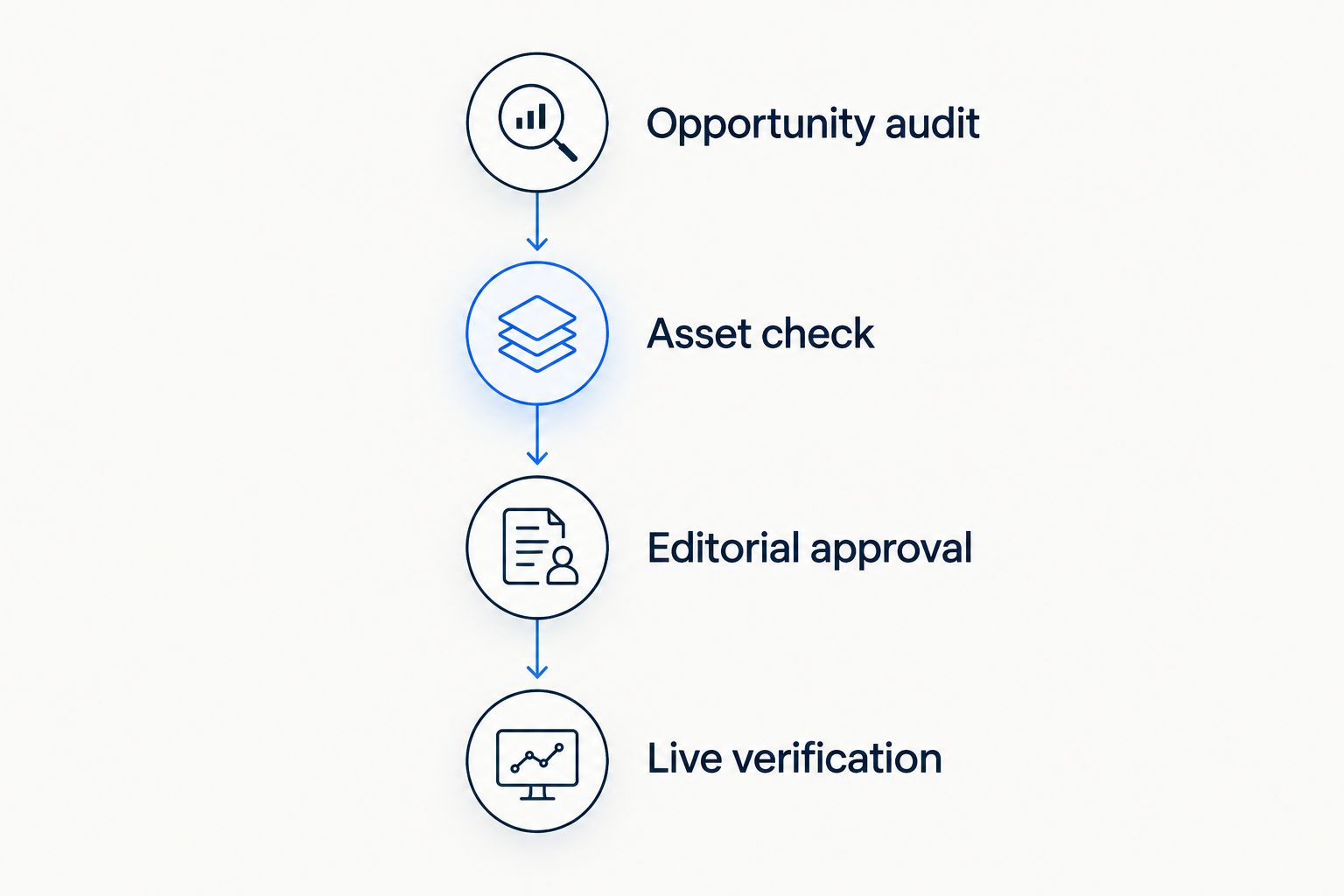
Use this sequence to compare a 2026 proposal:
- Opportunity audit: Identify the actual mention, lost link, article, request or prospective publisher.
- Asset check: Confirm the destination page answers the reader's need and is ready for review.
- Editorial approval: Identify who controls acceptance, changes and publication.
- Live verification: Check the published source URL, destination, anchor text and link attributes.
Ask an agency to explain what is ready now and what still needs approval. A proposal that treats every tactic as having the same delivery workflow conceals the dependencies you need to manage.
Which link building tactic should you choose?
Start with unlinked mentions and reclaimable backlinks if your brand has them. When neither opportunity exists, choose between relevant existing-page outreach and new content based on destination-page quality and editorial fit.
Before choosing Linkible or another link building agency, request 3 sample placements and assess the source page, surrounding paragraph and destination fit. This is a buyer checklist, not a claim about any provider's reporting or results.
Require 2 reporting dates for each completed placement: the date it went live and the date it was verified. Assign 1 accountable owner on your team for approving destination pages, expert responses and content changes. Those requirements make delivery status easier to audit without inventing a turnaround promise.
Use a 2026 brief that specifies:
- Target audience, including the relevant US, UK or Canadian buyer context.
- Priority pages and acceptable editorial topics.
- Manual outreach methods and publisher-selection criteria.
- Deliverables separated into activity, approval and live placements.
- Treatment of sponsored links, removals and unsuitable placements.
FAQ
What's the fastest link building tactic for an established brand?
Unlinked mention outreach is the first tactic to assess when relevant published mentions already exist. It avoids new article production, but the publisher still controls whether and when a backlink is added.
Are niche edits faster than guest posts?
Niche edits remove the need to produce a new standalone article. That reduces production dependencies, but it does not guarantee a shorter elapsed time than a guest post with an agreed publishing slot.
Can an agency guarantee when a backlink will go live?
An agency cannot control an independent publisher's editorial decisions. Ask which milestones the agency controls and whether a delivery commitment refers to outreach, approval or a verified live link.
How soon will a new backlink improve rankings?
A live backlink has no guaranteed ranking-impact date. Publication, discovery and ranking changes are separate events, so assess delivery and search performance separately.
Should a new SaaS brand start with mention outreach?
Mention outreach needs existing relevant mentions to work from. A new SaaS brand without that coverage should assess useful destination pages, suitable publisher topics and available expertise before selecting a tactic.
Does journalist coverage always include a backlink?
Journalist coverage does not always include a backlink. Confirm whether the proposed service reports responses, mentions, linked coverage or verified live backlinks.
What should a link building report include?
A placement report should identify the source URL, destination URL, anchor text, link attributes, publication date and verification date. Keep outreach activity and accepted pitches separate from completed placements.
One last thing
The fastest useful next move can be fixing your own destination page before sending another pitch. A broken reference, outdated resource or weak replacement match creates a problem that outreach volume does not solve.
To discuss Linkible's link building support, contact Linkible with your priority pages, available assets and intended campaign deadline. Ask for a proposed workflow that separates controllable delivery steps from publisher decisions.