Compare white label link building services with in-house outreach. Choose specialist execution or direct control, using clear quality and reporting checks.
Choose Linkible if your agency wants an external specialist for link building; choose in-house outreach if you need direct control over publisher relationships, staffing and delivery. The best white label link building services fit your client requirements and operating model—not just a backlink quota.
- Linkible suits agencies evaluating outsourced link building; confirm white label delivery terms before signing.
- In-house outreach wins when direct publisher relationships and day-to-day control are essential.
- Evaluate white label link building services on publisher relevance, outreach methods, deliverables and reporting.
- Keep client approvals and link-quality standards explicit, whichever delivery model you choose.
Why this matters
Your client holds your agency accountable for every backlink, even when another business handles outreach. A white label arrangement changes who performs the work; it does not transfer your responsibility for quality, communication or the claims you make.
Linkible's link building services include white-hat outreach, niche edits, digital PR and HARO link building. Evaluate those capabilities separately from the contractual requirements of white label delivery: confidentiality, client ownership, report branding and communication boundaries.
For your 2026 shortlist, compare an external specialist against the real alternative: building and managing outreach internally. This guide compares those operating models rather than assigning unsupported rankings to named providers.
At a glance: an agency partner versus in-house outreach
| Dimension | Linkible | In-house outreach |
|---|---|---|
| Best for | Agencies evaluating specialist outsourced link building | Agencies keeping outreach operations inside their team |
| Standout capability | Stated services span outreach, niche edits, digital PR and HARO link building | Your team owns the outreach operation directly |
| Operational control | Define approvals, responsibilities and escalation in the agreement | Direct control over staffing, prospecting and correspondence |
| Publisher relevance | Assess proposed publishers against each client's brief | Apply the same relevance checks to internal prospecting |
| Search-policy risk | Evaluate actual placement methods, not white-hat wording alone | Apply the same policy checks to internally acquired links |
| Reporting | Specify evidence, branding and delivery requirements | Build reporting around your existing client workflow |
| Commercial structure | Confirm the proposed scope, billing basis and exclusions | Budget for people, tools, content and management |
| Client handover | Agree confidentiality, account ownership and exit terms | Retain outreach records within your own systems |
An agency partner suits outsourcing; in-house suits ownership
Linkible is a link building agency for businesses seeking outsourced outreach and backlink services. That makes it a candidate for agencies assessing external delivery, not proof that every white label requirement is included automatically.
An external partner fits when you want another organisation to execute an agreed link-building scope. Your agency still needs someone to select client priorities, approve the brief and review the output. Outsourcing execution does not remove account management.
In-house outreach fits when publisher relationships and outreach knowledge must remain inside your business. You control the process directly, but you also take responsibility for recruitment, training, prospect research and quality checks.
For SaaS and ecommerce clients, start with the pages and audiences that matter commercially. A software integration guide and an ecommerce category page need different editorial contexts, even when both campaigns aim to earn relevant backlinks.
Verdict: choose an external specialist for delegated execution; choose in-house outreach for operational ownership.
An external specialist offers a service scope; in-house offers flexibility
The supplied service range gives you distinct approaches to discuss: outreach, niche edits, digital PR and HARO link building. Ask which approach fits the client's target page and what work the proposed engagement actually includes.
Do not treat those methods as interchangeable deliverables. A niche edit concerns an existing page, while a contributed article requires new content. Journalist outreach depends on a relevant request and an editorial decision; a pitch is not a published backlink.
An internal team can change its prospect criteria, content angle or outreach sequence under your direction. That flexibility comes with execution work: someone must research the opportunity, produce the material and manage the conversation.
Build the 2026 campaign brief around the required outcome and acceptable methods. Avoid purchasing an assortment of tactics without explaining why each belongs in the campaign.
Verdict: the specialist model packages external execution; the internal model keeps tactical decisions with your team.
In-house outreach wins on direct operational control
With an internal team, you decide who contacts publishers, which messages they send and how correspondence is stored. Changes pass through your management structure rather than a supplier relationship.
An external arrangement needs those boundaries written down. Establish whether you approve publishers before outreach, review content before submission or assess placements after publication. These are different approval points, not equivalent promises.
Use these questions before appointing a partner:
- Who approves target pages and anchor text?
- Who handles publisher objections or requested edits?
- Who can communicate with the end client?
- Who decides whether a placement meets the brief?
- What happens when the client changes priorities?
The trade-off is management responsibility. Internal control gives you authority over the work, but your agency must provide the people and supervision required to exercise it.
Verdict: in-house outreach wins when direct access to people, messages and decisions is non-negotiable.
Neither model wins on relevance without publisher checks
Outsourcing does not establish publisher quality. Neither does keeping outreach internal. Judge the proposed website, linking page and editorial context rather than the supplier's delivery model.
Use 4 publisher checks for either route:
- Audience fit: Does the publication reach people connected to the client's market?
- Topic fit: Does the proposed article or existing page genuinely relate to the destination?
- Editorial fit: Does the link help explain, support or extend the surrounding content?
- Destination fit: Does the target page fulfil the expectation created by the link?
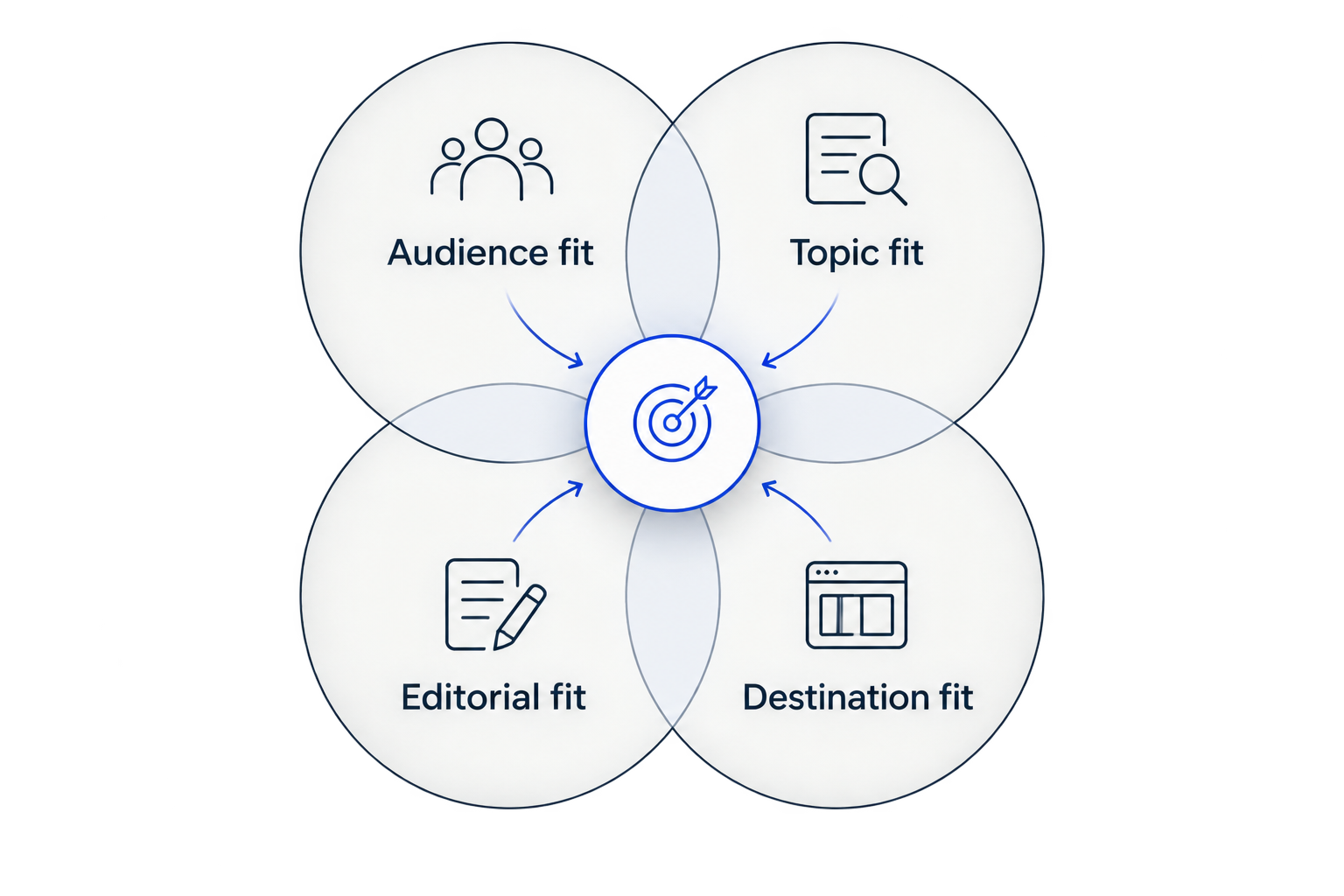
For a SaaS client, connect the proposed placement to the product's use case or buyer problem. For an ecommerce client, inspect whether the content supports the linked product category rather than merely mentioning a broad shopping topic.
A domain-level authority score cannot answer those questions alone. Require a placement-level explanation that your account manager can defend to the client.
Verdict: relevance is a tie until you inspect actual publisher and page examples.
Neither model removes search-policy risk
A white-hat description is not a substitute for examining the proposed activity. Google's link-spam policies address links created primarily to manipulate search rankings, including paid links that pass ranking credit.
Ask both external and internal teams how they handle paid placements, link qualification and editorial discretion. Payment does not make a placement an earned editorial endorsement. Relevant paid links need appropriate qualification under Google's policies.
For niche edits, inspect the surrounding passage and the reason for adding the link. An insertion should make editorial sense; an unrelated sentence added solely to hold anchor text fails that practical test.
Your agency should also reject ranking guarantees as a substitute for evidence. Search performance depends on factors beyond the delivery of a backlink, including the destination page and the wider competitive search results.
Verdict: policy scrutiny applies equally to outsourced services and in-house outreach.
In-house reporting wins on control; partner reporting needs a contract
An internal team lets you define report fields and connect them to your existing account workflow. The limitation is straightforward: your agency must maintain the records and check their accuracy.
For an external partner, make reporting part of the scope before work starts. White label presentation should not remove the evidence your team needs to evaluate a placement.
Require 6 reporting fields:
- Live URL: The published page containing the backlink.
- Target URL: The client page receiving the link.
- Anchor text: The exact linked wording.
- Link attributes: The recorded qualification of the link.
- Publication date: When the placement went live.
- Review status: Your agency's acceptance decision and any unresolved issue.
In your 2026 reporting template, distinguish outreach activity from published outcomes. A prospect list, a reply and a live placement represent different stages of work.
Report business outcomes separately from delivery evidence. A published backlink proves delivery; it does not, by itself, prove responsibility for a ranking or revenue change.
Verdict: in-house reporting offers direct control; external reporting must earn acceptance through clear evidence.
Commercial terms: compare the same scope before comparing proposals
For your 2026 supplier review, establish what triggers billing and what constitutes an accepted deliverable. A proposal is difficult to evaluate when content production, publisher research and campaign management sit outside its stated scope.
Ask whether the proposed arrangement uses a project scope, an ongoing engagement or a placement-based structure. Do not assume a particular model applies before reviewing the actual proposal.
The commercial trade-offs differ:
- Project scope: Useful for a defined assignment; specify how changes are handled.
- Ongoing engagement: Useful for continuing activity; define reporting and termination terms.
- Placement-based structure: Useful for counting accepted outputs; define acceptance without reducing quality to volume.
For in-house outreach, your budget must cover the operation rather than only published links. Include staff responsibilities, research tools, writing, editing and management time when comparing the workload.
Verdict: neither model wins commercially until you compare equivalent responsibilities and acceptance criteria.
In-house outreach wins on record ownership by default
Your internal team can retain publisher correspondence, prospect history and campaign decisions within agency-controlled systems. That gives you direct custody of the working record, provided your team actually documents it.
With a partner, establish what your agency receives when an engagement ends. Access during delivery and ownership after termination are separate questions.
Use 3 approval stages in the agreement:
- Brief approval: Confirm target pages, audience, prohibited topics and acceptable methods.
- Placement review: Check the published page against the agreed criteria.
- Campaign handover: Receive the agreed records and unresolved-issue log.
Also define confidentiality and client contact. If the supplier must remain behind your agency's brand, specify that boundary instead of relying on the phrase white label.
Verdict: in-house outreach wins on direct custody; an external partner needs explicit handover terms.
Final verdict: choose the operating model you can manage
Choose Linkible if you want specialist execution
Best for: an agency evaluating outsourced link building for SaaS or ecommerce clients. Discuss the stated service range, then confirm white label permissions, reporting, confidentiality and approval requirements in the proposal.
Keep strategy ownership inside your agency. A specialist engagement works best when the partner receives an actionable brief rather than an unexplained demand for more links.
Choose in-house outreach if control is the priority
Best for: an agency committed to owning publisher relationships and outreach operations. Choose this route when you want direct management of prospecting, correspondence, content and records.
Accept the accompanying responsibilities. Your agency must resource quality control and reporting, not just email sending.
For 2026, use this scorecard to keep the decision focused:
| Dimension | Winner |
|---|---|
| Delegated execution | External specialist |
| Tactical flexibility | In-house outreach |
| Direct operational control | In-house outreach |
| Publisher relevance | Tie—inspect actual opportunities |
| Search-policy scrutiny | Tie—same standards apply |
| Reporting control | In-house outreach |
| Commercial fit | Compare equivalent scopes |
| Record custody | In-house outreach |
FAQ
What are white label link building services?
White label link building services let an agency obtain link-building work from an external provider for delivery under the agency's brand. The agreement should define confidentiality, client communication, reporting and responsibility for approving placements.
Is Linkible a white label link building provider?
Linkible is a link building agency offering white-hat outreach, niche edits, digital PR and HARO link building. Confirm white label permissions, report branding and client-contact restrictions directly before agreeing to an engagement.
Is outsourced link building better than hiring internally?
Outsourcing fits delegated execution; hiring internally fits direct operational ownership. Compare the same responsibilities, including research, content, quality checks and reporting, before choosing.
What should a white label backlink report include?
A useful backlink report includes the live URL, target URL, anchor text, link attributes, publication date and review status. Keep outreach activity separate from accepted published placements.
Are niche edits automatically safe for client websites?
No, niche edits are not automatically safe. Inspect editorial relevance, payment arrangements and link qualification against Google's link-spam policies rather than accepting the method's name as evidence.
How should agencies compare white label link building proposals?
Compare equivalent scopes, acceptance criteria and billing triggers. Ask who handles research, writing, publisher communication, reporting and unresolved placement issues before assessing the commercial terms.
One last thing
Ask every prospective partner how it prevents outreach to publishers your client has already contacted. Share an agreed exclusion list and define who maintains it. Duplicate approaches create a coordination problem that a polished backlink report cannot fix afterwards.
Related guides
- Guest post pitch to a live placement: complete outreach workflow
- Best link building strategies for SaaS companies
- Best types of backlinks for ecommerce SEO
Next step: Contact Linkible with your client sectors, target pages and white label requirements. Request a written scope covering publisher criteria, approvals, reporting and handover before committing.