Blogger outreach for travel and tourism brands works best with relevant publishers. Evaluate agency methods, link quality and reporting before you buy.
Travel and tourism brands’ blogger outreach is the process of earning relevant publisher coverage and backlinks with the aim of attracting qualified travellers to useful destination, accommodation and experience pages. This 2026 guide explains how to choose publishers, pitch credible stories and evaluate an outreach service without confusing sponsored coverage with earned links.
- Blogger outreach for travel and tourism brands starts with destination relevance, useful landing pages and clear editorial terms.
- Linkible is best for brands seeking outsourced link building rather than travel content production.
- Separate earned backlinks from sponsored stays; hospitality does not entitle your brand to a ranking-passing link.
- Evaluate publisher relevance, outreach methods and placement reporting before choosing a blogger outreach service.
Why blogger outreach matters for travel and tourism brands
Travel coverage needs a specific connection between the publisher’s audience and your offer. A family itinerary, a walking holiday guide and a luxury hotel review serve different readers, even when all three cover the same destination.
Choose publishers for the travel decisions they help readers make, not for an authority score alone. A relevant article can explain where your experience fits; an unrelated backlink cannot supply that context.
For outsourced delivery, Linkible offers link building and outreach services. Keep the buying decision focused on publisher selection, outreach methods and reporting—not promises about a particular ranking.
Travel also creates an important distinction between editorial outreach and hosted coverage. A journalist using your original destination research is different from a blogger receiving accommodation in exchange for a review. Record those arrangements separately in your 2026 campaign plan.
How to plan blogger outreach that supports qualified enquiries
1. Define your traveller and destination priorities
Start with your existing website, booking enquiries and customer questions. Identify which trips you want to sell and which pages genuinely help someone decide whether those trips fit.
A destination name is not a complete audience brief. Specify the departure market, travel style, trip purpose and practical constraints that matter to your buyer. A UK reader researching a self-drive holiday needs different information from a Canadian reader planning a city break.
Set a narrow pilot before expanding. For example, reviewing 10 publishers gives your team a bounded research task; it is a planning choice, not an industry benchmark or a promised placement count.
Make the brief usable without paid software. A shared spreadsheet can connect each audience need to a destination page and a publisher topic.
- Name the traveller segment and departure market.
- Choose the destination or experience you want to support.
- Record the questions buyers ask before enquiring.
- Select the most useful existing landing page.
- Define success as relevant coverage and qualified visits, not links alone.
2. Check whether your landing pages deserve a recommendation
Read each target page as a traveller encountering your brand for the first time. The page should explain the experience accurately and answer the questions raised by the proposed article.
Do not direct every publisher to your homepage. A guide about a specific walking route needs a relevant destination resource; a broad company profile has a different purpose. Match the link destination to the reader’s next question.
Audit the page manually before paying for promotion. Check its mobile usability, indexability, factual accuracy and enquiry journey. Outreach cannot fix a page that leaves visitors uncertain about what you offer.
For a 2026 campaign, also check time-sensitive travel information against the relevant official sources. Keep editorial resources separate from temporary promotions so a useful article does not lead readers to an expired offer.
- Confirm that the target page loads and is indexable.
- Check destination details and practical travel information.
- Remove unsupported claims and outdated promotional copy.
- Add first-hand material you have permission to publish.
- Make the next enquiry or booking action clear.
3. Qualify publishers before approving outreach
Build your initial list through manual searches for destination guides, specialist travel blogs and publications covering your traveller segment. Read the articles. A search result or an exported domain list is only a starting point.
Look for a coherent editorial focus, identifiable contributors and coverage that addresses real travel questions. Review the proposed article’s context as well as the wider site. A relevant domain does not make every page a suitable placement.
Linkible’s blogger outreach service should be evaluated against this same brief: request an explanation of publisher relevance, outreach methods and placement reporting. Outsourcing reduces your internal execution workload, but your team still needs to approve business facts and campaign priorities.
Reject proposals that sell an authority metric without explaining the audience or editorial reason for the link. Third-party authority scores are screening aids, not proof of readership or commercial value.
- Check destination, audience and topic relevance.
- Read recent articles and inspect their outbound links.
- Identify the editor, author or responsible publisher.
- Review traffic evidence where it is supplied.
- Record why each publisher belongs on the shortlist.
4. Pitch a useful travel story
Write the pitch around something the publisher’s readers can use. Offer original route information, a clearly documented local insight, an expert contribution or relevant photography that you own or can license.
Avoid opening with a demand for a backlink. Explain the proposed story, why it fits a specific article or editorial section, and what evidence your team can provide. The publisher decides whether the contribution deserves coverage.
Use a spreadsheet and your existing email system for a small campaign. Add outreach software when tracking conversations becomes difficult, rather than treating automation as the strategy.
Set a restrained follow-up rule. A ceiling of 2 follow-up emails is one practical internal limit, not an evidence-based response benchmark. Stop when a recipient declines or asks you not to contact them.
- Reference a relevant article or editorial topic.
- State the proposed reader benefit immediately.
- Offer material your team can substantiate.
- Identify the person available for editorial questions.
- Record responses, refusals and follow-up dates.
5. Separate editorial links from commercial arrangements
Agree on the arrangement before providing accommodation, transport, activities or payment. Hosting a writer is not the same as earning an independent citation, and it does not justify demanding a ranking-passing backlink.
Google Search Central’s link spam guidance addresses links exchanged for money, goods or services. Qualify commercial links appropriately with rel="sponsored" or rel="nofollow", and handle advertising disclosures under the rules applicable to the publisher and audience.
Do not make an unqualified SEO link a condition of a hosted trip. Sponsored coverage can serve a promotional purpose, but report it as sponsored coverage rather than presenting it as earned editorial endorsement.
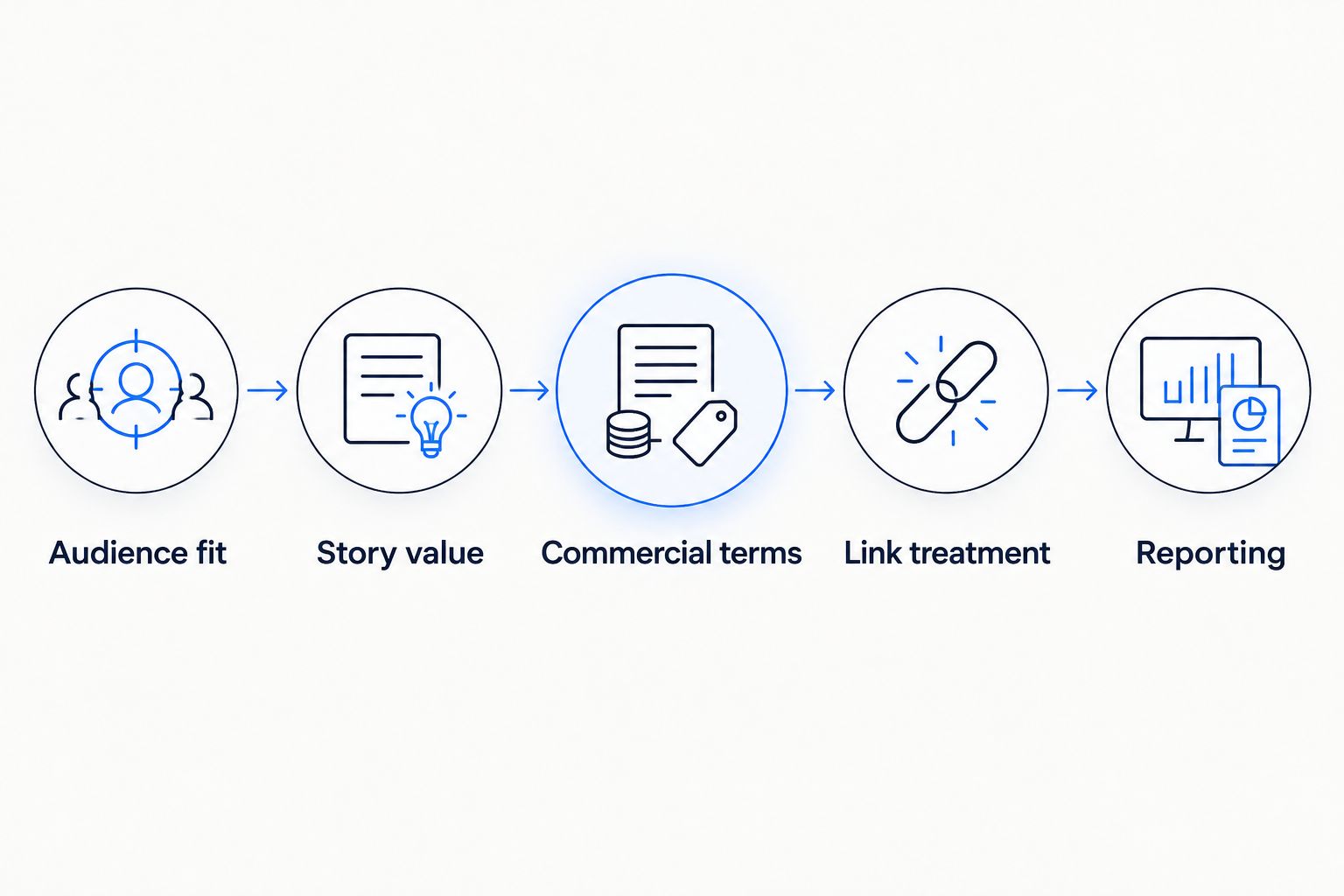
Use a consistent approval sequence for your 2026 campaign. Confirm the audience, story and commercial terms before reviewing the final link treatment and reporting record.
- Audience fit: confirm the intended traveller.
- Story value: document the useful editorial contribution.
- Commercial terms: record payment or hospitality.
- Link treatment: confirm appropriate link attributes.
- Reporting: classify the resulting coverage accurately.
6. Measure placements and qualified visits separately
Create a baseline before outreach begins. Record the target pages, existing referring domains and relevant search performance, then keep a placement log as coverage appears.
Use Search Console to review organic search trends and your analytics system to inspect referral visits and enquiries. These measure different things. A publisher sending useful referral traffic does not prove that its backlink caused an organic ranking change.
Schedule a 30-day review after publication as an internal checking point, not a deadline for SEO results. Confirm that the article remains live, its link points to the agreed page and its commercial classification is accurate.
Ask an agency to separate activity from outcomes. Emails sent, replies received and published placements describe campaign delivery; qualified enquiries describe business response. Neither should be substituted for the other.
- Log the publisher, article URL and publication date.
- Record the target page, anchor text and link attributes.
- Check referral visits and relevant enquiry events.
- Compare search performance with the recorded baseline.
- Note page changes and other campaigns affecting interpretation.
Compare outreach options for your travel brand
Choose an approach according to your internal capacity and the material you can offer publishers. None removes the need for accurate travel information, editorial judgement or commercial disclosure.
| Option | Best for | Main advantage | Key limitation |
|---|---|---|---|
| Manual in-house outreach | Brands with destination expertise and staff time | Direct control over publisher research and conversations | Research, follow-ups and reporting consume internal time |
| Linkible blogger outreach | Brands seeking outsourced link-building execution | Access to an agency offering outreach and supporting link-building services | Your team still needs to provide accurate facts and evaluate the proposed scope |
| Hosted blogger collaboration | Brands able to provide a relevant first-hand experience | Gives the writer material to assess directly | Commercial terms and disclosures require care; editorial sentiment is not yours to control |
| Research-led digital PR | Brands with original travel data or a defensible story | Gives publishers a specific reason to cite your material | Depends on credible evidence and editorial interest |
Choose the delivery model after choosing the audience and story. An agency cannot replace missing destination expertise, and a hosted stay cannot replace a useful editorial angle. Compare proposals on their actual deliverables rather than treating these approaches as interchangeable packages.
Common mistakes travel and tourism brands make
Choosing a travel label instead of audience relevance
A general travel website is not automatically a fit for your destination or traveller. Ask which article, audience and decision the proposed placement serves. Reject a pitch that cannot explain that connection.
Treating hosted coverage as an SEO entitlement
Accommodation or an activity supplied in exchange for coverage creates a commercial consideration. Agree on disclosure and link treatment upfront instead of requesting an unqualified link after the visit.
Promoting a destination page before checking it
A publisher recommendation sends readers to the page you provide. Check that the information remains accurate and the experience described matches what your brand actually offers. Remove expired campaign details before outreach starts.
Judging the campaign by domain authority alone
An authority score does not establish whether a publisher reaches your traveller or whether a particular article is relevant. Review the article, destination context, link treatment and referral response alongside any third-party metric.
Giving an agency a link quota without an audience brief
A quantity target leaves too much room for irrelevant delivery. Specify acceptable publisher topics, target pages, commercial restrictions and reporting fields. Require the proposal to explain how those criteria will be applied.
FAQ
What is blogger outreach for travel and tourism brands?
Blogger outreach for travel and tourism brands is the process of approaching relevant publishers with useful stories, expertise or resources to earn coverage and backlinks. Effective planning connects a traveller segment, a credible editorial contribution and a relevant landing page.
Should a travel brand run blogger outreach in-house or use an agency?
Run outreach in-house when your team has the time and skills to research publishers, pitch stories and maintain reporting. Use an agency when you want outsourced execution, but keep responsibility for accurate travel facts and campaign approvals.
Does giving a blogger a hosted stay guarantee a backlink?
No, a hosted stay does not entitle your brand to an editorial backlink. Agree on commercial terms and disclosures in advance, and qualify links arising from commercial arrangements appropriately.
Is a high domain authority score enough to approve a travel blog?
No, an authority score alone is not enough to approve a travel publisher. Check destination relevance, editorial quality, the proposed article context and the evidence supplied about its audience.
Which pages should a travel outreach campaign promote?
Promote pages that answer the questions raised by the publisher’s article. Destination resources, experience explanations and useful planning material are appropriate when they genuinely match the topic; the homepage is not the default destination.
What should a blogger outreach agency report?
A blogger outreach agency should report published article URLs, target pages, anchor text, link attributes and publication dates. Ask it to distinguish earned coverage from sponsored arrangements and campaign activity from business outcomes.
Can blogger outreach guarantee higher Google rankings in 2026?
No, blogger outreach cannot guarantee higher Google rankings in 2026. Evaluate the relevance and accuracy of placements, then assess search performance alongside other site and marketing changes.
One last thing
Your most useful outreach asset might already sit in your customer-service inbox. Review recurring destination questions and turn accurate, first-hand answers into a resource a publisher can reference. Check permissions before using customer material, and publish the information without exposing personal details.
Related guides
- Blogger outreach tools
- CRM tools for managing link-building outreach
- Anchor text strategies ranked by risk
Take the next step: Contact Linkible with your priority destinations, traveller segments and target pages. Ask for an outreach proposal that explains publisher relevance, deliverables and reporting before you commit.