Compare the best blogger outreach tools for prospecting, email discovery and campaign management. Choose software or managed outreach for your next campaign.
Best overall for relationship-led outreach: BuzzStream. Best for structured team campaigns: Pitchbox. Best for email discovery: Hunter. This guide compares the best blogger outreach tools in 2026, including Ahrefs for prospect research and Google Sheets for a spreadsheet-led workflow.
- BuzzStream is the best blogger outreach tools pick for relationship-led campaign management.
- Pitchbox suits structured team outreach; Hunter suits email discovery and verification.
- Ahrefs supports backlink research; Google Sheets supports a manually maintained prospect register.
- Linkible offers managed link building for brands that want outreach delivery rather than another software workflow.
Why this matters
Blogger outreach software handles parts of a campaign. Your team still needs to choose relevant publishers, develop a credible pitch, assess editorial standards and decide which opportunities deserve a response.
Buy around your operational bottleneck, not the longest feature list. A contact-finding tool will not fix weak publisher selection. A campaign platform will not make an irrelevant pitch persuasive.
For SaaS and ecommerce teams comparing software with delivery support, Linkible offers link-building services rather than an outreach application. That distinction matters: buying software and commissioning outreach solve different staffing problems.
What makes the best blogger outreach tools?
Use these criteria to judge the options before choosing a platform:
- Publisher research: Can you identify websites with a clear connection to your product, subject and target audience?
- Contact discovery: Can you find an appropriate editorial contact and check an address before sending?
- Relationship history: Can your team see previous conversations and avoid conflicting approaches to the same publisher?
- Campaign control: Can you manage pitches, follow-ups, ownership and replies without losing context?
- Reporting clarity: Can you connect prospect activity to published URLs, target pages and link attributes?
- Human review: Can your process preserve editorial judgement instead of treating every discovered website as a suitable prospect?
In 2026, keep publisher relevance ahead of sending volume. A large prospect list is not evidence that those publishers should link to your business.
Best blogger outreach tools at a glance
These tools occupy different parts of the workflow. The table identifies the strongest starting point for each job, not five interchangeable products.
| Tool | Best for | Standout capability | Key limitation |
|---|---|---|---|
| BuzzStream | Relationship-led outreach management | Contact records and outreach history | Your team still needs to qualify publishers and develop pitches |
| Pitchbox | Structured team campaigns | Outreach workflows and follow-up management | Workflow software does not replace editorial judgement |
| Hunter | Email discovery and verification | Domain-based contact research and verification | An email address does not establish publisher relevance |
| Ahrefs | Backlink-led prospect research | Analysis of referring domains and linking pages | Backlink research does not manage publisher negotiations |
| Google Sheets | A manually controlled prospect register | Flexible, shared campaign records | Accurate records depend on consistent manual updates |
1. BuzzStream: best blogger outreach tool for relationship management
BuzzStream combines contact management with outreach activity. Its central value is maintaining publisher relationships and conversation history instead of leaving that knowledge scattered across individual inboxes.
Best for: teams that repeatedly contact publishers and need a shared relationship record. Choose BuzzStream when campaign continuity matters more than simply finding another email address.
BuzzStream pros
- Contact records give outreach work a shared home.
- Communication history helps colleagues understand previous interactions.
- Campaign organisation supports ongoing publisher relationship management.
BuzzStream cons
- Contact management does not establish whether a website meets your editorial standards.
- Your team still owns prospect qualification, pitch development and reply handling.
During evaluation, follow a publisher from initial research through a response. Check whether another colleague can understand the relationship without asking the original sender for context.
For a SaaS campaign, record why the publication's audience overlaps with your buyer. For ecommerce, record the relevant category or editorial topic. A database full of names is less useful than a smaller register containing the reason each relationship matters.
Verdict: Buy BuzzStream if shared relationship history is your main operational gap. Skip it if your immediate problem is a lack of qualified prospects.
2. Pitchbox: best blogger outreach tool for structured team campaigns
Pitchbox supports outreach campaign workflows, including prospecting, email outreach and follow-up management. Its strongest fit is a team that needs to organise repeatable activity across campaign stages.
Best for: outreach teams with an established process that needs clearer execution and ownership. Evaluate Pitchbox against the handovers your team actually makes, not an imagined future campaign.
Pitchbox pros
- Campaign workflows give repeatable outreach work a defined structure.
- Follow-up management supports consistent handling of unanswered pitches.
- A dedicated outreach environment helps organise activity beyond separate inboxes.
Pitchbox cons
- A structured workflow can repeat poor targeting just as consistently as good targeting.
- Your team must still define approval rules, qualification standards and escalation decisions.
Ask the person responsible for replies to participate in the evaluation. Sending is only part of the job; questions about article angles, publication requirements and existing relationships need accountable owners.
Compare 2 campaign briefs during your assessment: one for a product-led SaaS audience and one for an ecommerce category. This is a suggested evaluation exercise, not a performance benchmark. The purpose is to establish whether the workflow supports different editorial contexts without reducing every pitch to the same template.
Verdict: Buy Pitchbox when a defined team process needs workflow support. Hold if your publisher criteria and campaign ownership remain undecided.
3. Hunter: best blogger outreach tool for email discovery
Hunter provides email discovery and verification tools. Use it when you already know which publications you want to approach but need help identifying and checking contact addresses.
Best for: teams whose research is sound but whose contact-discovery step slows outreach. Hunter addresses contact data; it does not decide whether a publisher is appropriate for a link-building campaign.
Hunter pros
- Domain-based discovery supports research into publication contacts.
- Email verification helps assess addresses before outreach.
- A focused contact-research role fits alongside a separate prospect register.
Hunter cons
- An address associated with a domain does not prove editorial responsibility.
- Verification does not guarantee delivery, a response or interest in your pitch.
Read the publication before choosing a recipient. A writer, editor and commercial contact can have different responsibilities, even when all appear associated with the same website.
Keep the reason for selecting each contact beside the address. That record helps the sender explain why the pitch belongs in that person's inbox and prevents contact discovery from becoming indiscriminate list collection.
For a 2026 shortlist, judge Hunter on whether contact research is the missing step in your existing process. Do not choose it merely because finding addresses feels more measurable than judging relevance.
Verdict: Buy Hunter for a contact-discovery bottleneck. Skip it as a substitute for publisher research or relationship management.
4. Ahrefs: best blogger outreach tool for backlink-led research
Ahrefs analyses backlinks, referring domains and linking pages. For blogger outreach, its role is research: identifying publications and understanding the content that has attracted links to other websites.
Best for: teams that need evidence-based starting points for publisher discovery. Treat a competitor's backlink as a research lead, not automatic approval to pursue the same website.
Ahrefs pros
- Referring-domain analysis exposes potential publisher leads.
- Linking-page research adds context beyond a domain name.
- Competitor analysis helps identify subjects and resources that attract editorial links.
Ahrefs cons
- A competitor's backlink profile can contain irrelevant or unsuitable opportunities.
- Research findings still need contact discovery, outreach and editorial review.
Inspect the actual linking page. Ask what the cited resource contributed and whether your proposed destination offers something relevant to that discussion.
Domain Rating is Ahrefs' proprietary backlink-profile metric, not a Google ranking score. Do not use it as a substitute for reading the publication, examining its audience and checking the context of the proposed link.
In 2026, use backlink research to develop a defensible prospecting hypothesis. A publication that cited a useful industry resource deserves investigation; it does not owe your brand equivalent coverage.
Verdict: Buy Ahrefs when publisher discovery and backlink analysis are the missing capabilities. Skip it as your primary outreach-management system.
5. Google Sheets: best blogger outreach tool for manual control
Google Sheets provides a shared spreadsheet for organising prospects, contacts and campaign status. It is a practical starting point when your team wants to define its process before adopting dedicated outreach software.
Best for: tightly scoped campaigns with a clear owner and disciplined record keeping. Its flexibility is useful only when everyone understands the fields and updates them consistently.
Google Sheets pros
- Custom columns let you record campaign-specific qualification criteria.
- Shared editing makes prospect information accessible to colleagues.
- Filters and validation help organise status and ownership fields.
Google Sheets cons
- Conversation context requires deliberate recording or references to your existing systems.
- Manual updates create gaps when campaign ownership is unclear.
Start with fields for publisher, relevant page, contact, relevance rationale, target page, owner, status and published URL. Record link attributes when a placement goes live rather than treating every published mention as the same deliverable.
Use a 20-prospect pilot to test the register before expanding the campaign. That is a recommended planning exercise, not a minimum campaign size or an expected result. If records repeatedly become stale during the pilot, fix ownership before adding more prospects.
Verdict: Buy into the Google Sheets approach when manual control fits your workload. Skip it when maintaining records already consumes the team's outreach time.
How to choose your outreach workflow
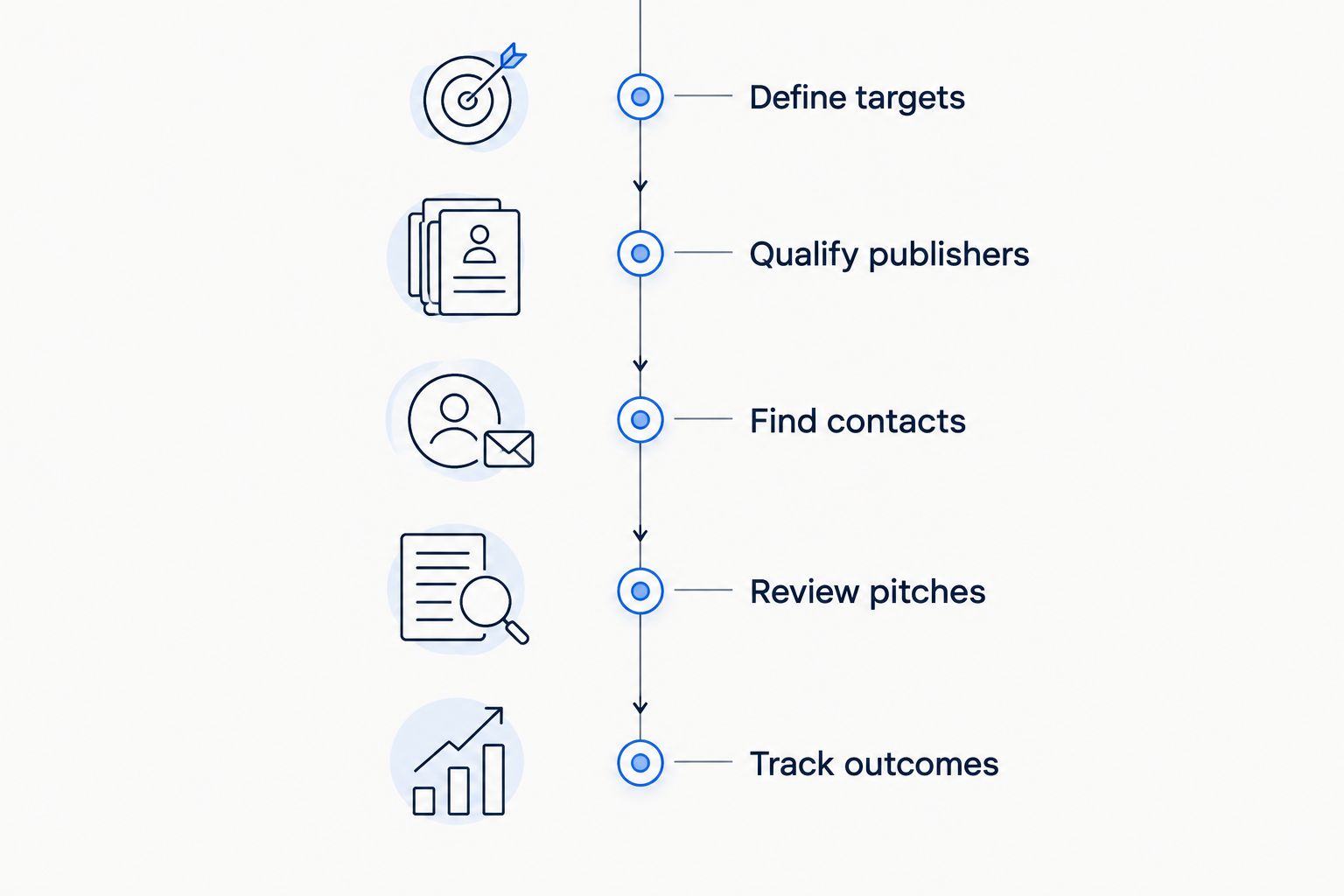
Use this sequence to turn the shortlist into a buying decision. Each stage should produce something your team can inspect.
- Define targets: Identify the commercial pages and editorial subjects the campaign should support.
- Qualify publishers: Review 10 publisher candidates for audience fit, relevant content and editorial context.
- Find contacts: Identify the person responsible for the relevant subject or publication section.
- Review pitches: Check the proposed contribution, destination page and reason for approaching that publication.
- Track outcomes: Record replies, published URLs, anchor text and link attributes separately.
The 10-publisher review is a suggested buying exercise, not a claim about campaign performance. It exposes whether the missing capability is research, contact discovery, coordination or delivery.
A SaaS brand should connect the publisher's subject matter to a buyer problem. An ecommerce brand should connect the publication's audience and article context to the relevant product category. Neither decision can be delegated to a domain metric alone.
How the recommendations are ranked
The ranking prioritises publisher research, contact discovery, relationship history, campaign control, reporting clarity and human review. BuzzStream takes the overall position for relationship-led outreach management; the other recommendations win distinct workflow roles.
This is a capability-based buying guide, not a claim of comparative campaign testing. No position promises backlinks, improved rankings or publication acceptance.
Which blogger outreach tools should you choose?
Choose BuzzStream as the default when you need a dedicated home for publisher relationships. Choose Pitchbox for structured campaign execution, Hunter for contact discovery, Ahrefs for backlink research and Google Sheets for a manually controlled register.
For 2026 procurement, distinguish a software requirement from a staffing requirement. If nobody owns prospect qualification, pitch writing, replies and reporting, adding an application leaves those responsibilities unfilled.
Linkible is a managed link-building option for SaaS and ecommerce brands that want an agency to handle outreach. Its services include white-hat outreach, niche edits, digital PR and HARO link building. Agency support does not remove the need to agree on target pages, publisher relevance and reporting expectations.
FAQ
What's the best blogger outreach tool overall?
BuzzStream is the default recommendation for relationship-led blogger outreach management. Choose a different tool when your main need is contact discovery, backlink research or structured campaign execution.
Is Pitchbox better than BuzzStream?
Pitchbox is the stronger shortlist choice when structured campaign workflows are your priority; BuzzStream is the default here for relationship management. Evaluate both against a real campaign brief and the people responsible for replies.
Can Hunter handle an entire link-building campaign?
Hunter does not replace the full link-building process. Email discovery and verification still need publisher qualification, a relevant pitch, editorial decisions and outcome reporting.
Is Ahrefs enough for blogger outreach?
Ahrefs is useful for backlink-led prospect research, but research alone is not a complete outreach workflow. You still need to identify contacts, manage conversations and review published placements.
Can I manage blogger outreach in Google Sheets?
Yes, Google Sheets can serve as a shared prospect and campaign register. Assign an owner and consistent status fields so manual updates do not leave colleagues working from incomplete records.
Should a SaaS brand choose outreach software or an agency?
Choose software when your team can own research, pitches, replies and reporting; consider an agency when you need delivery support. Linkible offers managed link-building services rather than an outreach software product.
What should blogger outreach reporting include?
Require publisher URLs, destination pages, anchor text, publication status and link attributes. Keep activity measures such as emails sent separate from completed editorial outcomes.
One last thing
Before choosing a tool, ask the campaign owner to explain why a particular publisher should cite your target page. If the answer is only a domain score, the buying decision is premature.
For managed outreach, take that same brief to Linkible through the existing website enquiry route. State your target pages, buyer markets and publisher requirements, then ask how manual outreach, editorial review and reporting would be handled.