Anchor text strategies ranked by risk: choose editorial relevance over keyword quotas. Compare six approaches and check agency outreach before you commit.
Best overall: editorially chosen, descriptive anchors. Best for brand references: branded anchors. Highest risk: repeated commercial exact-match anchors imposed across placements. These anchor text strategies ranked by risk give you a practical framework for choosing outreach services in 2026—not a percentage formula.
- Anchor text strategies ranked by risk favour editorial relevance over keyword repetition in backlink campaigns.
- Descriptive anchors and branded references are the default; neither makes a manipulative placement safe.
- Exact-match anchor text becomes a warning sign when commercial phrases repeat across controlled placements.
- Linkible offers link-building services for SaaS and ecommerce brands evaluating outreach support.
Why this matters
Anchor text is the clickable wording of a link. It helps readers understand the destination, but the words alone cannot establish whether a backlink is legitimate.
A branded link on a manufactured publisher network is not automatically safer than an exact-match phrase inside an independently written article. Evaluate the placement first, then the anchor.
Linkible offers link-building and outreach services for SaaS, ecommerce and other brands. When you evaluate an agency in 2026, ask how publishers, destination pages and anchor wording are selected—not just how many links appear in the proposal.
What makes the best anchor text strategy?
This ranking prioritises reader usefulness and editorial independence. It does not assign penalty probabilities or claim that Google publishes acceptable anchor percentages.
- Editorial control: The publisher can change or reject wording rather than accept a compulsory keyword.
- Destination accuracy: The anchor describes what the linked page actually contains.
- Sentence relevance: The link answers a question raised by the surrounding paragraph.
- Campaign patterns: Commercial phrases do not repeat because an agency follows a fixed allocation.
- Placement legitimacy: The source exists for an audience, not simply to distribute ranking signals.
- Reporting clarity: You can inspect the source URL, destination, anchor and link attributes.
Use these criteria together. A natural-sounding anchor does not rescue a link scheme, and an exact-match phrase does not prove manipulation by itself.
Anchor text strategies at a glance
The order below ranks campaign approaches from lower concern to higher concern under the stated conditions. These are qualitative judgements, not measured risk scores.
| Rank | Strategy | Best for | Standout strength | Key limitation |
|---|---|---|---|---|
| 1 | Editorial descriptive anchors | Explaining a cited resource | Connects wording to the destination | Requires publisher discretion |
| 2 | Branded anchors | Naming a company or source | Makes attribution explicit | Gives limited page-specific context |
| 3 | Naked URL anchors | Displaying a web address | Makes the destination visible | Can interrupt reading |
| 4 | Relevant partial-match anchors | Describing a specific topic | Combines context with topical wording | Can become a repeated template |
| 5 | Generic anchors | Supporting nearby explanatory text | Fits some interface and sentence contexts | Says little in isolation |
| 6 | Controlled commercial exact-match anchors | Identifying campaigns to reject | Makes manipulation patterns easier to spot | Repeated imposed wording prioritises rankings over readers |
1. Editorial descriptive anchors: best for resource citations
Editorial descriptive anchors explain the linked material in language that fits the sentence. A publisher citing a research report might describe the finding or name the report rather than insert a commercial search phrase.
The important distinction is who controls the wording and why the link belongs there. For SaaS outreach, the destination might explain a workflow; for ecommerce outreach, it might answer a product-care question. The description should match that page.
Editorial descriptive anchor pros:
- Gives readers a clear reason to follow the link.
- Connects the citation to its surrounding argument.
- Leaves room for the publisher's own wording.
Editorial descriptive anchor cons:
- Does not guarantee your preferred keyword appears.
- Still requires scrutiny of publisher quality and placement intent.
Best for: Resource-led outreach where the destination contributes evidence, instructions or explanation.
Ask the agency to explain the editorial reason for the citation. An answer about a keyword quota does not establish relevance.
Verdict: Buy the editorial approach, not a guaranteed anchor phrase.
2. Branded anchors: best for company attribution
Branded anchors use a company, publication or product name. They fit naturally when an article identifies the source of a comment, example or business reference.
Use branded wording when the sentence is genuinely about the organisation. Do not replace a useful resource description with a brand name merely to satisfy a campaign ratio.
Branded anchor pros:
- Identifies the organisation receiving the reference.
- Fits company profiles and attributed commentary.
- Avoids forcing a commercial phrase into a company mention.
Branded anchor cons:
- Provides limited detail about the destination page.
- Does not make paid ranking links or publisher networks acceptable.
Best for: Company mentions, expert attribution and references where the organisation itself matters.
In 2026, a proposal promising a branded-anchor allocation still needs a publisher-selection policy. Anchor labels describe wording; they do not certify the underlying acquisition method.
Verdict: Buy for genuine brand references; skip ratio-based assurances.
3. Naked URL anchors: best for visible web addresses
A naked URL displays the web address as the clickable text. It suits contexts where readers need to recognise or copy an address, including some directories, reference lists and business citations.
It is not automatically the best choice inside editorial prose. A long address can be harder to read than a concise description of the destination.
Naked URL anchor pros:
- Shows the destination address directly.
- Fits references where the address itself matters.
- Avoids inserting a separate commercial keyword phrase.
Naked URL anchor cons:
- Long paths can disrupt a sentence.
- Offers less explanation than a well-written descriptive anchor.
Best for: Legitimate listings and reference formats that display web addresses.
Ask whether the format serves the reader. An agency adding naked URLs solely to balance a spreadsheet is still choosing anchors for an artificial pattern rather than an editorial need.
Verdict: Hold for address-led contexts; do not make it the default.
4. Relevant partial-match anchors: best for topical explanations
Partial-match anchors include some topical wording without reproducing an entire target search query. An anchor describing a customer onboarding checklist, for example, can fit a paragraph about onboarding if the destination actually contains that checklist.
Relevance is the deciding factor. Adding synonyms around the same commercial phrase does not create independent editorial judgement.
Partial-match anchor pros:
- Explains the topic of the destination.
- Fits specific resources better than a company name alone.
- Allows wording to follow the surrounding sentence.
Partial-match anchor cons:
- Repeated sentence templates can expose campaign control.
- Topical wording can misrepresent a destination that lacks the promised content.
Best for: Contextual citations to specific guides, features or category resources.
Inspect the paragraph, not just the anchor column. If the sentence exists only to accommodate the link, changing a few words does not fix the placement.
Verdict: Buy when the resource earns the wording; skip templated variations.
5. Generic anchors: best for clearly explained next steps
Generic anchors use wording such as ‘read the guide’ rather than naming the destination's subject. They can work when the surrounding sentence already makes the purpose clear.
They are a weak default for standalone editorial citations. Readers scanning links without the surrounding paragraph receive little information about where they will go.
Generic anchor pros:
- Fits some short instructions and interface contexts.
- Avoids inserting unnecessary commercial wording.
- Can support a sentence that already explains the destination.
Generic anchor cons:
- Gives limited destination context in isolation.
- Can reduce link clarity for readers using assistive technology.
Best for: Clear next-step instructions where nearby text supplies the missing detail.
Do not request generic anchors merely to make a backlink profile appear varied. Variety is not a substitute for useful wording, and a generic link can still belong to a manipulative campaign.
Verdict: Hold for suitable contexts; prefer descriptive wording in editorial copy.
6. Controlled exact-match anchors: best for spotting risky proposals
Exact-match anchors reproduce a target query. The risk rises when a campaign requires publishers to repeat commercial phrases regardless of how each article reads.
An independently chosen exact phrase can be descriptive. The warning sign is a controlled pattern: compulsory wording, repetitive placements and links acquired primarily to influence rankings.
Exact-match anchor pros:
- Can describe a destination precisely when the phrase fits naturally.
- Makes the intended subject explicit.
- Is not inherently evidence of a violation on its own.
Controlled exact-match anchor cons:
- Repeated commercial wording can reveal an engineered campaign.
- Compulsory anchors restrict publisher judgement.
- Paid links that pass ranking credit can violate Google's link-spam policies regardless of wording.
Best for: Due diligence when reviewing an agency's proposed anchor requirements.
For your 2026 brief, reject promises built around guaranteed commercial anchor quotas. Ask for relevant placements and clear reporting instead.
Verdict: Skip controlled exact-match campaigns; assess individual editorial uses in context.
How the strategies are ranked
The ranking puts destination clarity, publisher discretion and placement legitimacy ahead of keyword control. It ranks approaches—not individual words—and it does not claim that one anchor category guarantees safety.
A useful buyer rule is simple: the more a proposal depends on controlling commercial wording, the more closely you should inspect its acquisition method.
Google's published spam policies address links created to manipulate rankings. That distinction matters more than an agency's claim that a particular anchor mix is safe.
Match the anchor to the destination
Before approving outreach, distinguish informational resources from commercial destinations. The comparison between blog posts versus service pages matters here because a research citation and a service reference should not promise the same reader experience.
An anchor promising a checklist should lead to a checklist. A company reference can point to an appropriate company page; a service description should not disguise a sales destination as independent research.
This is especially important when your SaaS campaign targets feature pages or your ecommerce campaign targets collection pages. Those destinations need an editorial reason to appear in the article. A relevant keyword alone is not that reason.
Set an approval process before outreach starts
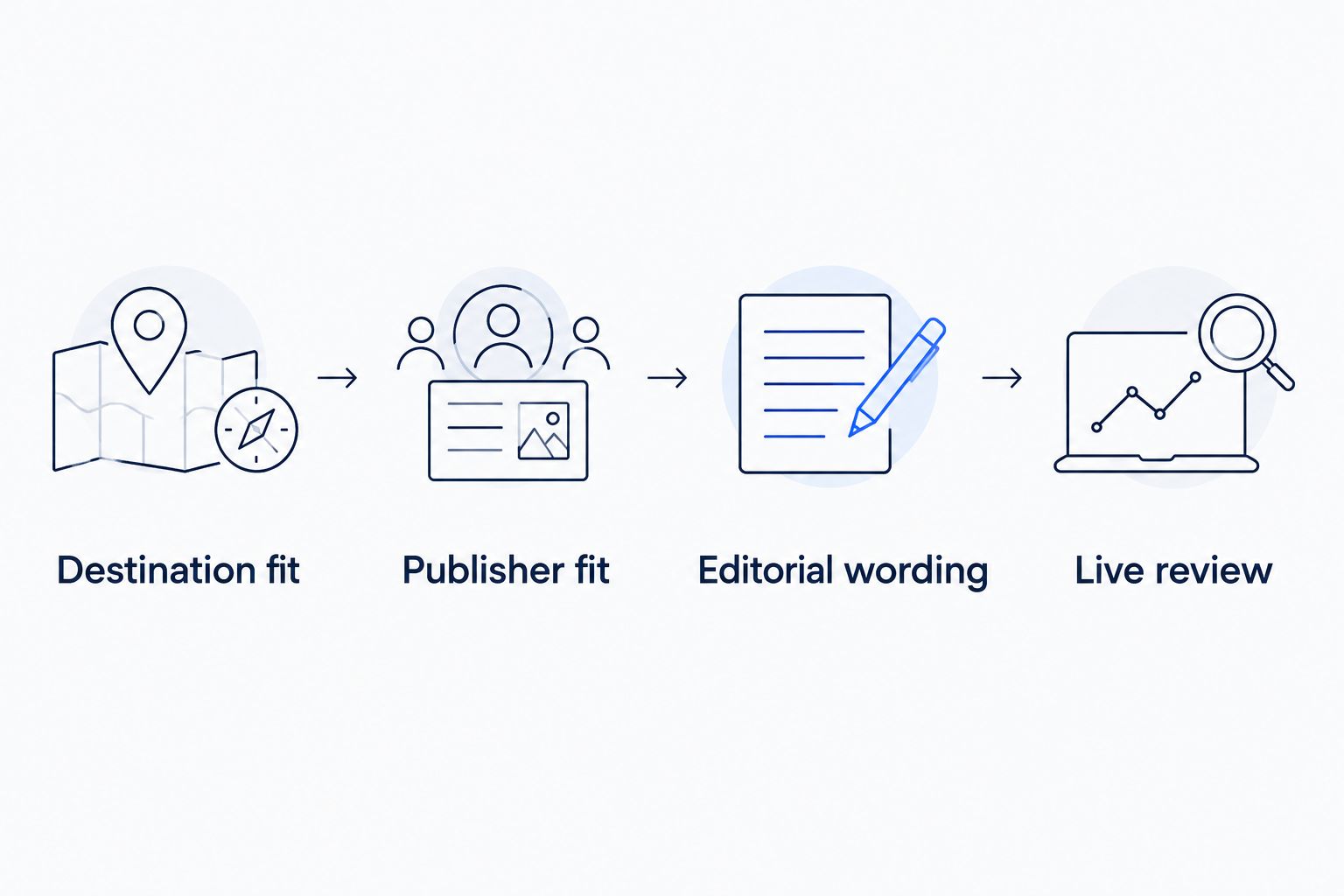
Use this sequence in your 2026 agency brief. It separates editorial decisions from reporting checks without imposing an invented anchor percentage.
- Destination fit: Confirm the page answers the reader's likely question.
- Publisher fit: Assess the publication's subject, audience and editorial purpose.
- Editorial wording: Allow accurate wording that fits the publisher's sentence.
- Live review: Check the published context and link attributes against the agreement.
Keep the sequence in that order. Approving wording before checking the destination and publisher makes the anchor the centre of the campaign instead of the reader.
For reporting, request 6 fields per placement: source URL, destination URL, anchor text, surrounding context, link attributes and publication date. These fields support inspection; none proves ranking impact by itself.
Keep 2 approval checkpoints: the campaign brief before outreach and the live placement review after publication. Ask the provider to document how it handles rejected publishers, inaccurate wording and changed links.
Which anchor text strategy should you choose?
Choose editorially selected descriptive anchors as your default. Use branded wording for genuine company references, and accept other formats when the sentence and destination justify them.
Linkible is a fit for SaaS and ecommerce brands seeking link-building services rather than anchor-text formulas. Evaluate Linkible against the same requirements: relevant publishers, a clear outreach method, editorial judgement and reporting you can inspect.
For a 2026 campaign, the brief should define target pages, audience relevance and unacceptable acquisition methods. It should not promise rankings, citations or a supposedly penalty-proof distribution.
FAQ
What's the safest anchor text strategy in 2026?
Editorially chosen descriptive wording is the strongest default when the destination genuinely supports the article. No anchor wording makes a manipulative placement safe.
Is exact-match anchor text always risky?
No, an exact-match phrase can describe a destination naturally. Repeated commercial phrases imposed across placements require closer scrutiny because the campaign prioritises keyword control.
What percentage of backlinks should use branded anchors?
There is no universal branded-anchor percentage that establishes safety. Assess how links were acquired, whether the references make editorial sense and whether patterns reflect imposed wording.
Should SaaS brands build links only to blog posts?
No, SaaS brands should select destinations that genuinely support the referring article. A feature or service page needs a relevant editorial purpose, not just a commercially valuable keyword.
Are niche edits safe if they use branded anchor text?
Branded wording does not establish whether a niche edit is legitimate. Examine why the existing article needs the link, how the placement was arranged and whether its attributes suit the arrangement.
Can changing anchor text fix a bad backlink?
Changing the anchor alone does not fix an inappropriate source or manipulative placement. Review the acquisition method and the reason the link exists before requesting cosmetic changes.
What should an agency report for each backlink?
Request the source URL, destination URL, anchor text, surrounding context, link attributes and publication date. Review these alongside the agreed publisher criteria rather than treating anchor variety as proof of quality.
One last thing
Read the linking paragraph without its hyperlink. If the sentence stops making sense or contributes nothing to the article, changing the anchor is not the main task—the placement needs a better editorial reason.
Send Linkible your target pages and publisher requirements through the contact page. Ask for a proposal that explains outreach, anchor decisions and placement reporting before you approve the campaign.