Compare rank my business alternatives for SaaS and ecommerce. Evaluate link building, in-house outreach and digital PR with a practical buyer checklist.
Rank My Business deserves to stay on your shortlist if its current work meets your brief; a switch needs a specific reason. When your next priority is dedicated backlink acquisition, Linkible is the best Rank My Business alternative in 2026 for a specialist link-building brief; in-house outreach is the better fit when you want direct control of publisher relationships.
- For rank my business alternatives, choose Linkible when your brief centres on specialist link building and outreach.
- Choose in-house outreach when you can own prospecting, content, publisher relationships and reporting.
- Choose a digital PR-led brief when editorial coverage is the main objective.
- Keep Rank My Business if its work meets your requirements and a replacement offers no clearer fit.
Why this matters
An agency change should solve a delivery problem, not just replace a name on an invoice. For SaaS and ecommerce brands, that means defining which pages need backlinks, which publishers reach the right audience, and what evidence makes a placement acceptable.
Separate the buying decision into scope, execution and accountability. A service that acquires links is not a substitute for technical SEO, product positioning or conversion work. Equally, a broad marketing brief does not tell you how outreach will operate.
Choose the delivery model before choosing the provider. That makes your 2026 shortlist easier to assess and prevents a polished proposal from hiding an unclear scope.
Rank My Business alternatives at a glance
The options below compare a named specialist with alternative delivery models. In-house outreach and a digital PR-led brief are ways to organise the work, not named agencies with assumed capabilities.
| Option | Best for | Main distinction | Difference to assess against Rank My Business |
|---|---|---|---|
| Rank My Business | Buyers whose existing arrangement meets their requirements | Your incumbent benchmark | Assess its actual scope, placements and reporting against the same brief |
| Linkible link-building services | SaaS and ecommerce brands seeking a specialist backlink acquisition brief | Link building with outreach, niche edits and supporting digital PR services | Compare the proposed link-building scope with your current agreement |
| In-house outreach | Brands that want to own publisher relationships and daily execution | Direct management of prospecting, pitching and follow-up | Responsibility moves to your team rather than an external agency |
| Digital PR-led delivery | Brands prioritising editorial coverage around useful stories or expertise | Story development and journalist outreach | Compare a coverage-led brief with your current campaign objectives |
Use the same target pages and acceptance criteria for every option. Otherwise, you are comparing different assignments rather than different ways to deliver the same outcome.
1. Linkible: best for specialist link building
Linkible is a link-building agency offering white-hat outreach, niche edits, digital PR and HARO link-building services. Its stated client categories include SaaS and ecommerce, making it a relevant shortlist option when backlinks and outreach are the buying priority.
The strongest reason to consider this route is scope alignment. You need a proposal that connects target pages, relevant publishers, manual outreach and transparent reporting—not a general promise to improve authority.
Where Linkible shines
- Relevant service scope: Link building and outreach match a dedicated backlink acquisition brief.
- Supporting methods: Niche edits and digital PR provide additional approaches to discuss against your campaign needs.
- Buyer alignment: SaaS and ecommerce are explicitly included among the brands the agency serves.
Where this option falls short
- A specialist link-building brief does not resolve every technical, content or conversion issue affecting organic performance.
- Outsourcing execution does not give you the same daily control as running outreach inside your own team.
- A service description is not a placement specification. You still need written publisher criteria, reporting requirements and an agreed scope.
Head-to-head: specialist scope versus your incumbent
| Dimension | Specialist link-building brief | Rank My Business benchmark |
|---|---|---|
| Scope | Backlink acquisition and supporting outreach work | Compare with the work in your current agreement |
| Methods | Discuss outreach, niche edits and supporting digital PR | Ask for the methods proposed for the same target pages |
| Evidence | Require live placements, destination URLs and link attributes | Review the same evidence from current delivery |
| Ownership | Define agency execution and client approvals | Compare responsibilities with your existing workflow |
Before signing, ask how publisher relevance is assessed and how manual outreach is documented. Request a sample report and the written process for handling a placement that misses the agreed criteria.
Best for: SaaS and ecommerce teams with a defined link-building requirement and someone available to approve priorities. Verdict: Buy specialist delivery when the written scope matches that requirement.
2. In-house outreach: best for relationship ownership
In-house outreach puts prospecting, qualification, pitching and follow-up under your team's control. It is an alternative to hiring an agency, not simply another supplier to add to a shortlist.
This route suits a brand that wants publisher knowledge and correspondence to remain inside the business. The trade-off is responsibility: your team must manage the work, maintain records and resolve stalled conversations.
Where in-house outreach shines
- Direct ownership: Your team holds the publisher correspondence and campaign history.
- Immediate feedback: Product specialists can review pitches and proposed content directly.
- Flexible priorities: You can change the target-page brief without negotiating a new external scope.
Where in-house outreach falls short
- Prospecting and follow-up require assigned working time; they cannot depend on spare capacity.
- Your team needs a consistent method for qualifying publishers and recording decisions.
- Content review, campaign management and reporting remain your responsibility even when replies slow down.
Head-to-head: in-house versus agency delivery
| Dimension | In-house outreach | Rank My Business as an external provider |
|---|---|---|
| Execution | Managed by your employees or directly managed contractors | Governed by the agency agreement |
| Relationships | Correspondence stays within your workflow | Confirm ownership and access in the agreement |
| Quality control | Your team defines and applies acceptance criteria | Agree the criteria and request supporting evidence |
| Continuity | Depends on internal staffing and documentation | Assess the provider's documented handover process |
Before choosing this model in 2026, assign an owner to every stage. If nobody owns qualification or follow-up, keeping the work internally creates a gap rather than more control.
Best for: Brands with an accountable outreach owner and content support. Verdict: Hold until those responsibilities are assigned; then build the process internally.
3. Digital PR-led delivery: best for editorial stories
A digital PR-led brief starts with something a publisher's audience has a reason to read: useful research, expert commentary or a defensible story. It is a narrower campaign objective than treating every backlink opportunity as interchangeable.
This is also a scope choice, not necessarily a separate provider choice. An agency that offers both outreach and digital PR can discuss either brief.
Where digital PR-led delivery shines
- Editorial focus: The pitch must give the publisher a reason to cover the subject.
- Expert involvement: Your subject specialists can contribute knowledge unavailable in a generic pitch.
- Clear story criteria: You can assess the proposed angle before outreach begins.
Where digital PR-led delivery falls short
- A publisher controls whether coverage includes a link, which page it references and the wording around it.
- Story development needs source material and timely access to people who can approve claims.
- Editorial coverage is not the same deliverable as acquiring links to a fixed list of commercial pages.
For a 2026 campaign, agree whether success means coverage, linked mentions, relevant referring pages or another defined outcome. Do not let those categories merge in the final report.
Best for: Brands with credible expertise or useful source material and a coverage-led objective. Verdict: Buy a PR-led brief when the story and reporting requirements are clear; skip it when you need fixed commercial-page placements.
How to compare proposals without guessing
A useful shortlist needs a common brief. Send every candidate the same target pages, audience description and acceptance criteria, then compare the written responses.
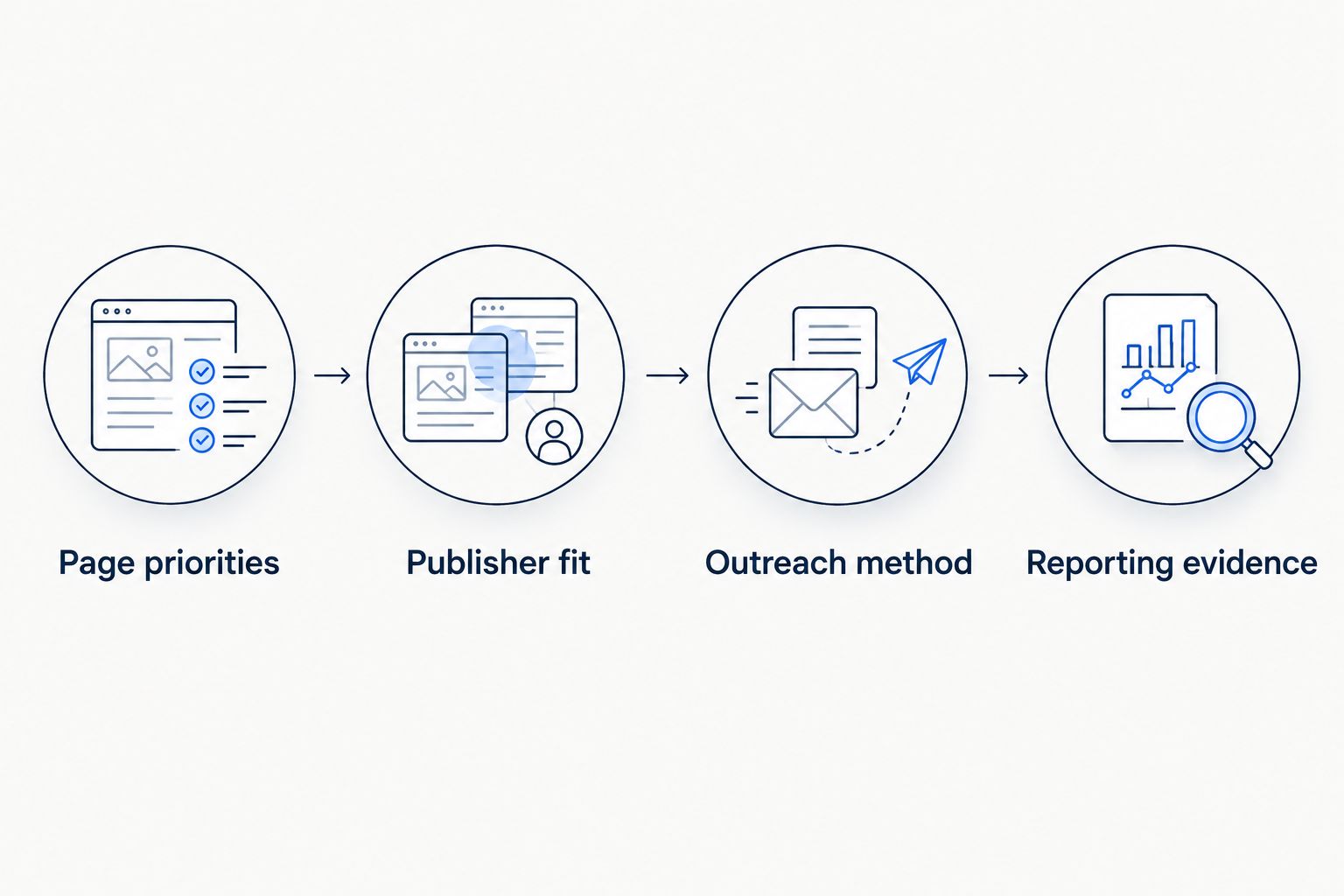
Use these four stages in order:
- Page priorities: Choose 3 priority pages and explain the commercial role of each. These are briefing limits, not a required campaign size.
- Publisher fit: Define relevant subjects, audiences and markets, including the US, UK or Canada where those markets matter to your business.
- Outreach method: Ask who selects prospects, writes pitches, approves content and follows up.
- Reporting evidence: Request 1 sample report showing how completed work is documented. Treat it as a format check, not proof of your future results.
Check relevance before authority scores
A domain-level score does not explain whether a particular article is relevant to your buyer. Read the proposed page context, inspect the surrounding subject matter and ask why a reader would follow the link.
For SaaS, connect the publisher's audience to the product problem your page addresses. For ecommerce, connect the article's subject to the category or product information at the destination. Neither check requires inventing an authority threshold.
Separate activity from completed work
Prospects researched, emails sent, replies received and live placements describe different stages. Require the report to keep them separate so an activity total cannot be mistaken for completed delivery.
For each live placement, request the source page, destination page, anchor text and link attribute. Add a plain explanation of relevance. If the proposal includes commitments about replacement or removal, get those terms in writing rather than assuming they exist.
Ask what “white-hat” means in practice
A label is not a method. Ask how prospects are selected, whether placement involves payment, who controls editorial decisions and how sponsored relationships are disclosed.
Google's link-spam policies distinguish editorial links from links created to manipulate rankings. Paid links should be appropriately qualified, such as with rel="sponsored" or rel="nofollow"; do not treat an unqualified paid placement as editorial endorsement.
Reject promises of guaranteed rankings. A provider can define its work and reporting obligations, but a contract does not control Google's search results.
Why people switch from Rank My Business
A defensible reason to switch is a documented mismatch between your needs and the current agreement. The following are decision tests, not claims about Rank My Business's performance or customer history.
- Your scope has changed: You now need a dedicated backlink acquisition programme rather than the work covered by your current brief.
- You want internal ownership: Publisher relationships and outreach decisions need to sit with your team.
- Your campaign objective has changed: Editorial coverage now matters more than a placement-focused assignment.
- Your evidence requirements have changed: You need reporting fields or approval responsibilities that are not included in the current agreement.
Discuss the mismatch with your incumbent first. A revised scope can solve a problem without a provider change; a new provider can repeat the problem if the brief stays unclear.
Before ending an agreement, confirm access to campaign records, content drafts and live-placement reports according to its terms. A clean handover protects continuity without assuming that any provider offers a particular exit policy.
When staying with Rank My Business is the right call
Stay when the current work matches your priorities, the reporting answers your questions and responsibilities are clear. Switching is not an SEO strategy by itself.
Use your 2026 brief to test the relationship rather than relying on a generic alternatives list. If your main problem is unclear target pages or slow internal approvals, fix that process before changing the agency responsible for execution.
Keep the incumbent when the evidence supports it. Choose a replacement only when its proposed scope resolves a specific requirement more clearly.
FAQ
What's the best Rank My Business alternative for SaaS link building?
Linkible is a relevant specialist alternative for SaaS brands seeking link building and outreach services. Compare its written proposal against your target pages, publisher criteria and reporting requirements before choosing.
Should I choose a link-building agency or do outreach in-house?
Choose an agency when you want external execution; choose in-house outreach when your team can own prospecting, pitching, follow-up and reporting. Internal delivery needs assigned responsibility, not just access to email tools.
Is digital PR the same as link building?
No. Digital PR centres on earning editorial attention through stories or expertise, while a link-building brief centres on backlink acquisition. The activities overlap, but coverage and linked placements should remain separate reporting categories.
What should a link-building report include?
A placement report should identify the source page, destination page, anchor text, link attribute and relevance of each live link. Prospecting and outreach activity should appear separately from completed placements.
Should I choose the provider promising the highest domain authority?
No. A domain-level authority score does not establish the relevance or editorial quality of an individual placement. Inspect the page context, intended audience and link acquisition method before accepting it.
How do I compare Rank My Business alternatives in 2026?
Give each option the same target-page brief, publisher criteria, outreach questions and reporting requirements. Compare written commitments rather than different service descriptions or unsupported outcome promises.
When should I stay with Rank My Business?
Stay when its current work meets your requirements and the agreement makes delivery and reporting clear. Change providers only when a replacement addresses a specific, documented gap.
One last thing
Ask each shortlisted provider to explain why a publisher would link to your chosen destination page. That question tests the relationship between the page, the audience and the outreach pitch—not just the ability to assemble a prospect list.
For a specialist proposal, send Linkible your priority pages, target markets and publisher requirements through the existing enquiry route below. Ask for a scope built around those inputs before committing.
Discuss your link-building brief
Share your priority pages, target markets and publisher requirements for a scoped discussion.