The best types of backlinks for ecommerce SEO are relevant editorial links. Compare seven options, spot risky placements and brief your outreach agency.
Best overall: relevant editorial backlinks. Best for newsworthy research: digital PR links. Best for existing commercial relationships: supplier and partner links. The best types of backlinks for ecommerce SEO in 2026 connect useful store content with publishers whose readers match your buyers—not simply domains with high authority scores.
- The best types of backlinks for ecommerce SEO are relevant editorial links earned through useful content and outreach.
- Digital PR suits original research; supplier links suit genuine commercial relationships.
- Linkible offers ecommerce link building; evaluate publisher relevance, placement methods and reporting before choosing an agency.
- Reject paid ranking links, forced anchor text and unrelated publishers, regardless of authority scores.
Why this matters
A backlink is a reference from another website, but the label alone tells you little. A useful buying guide and an unrelated article selling placements both contain links; they do not deserve the same treatment.
For your 2026 campaign, separate the acquisition method from the placement quality. Linkible's link building services include outreach and supporting approaches such as digital PR and niche edits. Assess each proposed placement against your audience, destination page and editorial context.
The right question is not which backlink type produces the most links. It is which type gives a relevant publisher a genuine reason to reference your store.
What makes the best ecommerce backlinks
Use these criteria before comparing tactics:
- Audience relevance: The publisher covers your category or a closely connected buyer problem. Its readers have a reason to visit your destination page.
- Editorial purpose: The link supports a statement, recommendation or resource. It is not inserted solely to carry an anchor text phrase.
- Destination fit: The linked page answers the reader's next question. Choose between a product, category, guide or research page deliberately.
- Acquisition method: Outreach explains the value of the reference. Paid or sponsored relationships require appropriate link qualification.
- Publisher quality: Review actual articles, authorship, topical consistency and outbound links—not just a domain rating.
- Reporting clarity: Your agency identifies the live source URL, destination, anchor text, link attributes and placement context.
There is no universal domain-rating threshold that makes a placement appropriate. In 2026, use authority metrics to support publisher checks, not replace them.
Best ecommerce backlink types at a glance
| Rank | Backlink type | Best for | Standout feature | Key limitation |
|---|---|---|---|---|
| 1 | Relevant editorial links | Useful buying guides and category expertise | A contextual reference chosen by an editor | Requires something worth referencing |
| 2 | Digital PR links | Original research and newsworthy stories | Connects reporting with source material | Coverage and links remain editorial decisions |
| 3 | Supplier and partner links | Existing commercial relationships | Reflects a genuine business connection | Depends on partner policies and page quality |
| 4 | Resource-page links | Evergreen educational resources | Places a guide among related references | Generic resource directories add little context |
| 5 | Contextual niche edits | Improving an existing article | Adds a useful reference to published content | Paid ranking placements create link-spam risk |
| 6 | Guest-contributed editorial links | Specialist expertise and education | Lets your expert explain a topic in depth | Scaled, anchor-led posting creates risk |
| 7 | Independent review links | Products that benefit from evaluation | Connects product evidence with buyer questions | Commercial relationships need disclosure and qualification |
1. Relevant editorial links: best for useful buying guides
Relevant editorial backlinks appear when a publisher references your guide, explanation or other useful page within an article. The surrounding text explains why the reference belongs there. For ecommerce, the destination should help readers make a decision—not interrupt the article with an unrelated product pitch.
Editorial link pros:
- Aligns the referring article with a real buyer question.
- Supports educational content beyond individual products.
- Allows the publisher to choose natural anchor text.
Editorial link cons:
- Requires distinctive information or a genuinely useful explanation.
- Editors control whether to include and retain the reference.
Best for: Stores with strong category knowledge and guides that answer specific purchase questions.
Verdict: Buy editorial outreach support when your content gives publishers a clear reason to reference it. This is the default starting point, not a promise of rankings.
2. Digital PR links: best for original research
Digital PR turns a credible finding, expert contribution or newsworthy story into a reason for journalists to cover your brand. Links typically support the source material behind the story. A promotional announcement without wider reader value is a weaker pitch.
Digital PR pros:
- Gives journalists material they can reference directly.
- Connects category expertise with a wider discussion.
- Supports research pages that remain useful after publication.
Digital PR cons:
- Requires a defensible story and accessible evidence.
- Coverage does not guarantee a backlink or preferred destination.
Best for: Ecommerce brands with original research, documented expertise or a story relevant to a publication's audience.
Verdict: Wait until the evidence and story are ready. In 2026, commissioning outreach before validating the underlying claim puts activity ahead of editorial value.
3. Supplier and partner links: best for existing relationships
Supplier and partner backlinks connect genuine business relationships. Examples include an authorised stockist listing or a partner page that accurately explains the relationship. Request corrections to missing or outdated references rather than forcing promotional copy into the listing.
Supplier and partner link pros:
- Has a clear factual reason to exist.
- Can direct readers to a relevant category or store page.
- Starts with an established relationship rather than a cold introduction.
Supplier and partner link cons:
- Partners control listing eligibility and linking policies.
- A buried or poorly maintained page offers limited reader value.
Best for: Retailers with supplier, manufacturer or other legitimate commercial relationships.
Verdict: Buy outreach support only if relationship checks need coordination. Otherwise, handle accurate listing requests directly; an agency is not necessary for every link opportunity.
4. Resource-page links: best for evergreen educational content
Resource-page backlinks place useful content within a curated collection of references. Your page must satisfy the collection's purpose, such as explaining product care or helping readers understand a technical choice. A category page rarely substitutes for a detailed educational resource.
Resource-page link pros:
- Matches a specific information need.
- Gives evergreen guides another discovery route.
- Makes relevance straightforward to assess before outreach.
Resource-page link cons:
- Suitable collections can be difficult to find.
- Unmaintained lists and general-purpose directories need scrutiny.
Best for: Stores publishing detailed guides, practical reference material or tools that serve a defined audience.
Verdict: Buy targeted prospecting when the resource already exists. Skip mass directory submissions presented as resource outreach; the shared label does not make them equivalent.
5. Contextual niche edits: best for updating existing articles
A niche edit adds a link to an article that is already published. The defensible version fills a genuine gap: a missing explanation, a better reference or a useful update. Publication age alone does not make an insertion valuable.
Niche edit pros:
- Lets you assess the full article before requesting a reference.
- Can improve an incomplete explanation for existing readers.
- Provides clear context for evaluating destination fit.
Niche edit cons:
- Paid insertions intended to pass ranking credit create link-spam risk.
- An apparently relevant paragraph can sit on an unrelated placement-selling site.
Best for: Stores with a page that materially improves a specific existing article.
Verdict: Hold until the agency explains why the edit benefits readers and how the placement is obtained. Reject insertion offers justified only by authority scores and exact-match anchors.
6. Guest-contributed links: best for specialist expertise
Guest contributions let a retailer's subject specialist explain a topic for another publication. Any link should support the article, not serve as the article's reason for existing. Publisher editing and meaningful subject expertise matter more than a guest-post label.
Guest-contributed link pros:
- Gives specialist knowledge room for a detailed explanation.
- Reaches readers with a defined category interest.
- Allows useful supporting references within an educational article.
Guest-contributed link cons:
- Requires writing, expert input and editorial coordination.
- Large-scale, keyword-rich guest-post campaigns can violate Google's link-spam policies.
Best for: Stores with qualified contributors who can teach something relevant to another publisher's readers.
Verdict: Buy editorial contribution support when expertise leads the pitch. Skip services whose deliverable is a generic article wrapped around your preferred anchor text.
7. Independent review links: best for product evaluation
Independent reviews examine a product against practical buyer questions. The publisher controls the assessment and whether a link helps readers. Products supplied for review, affiliate arrangements and sponsorship introduce commercial relationships that require appropriate handling.
Independent review link pros:
- Connects a product with detailed purchase considerations.
- Gives readers context beyond a store's own description.
- Creates opportunities for relevant product-page references.
Independent review link cons:
- The assessment can include criticism or no recommendation.
- Commercial links require suitable disclosure and link qualification.
Best for: Products with meaningful features that a relevant reviewer can evaluate independently.
Verdict: Hold until the review terms protect editorial independence. Never treat a positive review or an unqualified ranking link as a required deliverable.
How these backlink types are ranked
This 2026 ranking prioritises audience relevance, editorial purpose, destination fit, acquisition method and reporting clarity. It is a decision framework, not a measured performance league table.
Editorial links lead because they start with a useful reference. Other methods become stronger choices when your assets fit: original research supports digital PR, while genuine supplier relationships support stockist references. No backlink label overrides a poor publisher or a manipulative acquisition method.
Turn the shortlist into an agency brief
Linkible is an ecommerce link building option for brands evaluating outreach, niche edits and digital PR. Assess the proposed work against the same requirements you would apply to any agency.
Use this sequence before approving a campaign:
- Destination fit: Identify which page deserves attention and what reader need it serves. Do not send every proposed link to the homepage.
- Publisher relevance: Define acceptable topics and audiences. For US, UK or Canadian campaigns, specify market relevance where it affects the buying context.
- Outreach method: Ask how prospects are selected, what the pitch offers and whether compensation or product supply is involved.
- Placement review: Request 3 sample placements for discussion. These are review examples, not proof that future placements will perform identically.
- Transparent reporting: Require 1 reporting row per placement, including source, destination, anchor text, attributes and live status.
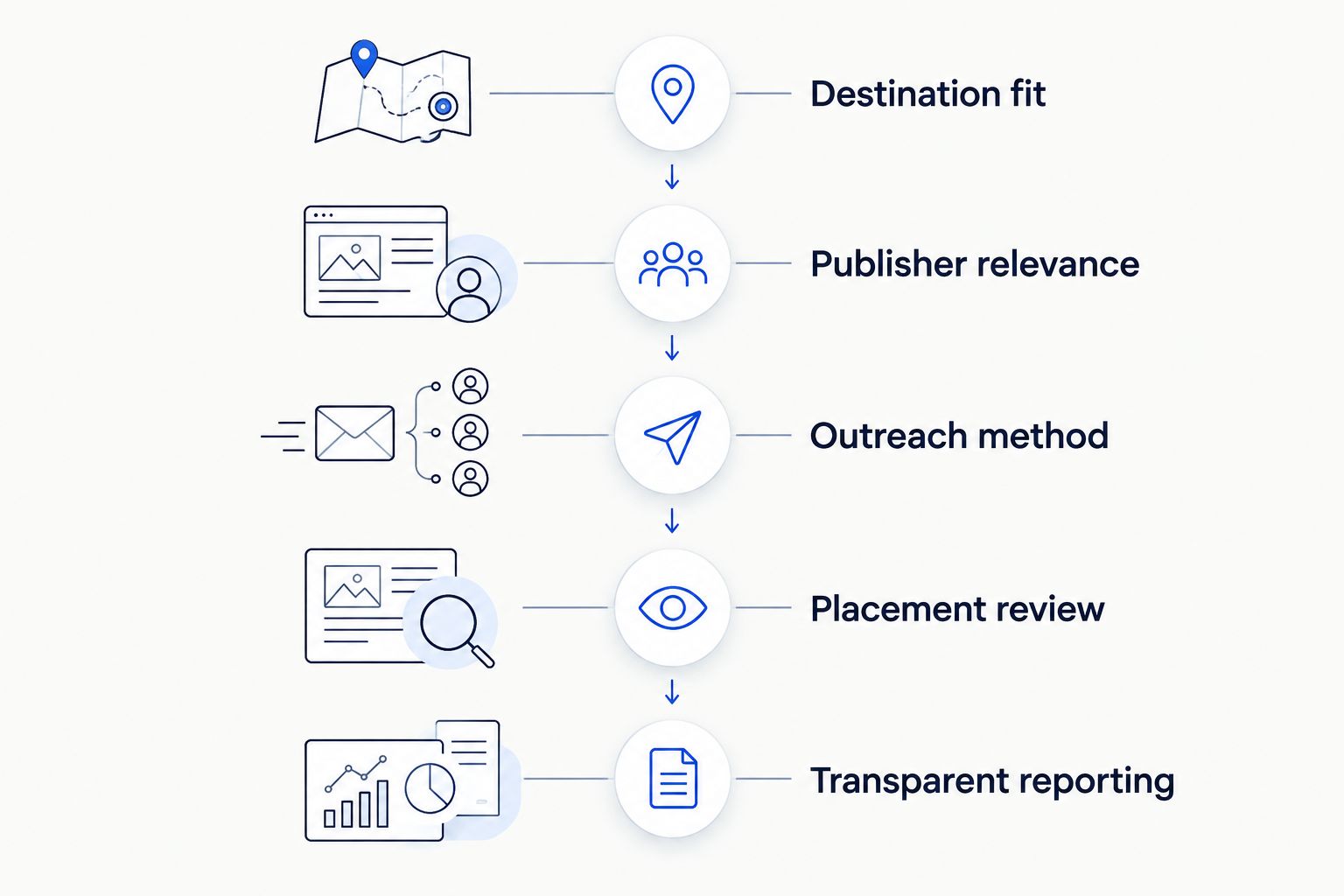
Keep manual outreach and editorial review explicit in the brief. Ask Linkible how those requirements will appear in the proposed scope and reporting rather than assuming that a service label answers them.
Set a 90-day review window as a planning checkpoint, not a ranking deadline. Review placement quality, relevant referral visits and changes to the destination pages' search performance separately; those observations do not establish that a particular backlink caused a ranking change.
Which ecommerce backlinks should you choose?
Choose relevant editorial outreach first if you already have useful content. Add supplier references where genuine relationships exist, and use digital PR when you have evidence worth reporting. Do not order every backlink type simply to make the campaign look varied.
For your 2026 brief, state the target audience, destination pages, editorial standards and reporting requirements. Choose the agency that explains its publisher selection and outreach methods clearly—not the proposal with the largest placement count.
FAQ
What are the best types of backlinks for ecommerce SEO?
Relevant editorial backlinks are the strongest default choice for ecommerce outreach because they connect useful content with an appropriate readership. Digital PR, supplier references and resource links suit different assets and relationships; assess each placement individually.
Should backlinks point to product pages or category pages?
Backlinks should point to the page that best answers the referring reader's question. Product reviews can justify product links, while educational articles often need a guide or research page rather than a commercial destination.
Are niche edits safe for an ecommerce store?
Niche edits are not automatically safe or unsafe; the acquisition method and editorial purpose determine the risk. A useful editorial update differs from a paid insertion designed to pass ranking credit, which falls under Google's link-spam policies.
Is a high domain rating enough to choose a backlink?
No, a high domain rating is not enough to approve a placement. Check topical relevance, the actual article, editorial purpose, outbound linking and the destination before using authority metrics as supporting evidence.
Are nofollow or sponsored backlinks useless?
No, qualified links can still help readers discover your store. Google treats link attributes as hints, and sponsored links should not be purchased as a promise of ranking credit.
Can an agency guarantee rankings from ecommerce backlinks?
No agency controls Google's rankings or a publisher's independent editorial decisions. Evaluate an ecommerce link building proposal through its methods, placement standards and reporting rather than a promised search position.
What should an ecommerce backlink report include?
An ecommerce backlink report should identify the source URL, destination URL, anchor text, link attributes and live status. Add placement context and agreed publisher criteria so you can assess relevance rather than count links alone.
One last thing
The easiest problem to miss is the destination page. A relevant publisher still needs a useful reason to send readers there; weak product information or an incomplete guide makes outreach harder to justify.
Before approving another placement, review the page you want referenced. Then contact Linkible with your target pages, buyer markets and preferred backlink types, and ask for a proposal that explains publisher relevance, manual outreach and reporting.