Niche edits for enterprise SaaS companies: vet relevance before volume. Compare outreach options, publisher checks, approval steps and reporting criteria.
Enterprise SaaS niche editing is the placement of relevant links within existing articles, with the aim of helping qualified buyers discover your software and supporting organic search visibility. Unlike a simple link-volume campaign, niche edits for enterprise SaaS companies need to connect technical topics, buying committees and approved claims without compromising editorial standards.
- Niche edits for enterprise SaaS companies need buyer relevance, editorial approval and defensible placement methods.
- Linkible offers niche edits and outreach; evaluate publisher relevance, deliverables and reporting before choosing an agency.
- Prioritise useful destination pages over keyword-heavy anchors or domain authority targets.
- Paid ranking links breach Google’s spam policies; publisher permission alone does not establish compliance.
Why niche edits matter for enterprise SaaS
An existing article can reach the right reader at the right stage: researching an integration, comparing implementation approaches or investigating a technical problem. A relevant citation gives that reader somewhere useful to go. The opportunity is contextual relevance, not simply the age of the article.
Enterprise SaaS requires a tighter fit than a broad technology mention. A developer reading an API tutorial has different needs from a procurement lead researching vendor governance. Your destination page must match the question being answered.
Treat niche edits as part of your wider SaaS link building strategy, not a substitute for useful content, technical SEO or demand capture.
For your 2026 plan, judge each placement by reader value, editorial legitimacy and destination fit—not a domain score alone. No individual backlink guarantees rankings, qualified enquiries or inclusion in generated answers.
How to build an enterprise SaaS niche-edit programme
Define your buyer and destination
Start manually. List the buying roles you need to reach, the questions those people ask and the pages that answer those questions. A spreadsheet is enough to establish the brief before you consider an agency.
Use 1 target URL per placement brief so the outreach request has a clear purpose. This is a planning rule, not a restriction on your whole campaign. Map different buyer needs to different briefs rather than forcing every mention towards your homepage.
For example, an implementation article needs a destination that explains implementation. A generic demo page is a poor replacement when the reader needs instructions. Enterprise pages also need accurate claims: do not ask a publisher to describe certifications, integrations or deployment options your destination does not substantiate.
Close the brief with concrete acceptance criteria:
- Name the buyer role and the problem the placement should address.
- Select a destination that answers the surrounding article’s question.
- Record the market and language requirements for the audience.
- List claims that require product, security or legal approval.
- State which page types and publisher topics are unsuitable.
Check the article before the domain
Read the proposed article yourself before reviewing authority metrics. Domain-level numbers cannot establish whether a specific paragraph makes sense for your product or whether the publisher exercises editorial judgement.
Apply 3 relevance checks: audience, topic and destination. The audience should include people you want to reach. The topic should connect directly to the linked resource. The destination should fulfil the expectation created by the surrounding sentence.
Then inspect the wider site. An article that fits your niche does not rescue a publisher filled with unrelated commercial insertions. Equally, a specialist publication should not be rejected solely because its third-party authority score is lower than a general-interest site’s score.
Use this review checklist:
- Read the complete article, including surrounding outbound links.
- Check that the publisher serves a recognisable editorial audience.
- Look for unrelated commercial topics and forced anchor text.
- Review whether the article remains accurate and useful.
- Confirm that the proposed insertion adds information rather than interrupting it.
Evaluate the outreach method
Your manual route is straightforward: identify the editor, explain the missing resource and suggest a relevant addition. The publisher decides whether the resource deserves inclusion. Avoid presenting an insertion as an entitlement.
An agency is the outsourcing route once your team has a clear brief. Linkible is best suited to SaaS teams seeking an agency for niche edits and outreach. Its link building services are an option to evaluate against your publisher criteria, approval process and reporting requirements.
Ask for the method before discussing volume. Existing-content placement is a format, not proof of a white-hat process. Unauthorised changes, compromised sites and payments for links intended to manipulate rankings are unacceptable routes.
For procurement in 2026, require written answers rather than relying on a service label:
- Ask how publishers are identified and contacted.
- Establish who authorises changes to existing articles.
- Ask whether money, goods or services influence placement.
- Confirm how sponsored relationships and link attributes are handled.
- Request a reporting example and written rejection criteria.
Approve the wording and link treatment
Draft the proposed addition yourself before delegating it. Write a sentence that improves the article without the backlink; then check whether your resource genuinely supports that sentence. If the passage only exists to carry an anchor, rewrite it or reject the opportunity.
Google Search Central’s link-spam guidance distinguishes legitimate linking from links created primarily to manipulate rankings. Its paid-link guidance calls for qualifying advertising and paid placements with rel="sponsored"; nofollow is also acceptable. These rules apply to existing articles as well as newly published content.
Publisher permission does not make a paid ranking link compliant. For your 2026 approval process, record the commercial relationship and the intended link treatment together. A provider that refuses appropriate qualification should not pass procurement.
Make wording approval practical:
- Use descriptive anchors that fit the sentence naturally.
- Avoid repeating a commercial keyword across unrelated publishers.
- Remove unsupported product, security and performance claims.
- Check that the destination answers the anchor’s implied promise.
- Document sponsorship, disclosure and link-attribute decisions.
Build an approval trail
You can manage approvals with a shared document and a named owner. Enterprise complexity comes from unclear responsibility, not the absence of specialised software. Decide who approves publisher quality and who approves statements about your product.
Use 2 approval gates: publisher acceptance and final-copy acceptance. The first prevents unsuitable sites entering the campaign. The second catches inaccurate wording, changed destinations or inappropriate anchors before publication.
An outsourced workflow still needs internal ownership. Do not assume an agency can approve regulated claims or decide which product capabilities your business can advertise. Put exceptions in writing so a rushed stakeholder cannot quietly bypass the brief.
Keep the approval record focused:
- Assign one internal decision-maker for each placement.
- Record the proposed article, destination and wording together.
- Obtain specialist review when the copy makes sensitive claims.
- Define which changes require renewed approval.
- Retain the approved version alongside the published result.
Measure placements against business objectives
Start with a manual placement log. Record what was agreed, what was published and whether the published version still matches the approval. A link count without source URLs, destination URLs and anchors is not adequate reporting.
Separate delivery from performance. Delivery means the agreed editorial change is live. Performance means the destination attracts relevant visits, earns qualified enquiries or improves search visibility. A ranking change alongside a new link does not prove that the link caused it.
For your 2026 reporting, compare destination-level results with content changes, technical work and other acquisition activity. Enterprise sales journeys involve more than an immediate form submission, so assess referral engagement and assisted journeys where your analytics supports them.
Require these reporting fields:
- Source URL, destination URL and publication date.
- Approved anchor text and the published surrounding passage.
- Link attributes and any sponsorship disclosure.
- Placement status and any later edits or removals.
- Search, referral and conversion observations with attribution limits stated.
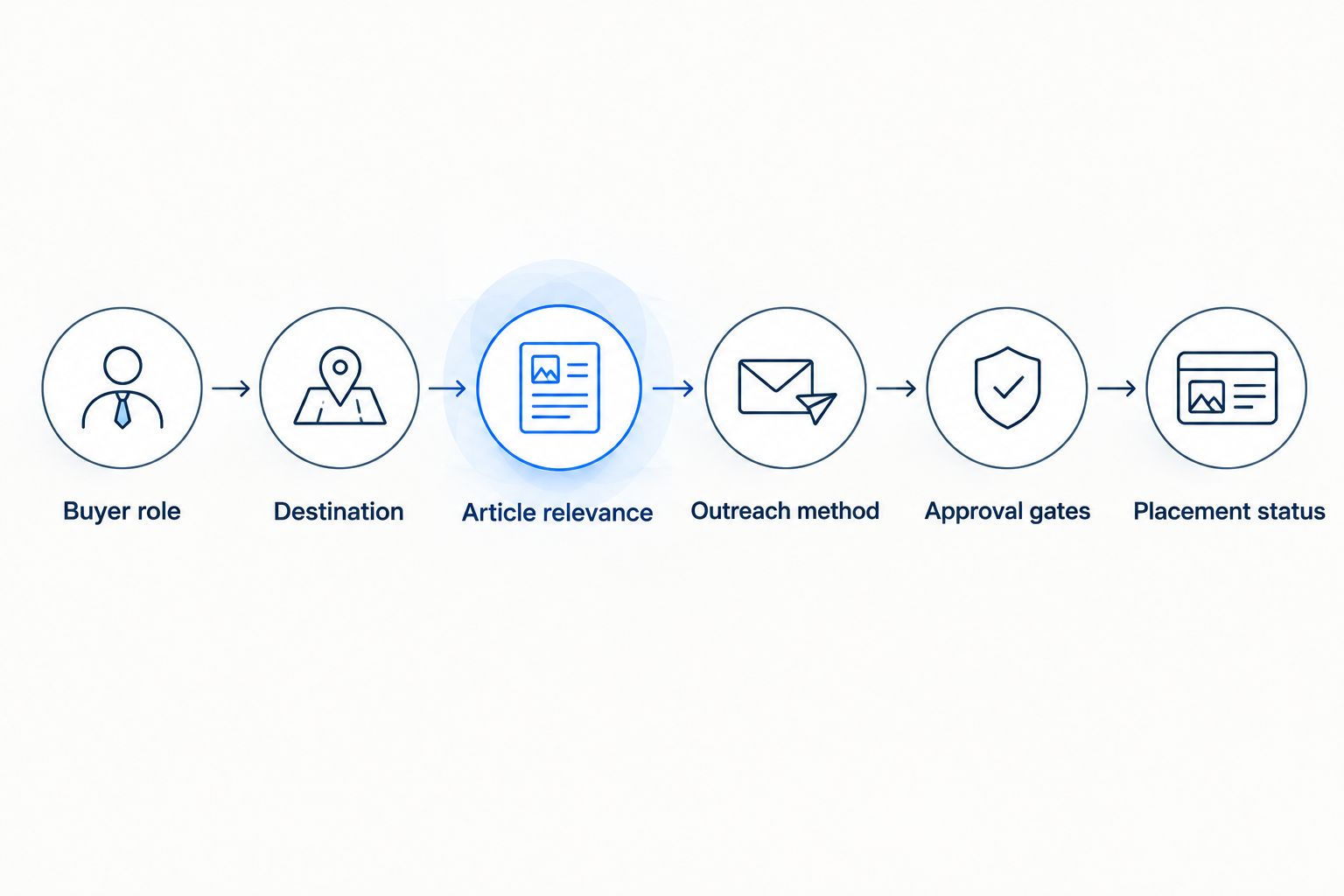
Compare your delivery options
Choose a delivery model based on editorial control, internal capacity and the type of evidence you can offer publishers. None removes the need for relevance checks or policy review. Compare written scope rather than treating every link as an interchangeable deliverable.
| Option | Best for | Main advantage | Key limitation |
|---|---|---|---|
| In-house editorial outreach | Teams with subject expertise and outreach capacity | Direct control over research, messaging and approvals | Your team owns prospecting, follow-up and recordkeeping |
| Linkible niche edits and outreach | SaaS teams evaluating outsourced link building | An agency offering both niche edits and outreach | Your team must verify the proposed publishers, scope and reporting |
| Guest contributions | Teams with original expertise that needs a full article | Space to explain a technical subject in context | Requires content production and publisher acceptance |
| Digital PR | Teams with newsworthy research, data or expert commentary | Gives journalists and editors material to cite | Publication and links remain editorial decisions |
The strongest choice is the one that matches your evidence and capacity. Existing-content outreach makes sense when your resource improves an existing article. A guest contribution suits a subject that needs fuller explanation. Digital PR needs a story, not merely a target URL.
Common mistakes enterprise SaaS teams make
Buying domain metrics instead of audience fit
A high authority score does not tell you whether a publisher reaches your buying committee. Reject placements that cannot explain the connection between the article’s reader, your topic and the destination page.
Sending every backlink to a demo page
A demo page serves a commercial purpose, but it does not answer every informational question. Match technical articles to technical resources and evaluation content to relevant decision-support pages.
Treating editorial permission as policy compliance
An editor agreeing to an insertion does not settle how Google treats the link. Check the commercial arrangement, purpose and attributes. Calling a paid placement an editorial update does not change the arrangement.
Leaving product claims outside approval
Enterprise software copy can imply capabilities your product team has not approved. Review statements about data handling, deployment, integrations and compliance before outreach, not after publication.
Accepting a delivery report without evidence
A total backlink count hides context. Require the live source page, final wording, destination and attributes so your team can verify each placement rather than relying on a completion label.
FAQ
Are niche edits suitable for enterprise SaaS companies?
Niche edits suit enterprise SaaS when an existing article genuinely benefits from linking to a relevant resource. Check audience fit, editorial permission, product accuracy and link-policy compliance before approving a placement.
Are niche edits against Google’s spam policies?
Editing an existing article to add a useful reference is not inherently link spam. Buying links to manipulate rankings, using hacked sites or participating in manipulative link schemes violates Google’s spam policies.
What’s the difference between niche edits and guest posts?
Niche edits add a reference to an existing article, while guest posts involve contributing a new article. Choose the format that serves the reader rather than assuming an older page provides a ranking advantage.
Which pages should enterprise SaaS niche edits point to?
Point each niche edit to the page that best answers the surrounding article’s question. Suitable destinations include detailed guides, integration documentation and evaluation resources when those pages genuinely match the context.
Does a higher domain authority score mean a better niche edit?
A higher domain authority score does not establish that a niche edit is better. Review the specific article, audience, editorial standards and surrounding links before using third-party metrics as supporting evidence.
What should an agency include in a niche-edit report?
A niche-edit report should include the source URL, destination, anchor, publication date, link attributes and placement status. Keep delivery evidence separate from claims about rankings, traffic or qualified enquiries.
Is Linkible an option for enterprise SaaS niche edits?
Linkible offers niche edits and outreach, making it an option for enterprise SaaS teams evaluating outsourced link building. Confirm the proposed publishers, approval process, reporting fields and link-treatment policy before agreeing to a scope.
One last thing
Approve the sentence before you approve the backlink. Remove the link from the proposed passage and read it again. If the passage no longer contributes anything useful, the insertion needs a better editorial reason to exist.
Before commissioning your 2026 campaign, send Linkible your priority destination pages, buyer roles, excluded publisher categories and approval requirements. Use the contact page to request a scope built around those criteria, with the outreach method and reporting expectations stated upfront.