Linkible vs Supple: choose specialist link building or assess a wider SEO brief. Compare outreach, publisher quality, reporting and proposal terms.
Choose Linkible if you need a specialist link building agency for SaaS or ecommerce outreach; choose Supple if its written proposal better covers the wider SEO work you need alongside backlinks. For this 2026 comparison, make the decision on scope, publisher relevance and accountable deliverables—not an agency name or a promised ranking.
- Linkible vs Supple is a scope decision: specialist link building versus the services documented in your competing proposal.
- Linkible offers white-hat outreach, niche edits, digital PR and HARO link building.
- Choose Supple when its written scope better matches your requirements beyond backlinks.
- Require publisher examples, outreach methods and reporting commitments before signing either proposal.
Why this matters
A backlink campaign and a wider SEO engagement solve different problems. If your pages need technical repairs, better content or clearer targeting, buying links alone leaves those tasks unresolved. If you already have those responsibilities covered, assess the backlink work as a separate scope.
Start with the link building services under consideration, then compare proposals against the same brief. A SaaS marketing lead with an established SEO team needs a different engagement from an ecommerce founder seeking help across the search programme.
Linkible is a link building agency for SaaS and ecommerce teams buying specialist outreach. That establishes its service focus; it does not establish a performance advantage over another agency.
At a glance
The table separates stated services from commitments you should secure in a proposal. Treat an unanswered question as a procurement task, not as evidence that either agency lacks the capability.
| Dimension | Linkible | Supple |
|---|---|---|
| Best for | Buyers seeking specialist link building and outreach | Buyers whose competing proposal better covers their wider SEO brief |
| Outreach focus | White-hat outreach is an explicitly stated service | Require the proposed outreach method in writing |
| Service mix | Outreach, niche edits, digital PR and HARO link building | Assess the services included in the actual proposal |
| Publisher relevance | Require examples matched to your topic and audience | Apply the same publisher relevance checks |
| Reporting | Specify placement-level reporting before signing | Specify the same reporting fields before signing |
| Scope ownership | Suitable for evaluating a distinct backlink workstream | Prefer when the proposal assigns the broader work you need |
| Pricing model | Confirm the billing basis and included work in the proposal | Confirm the billing basis and included work in the proposal |
| Standout feature | An explicitly stated link building service focus | The deciding feature must be documented against your brief |
Specialist outreach fits a defined backlink brief
Choose a specialist link building scope when you already know which pages need authority and who owns the rest of your SEO. This is the clearest fit for a SaaS team with content and technical resources, or an ecommerce team with established category pages and an internal search lead.
The advantage is a focused brief. You can evaluate the proposed publishers, target pages, anchor text approach and delivery process without mixing those decisions with unrelated work.
The limitation is equally important: a link building brief does not, by itself, assign responsibility for technical SEO, conversion work or content improvements. Do not assume those tasks are included.
Before requesting proposals, identify:
- Target pages: Which commercial pages deserve support, and why?
- Audience: Which readers and publisher topics match your customers?
- Ownership: Who checks page quality and resolves technical problems?
- Success criteria: Which deliverables and search outcomes will you review separately?
For a 2026 buying decision, keep the brief tied to business priorities. A campaign aimed at a product category needs a different publisher shortlist from one supporting a SaaS integration page.
Supple wins the wider brief only with documented coverage
Choose Supple when its proposal assigns the wider SEO work you need and the competing specialist scope does not. This is a scope advantage, not a claim about agency-wide quality or results.
A founder without an internal SEO owner should ask who handles diagnosis, implementation, content decisions and backlinks. A proposal that leaves those responsibilities unassigned creates work for your team, even when its backlink component looks attractive.
The benefit of wider coverage is consolidated responsibility when the contract actually provides it. The trade-off is that link building can become difficult to inspect if the proposal groups everything under a broad monthly activity description.
Ask these questions before choosing the broader engagement:
- Which tasks are included, rather than simply recommended?
- Who implements changes, and who approves them?
- What backlink deliverables are identifiable within the overall scope?
- Which work stops if another task takes priority?
- What does your team still need to supply?
Do not award this category for a longer service list. Award it for a proposal that closes the gaps in your operating plan.
A stated service mix gives you a clearer outreach starting point
Linkible explicitly offers white-hat outreach, niche edits, digital PR and HARO link building. That gives you named methods to discuss rather than an undefined promise to build authority.
Those methods are not interchangeable. Outreach concerns contacting relevant publishers; niche edits concern links added to existing content; digital PR centres on material or expertise that earns editorial attention. HARO-style work centres on responding to journalist requests with relevant expertise.
Ask why each proposed method fits the target page. A service name is not a quality standard, and a mixture of methods is not automatically better than a focused campaign.
For either proposal, request:
- The method proposed for each part of the campaign.
- The content or subject-matter input required from your team.
- The editorial checks applied before accepting a placement.
- The treatment of paid or sponsored relationships.
- The action taken when a proposed placement fails your criteria.
Treat white-hat positioning as a claim to examine through the actual process. Google's link spam policies address links created primarily to manipulate search rankings; an agency's terminology does not replace a policy check.
Both proposals need the same publisher relevance test
Neither proposal wins on publisher quality without inspectable examples. Domain Rating or another authority score can support screening, but it is not Google's own quality rating and does not establish audience relevance.
For a SaaS business, inspect whether the publication and linking article connect naturally to the software problem you solve. For ecommerce, inspect whether the article provides a credible context for the product category. A recognisable topic relationship matters more than a convenient place to insert anchor text.
Use the same checks for both agencies:
- Topic fit: Does the article genuinely relate to your page?
- Audience fit: Would the publication's readers have a reason to visit?
- Editorial context: Does the link support the surrounding content?
- Link attributes: How will sponsored or other qualifying attributes be handled?
- Publisher independence: Is the editorial decision separate from your preferred anchor text?
Request 5 publisher examples as a screening exercise, not as proof of future placements. Ask the agency to explain why each example belongs in your campaign. The explanation exposes the selection logic more clearly than a spreadsheet of authority scores.
Reporting is a tie until the deliverables are specified
Neither agency earns a reporting advantage from a promise of transparency alone. Put the required fields into the agreement and ask for a sample report structure.
At minimum, distinguish completed placements from outreach activity. An email sent, a publisher reply and a live backlink are different events; combining them makes delivery difficult to assess.
Your reporting requirements should include:
- Live placement URL and destination URL.
- Publication date and the date the placement was checked.
- Anchor text and link attributes.
- Placement method and relevant publisher context.
- Status of outstanding work, removals and agreed remedies.
Keep delivery reporting separate from performance reporting. A published link is a deliverable; an improvement in organic performance requires its own measurement and context. Neither proves the other automatically.
For your 2026 review process, agree who provides search performance data and who explains changes to the target pages. Do not let a list of live links substitute for a discussion of commercial priorities.
Clear ownership beats a longer list of services
The strongest proposal connects every task to an owner. Choose the engagement that makes your team's remaining workload explicit. This applies whether you buy specialist outreach or a wider SEO programme.
Use 3 target pages to test the handover before signing. Ask each agency to explain page selection, publisher selection, approval responsibilities and reporting for those same pages. This is a recommended comparison exercise, not a performance benchmark.
A practical ownership map has four parts:
- Page selection: Who decides which URLs receive support?
- Publisher selection: Who checks relevance and rejects unsuitable sites?
- Approval: Who signs off on content, claims and anchor text?
- Reporting: Who records delivery and reviews performance?
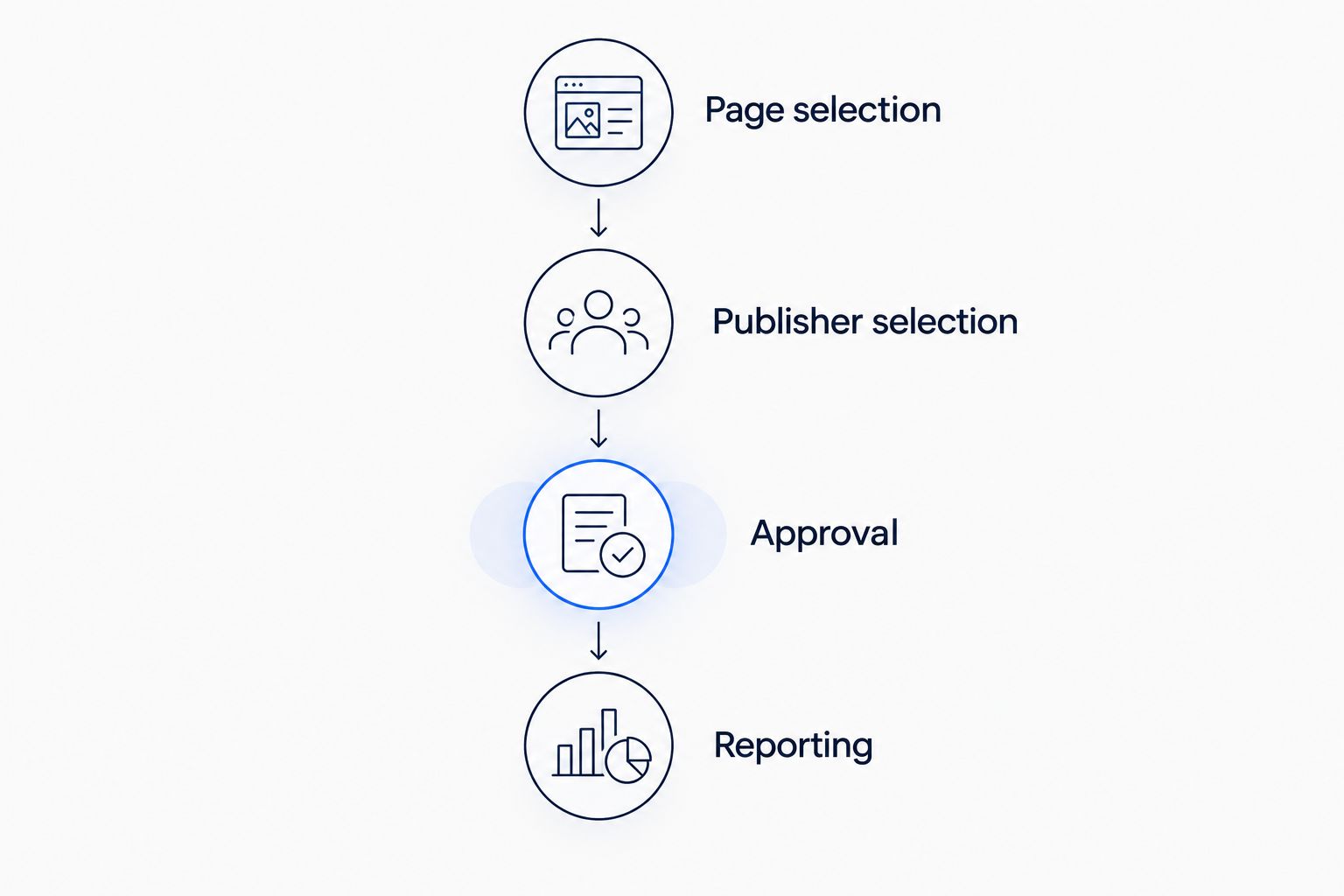
An approval-heavy process needs a named decision-maker on your side. A delegated process needs clear rejection criteria. Neither arrangement is inherently better; the agreement must match how your team actually works.
Pricing: compare the commitment, not just the invoice
Choose the commercial model that makes scope and responsibility clear. For a 2026 proposal review, establish whether billing is recurring, project-based or tied to defined placements before comparing the commitment.
A recurring arrangement provides an ongoing planning structure, but you need to know what carries over when delivery is incomplete. A project-based arrangement defines a bounded piece of work, but additional requirements need explicit treatment. A placement-based arrangement makes the unit of delivery visible, but requires careful acceptance criteria.
Apply these questions to both proposals:
- What event triggers an invoice or marks work as delivered?
- Which research, writing and approval tasks are included?
- What happens to rejected, removed or changed placements?
- What commitment, cancellation and renewal terms apply?
- How are changes to target pages handled?
Request a 90-day plan to make sequencing visible. Treat that period as a planning exercise, not a promised deadline for rankings. Publisher decisions and search outcomes are separate from the agency's controllable work.
Final verdict: choose the scope you can hold accountable
Choose Linkible if you own SEO and need specialist outreach
Winner for this profile: Linkible. You are a SaaS marketing lead or ecommerce SEO manager seeking a defined link building workstream, with internal ownership of content and technical priorities.
The stated service focus matches that brief. Confirm publisher criteria, manual outreach responsibilities, placement acceptance and reporting before committing; the agency's category fit does not remove those checks.
Choose Supple if its proposal closes your wider SEO gaps
Winner for this profile: Supple, when the written scope meets that condition. You are a founder or marketing lead seeking responsibilities beyond backlinks, and the proposal assigns those tasks alongside an inspectable link building scope.
Do not choose that engagement merely to avoid managing multiple suppliers. Choose it when the contract shows who will do the work your team cannot cover.
| Dimension | Winner |
|---|---|
| Defined specialist backlink brief | Linkible |
| Wider SEO brief | Supple, when documented in its proposal |
| Explicitly stated outreach service mix | Linkible on the supplied service description |
| Publisher relevance | Tie until examples are assessed |
| Reporting | Tie until commitments are specified |
| Scope ownership | The proposal with named responsibilities |
| Pricing model | The proposal with clearer commercial terms |
| Standout feature | Match to the brief, not an unsupported feature claim |
FAQ
Is Linkible better than Supple for link building?
Linkible is the clearer service match when you want a specialist link building agency. Compare publisher examples, outreach methods and contractual deliverables before treating service fit as a quality advantage.
When should I choose Supple instead?
Choose Supple when its written proposal covers the wider SEO responsibilities you need better than the competing scope. Require named owners and separate backlink deliverables rather than accepting a broad activity description.
Which agency is better for a SaaS company?
A SaaS team with existing SEO ownership should prioritise a specialist outreach brief. A team with unassigned technical or content responsibilities should compare proposals that explicitly cover those gaps.
What should an ecommerce brand check before buying backlinks?
Check publisher relevance, the linking article's context and the suitability of the destination page. Ask how the agency handles approval, anchor text, link attributes and unsuitable placements.
Does a higher Domain Rating mean a better backlink?
No, a higher Domain Rating does not establish that a backlink is relevant or editorially appropriate. Review the publication, article context, destination page and link attributes alongside any third-party authority metric.
How should I compare agency pricing models?
Compare what triggers billing, what counts as delivery and which tasks are included. Review commitment terms and the treatment of rejected or removed placements before choosing a model.
Can either agency guarantee better rankings?
An agency cannot control Google's ranking decisions. Separate contractual delivery commitments from claims about organic traffic, rankings or revenue.
One last thing
Ask each agency which proposed publisher it would reject—and why. A rejection explanation shows how the selection criteria work when a placement looks attractive on paper but fails the brief.
For a 2026 campaign, send Linkible your priority pages, audience markets and existing SEO responsibilities through the contact page. Ask for a scope that identifies outreach methods, publisher relevance checks, deliverables and reporting before you decide.