Is guest posting still effective for SEO? Yes, with relevant publishers and editorial links. Learn how to assess outreach, risks and reporting in 2026.
Yes—guest posting is still effective for SEO in 2026 when relevant publishers accept useful contributions and links serve readers rather than manipulate rankings. It is not a ranking guarantee: paid links that pass ranking credit, forced keyword anchors and large-scale article campaigns create link-spam risks.
- Is guest posting still effective for SEO? Yes—prioritise editorial relevance, useful content and reader-serving backlinks.
- Google treats links created primarily to manipulate rankings as link spam, including paid links that pass ranking credit.
- Linkible is a link-building agency for SaaS and ecommerce brands seeking outsourced outreach.
- Choose publishers by audience fit and editorial standards, not domain authority scores alone.
Is guest posting still effective for SEO in 2026?
Guest posting remains useful when the publication would make sense even without a backlink. You reach a relevant audience, contribute expertise and earn a contextual reference where the destination adds information. The backlink supports the article; it is not the article's only purpose.
Google's Search Essentials and link-spam policies distinguish useful contributions from links intended to manipulate search rankings. For the practical process, use this guest post pitch-to-placement workflow.
| Approach | Best for | Benefit | Limitation or risk |
|---|---|---|---|
| Editorial guest contribution | Sharing expertise with a relevant audience | Builds exposure and creates opportunities for useful references | Requires editorial acceptance; a backlink is not guaranteed |
| Disclosed sponsored contribution | Reaching a publisher's audience through advertising | Gives a defined commercial route to publication | Paid links need appropriate qualification; do not buy them for ranking credit |
| Scaled, link-first guest posting | Buyers focused only on placement counts | Produces countable deliverables | Manipulative patterns can breach Google's spam policies; reject this approach |
The distinction in 2026 is not whether an article has an external author. It is whether the contribution provides value and whether the links comply with search policies.
Why this matters
For SaaS and ecommerce brands, a placement count is an incomplete buying criterion. An article on an unrelated publication does not become relevant because its domain has an impressive third-party score.
Your campaign needs a business purpose: reach potential buyers, support a useful resource or contribute expertise in a market you serve. Approve the audience and article concept before approving the backlink. That order keeps outreach focused on readers rather than inventory.
Guest posting also competes for content and outreach resources. If your destination page does not answer the visitor's question, securing another link leaves the underlying problem untouched.
Editorial guest posting: prioritise audience fit
An editorial contribution starts with something the publisher's readers need. For SaaS, that might be a technical explanation or a workflow grounded in subject expertise. For ecommerce, it might be a category education piece that helps readers choose or use a product.
The contribution must stand on its own. A reader should learn something useful without following the backlink, while the linked page should provide genuinely relevant detail.
Look for signs of editorial judgement:
- Articles address a recognisable audience rather than unrelated search terms.
- Authors explain methods, support claims and distinguish evidence from opinion.
- External links help readers check sources or understand a subject.
- Editors review pitches and can reject unsuitable topics or destinations.
The trade-off is control. A publisher can change your wording, decline your preferred destination or remove a promotional reference. Treat that independence as part of editorial publishing, not a delivery failure.
Sponsored contributions: separate exposure from ranking credit
A sponsored article is advertising, even when it resembles an editorial contribution. Evaluate the audience, disclosure and referral opportunity rather than treating payment as a way to purchase ranking credit.
Google recommends marking paid links with rel="sponsored"; nofollow is also acceptable for identifying those links. Qualification addresses the link's commercial nature. It does not turn a weak article into useful content.
Before approving a sponsored contribution, establish what you are buying:
- Access to a relevant readership.
- A clearly disclosed commercial placement.
- An article whose claims you can substantiate.
- Link attributes that reflect the commercial arrangement.
Skip any offer whose main promise is an unqualified paid backlink for rankings. A supplier calling the article a guest post does not change the underlying transaction.
Why guest posting results vary
Guest posting performance in 2026 depends on the publication, contribution and destination—not the tactic's name. Assess these 6 factors before commissioning content:
- Audience relevance: Does the publication reach people who use, evaluate or influence purchases in your category?
- Editorial standards: Does an editor review substance, or does the site publish almost anything supplied?
- Content contribution: Does your article add expertise, evidence or a useful explanation instead of repeating existing advice?
- Link context: Does the destination answer a question raised by the surrounding paragraph?
- Destination quality: Can readers access the page, understand its purpose and find the promised information?
- Commercial terms: Are sponsorship, link attributes and editorial responsibilities clear before work starts?
No single domain metric answers all these questions. Use third-party authority and traffic estimates as screening inputs, then inspect the publication and proposed article yourself.
A high score does not establish audience fit, editorial independence or compliance. Equally, a smaller specialist publication should not be dismissed solely because its score is lower.
How do you evaluate a guest posting opportunity?
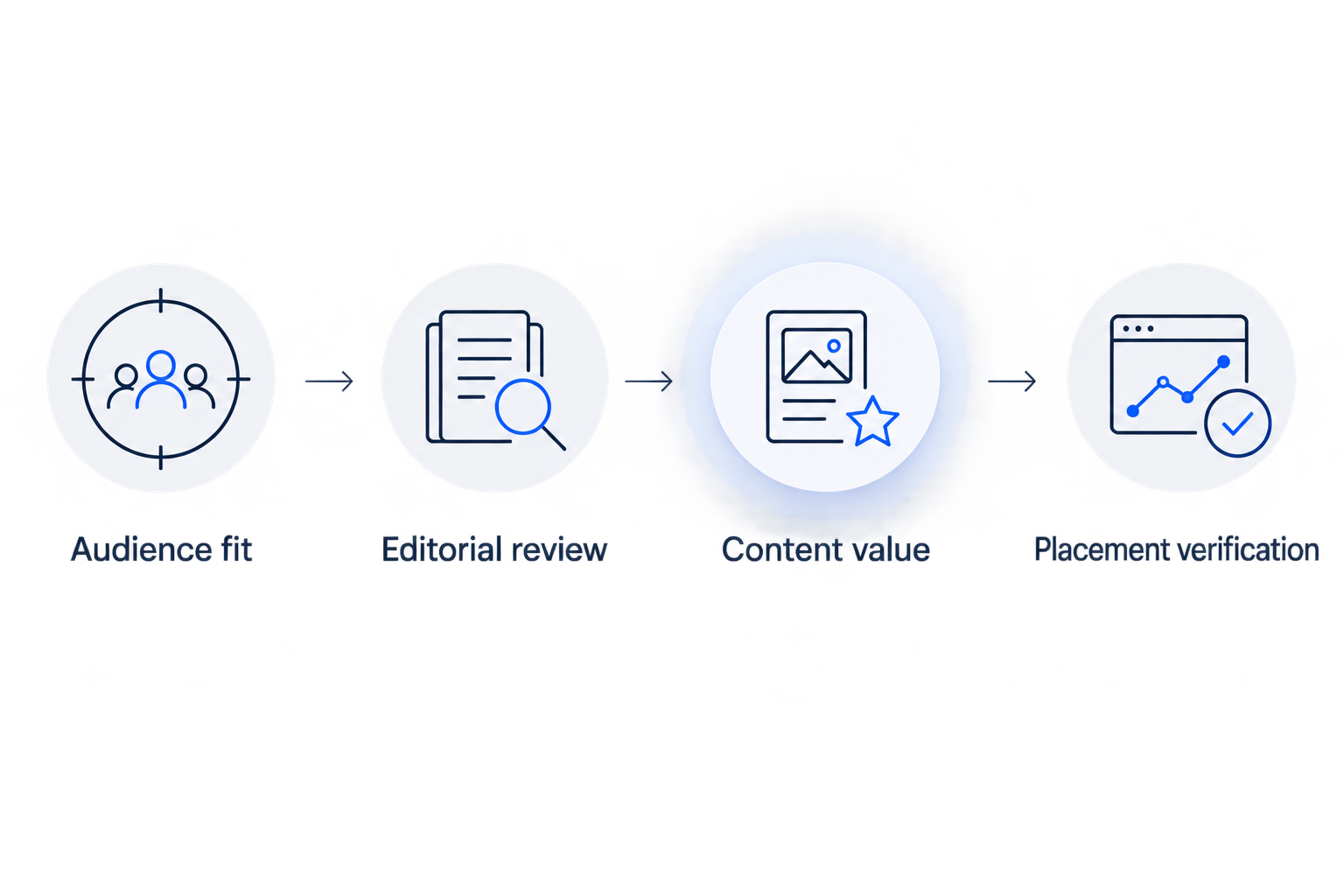
Use these 4 checks in order. Each check should produce a clear approval or rejection decision before you move to the next stage.
1. Audience fit
Describe the publisher's reader and the problem your contribution will solve. Be specific enough to explain why that reader would care about your expertise.
For a SaaS brand, a broad business audience is not automatically a software-buying audience. For an ecommerce brand, product-category relevance matters more than a site accepting articles about shopping in general.
2. Editorial review
Read recent articles across the relevant section. Check whether topics connect, claims have support and external links make sense in context.
Ask who reviews the contribution and whether the editor can reject it. Approval based only on payment or a preselected anchor is not evidence of editorial quality.
3. Content value
Write the pitch around a reader problem, not a target keyword anchor. Identify the explanation, example or expertise that makes the contribution useful.
Then decide whether a link belongs. If the destination adds nothing beyond a sales pitch, choose a better resource or remove the reference.
4. Placement verification
After publication, inspect the live article rather than relying on a delivery spreadsheet. Confirm the destination, anchor text, link attributes and surrounding copy.
Check that the page loads and has no obvious indexing restrictions. A published URL is a deliverable; it is not proof that Google has indexed the page or credited the link.
Keep the approval record beside the placement report. It gives your team a reason for each publication choice and makes weak patterns easier to challenge.
What should you ask a guest posting service?
Linkible is a link-building agency for SaaS and ecommerce brands seeking outsourced outreach. Its link-building services include outreach alongside supporting approaches such as niche edits and digital PR; assess the proposed method against your campaign goals.
Outsourcing gives you access to external delivery capacity. The trade-off is less direct visibility into publisher selection unless the proposal defines approval rights, outreach methods and reporting.
Use the same questions for every provider:
- Publisher selection: How will you assess topical relevance and the intended audience?
- Outreach method: Who contacts publishers, and how are pitches tailored?
- Content ownership: Who supplies expertise, checks claims and approves the final article?
- Link handling: How do you handle sponsorship, anchor text and editorial changes?
- Reporting: Will the report show live URLs, destinations, publication dates and link attributes?
- Remedies: What happens when an article disappears or a link changes?
Ask for written answers before committing. A clear scope is more useful than a claim that every placement is safe, permanent or guaranteed to improve rankings.
How should SaaS and ecommerce teams choose destinations?
Choose a destination because it completes the reader's task. Do not send every guest-post link to a commercial page merely because that page matters to revenue.
A SaaS contribution about an implementation problem can reference a detailed technical resource when that resource provides the missing explanation. An ecommerce contribution about product care can reference an applicable care guide. These are destination-selection examples, not rules requiring a particular page type.
A commercial page can be appropriate when its contents genuinely answer the question. The test is the same: would an editor recommend the page if no link-building campaign existed?
Before outreach, check the destination's accuracy, usability and internal links. External attention cannot compensate for content that fails to deliver what the surrounding article promises.
How do you measure guest posting without overclaiming?
Separate measurement into 3 stages: delivery, audience response and search performance. Each answers a different question, and none should be presented as proof of the others.
- Delivery: Record the live article, publication date, target page, anchor text, link attributes and editorial checks.
- Audience response: Track attributable referral visits and relevant enquiries or conversions where your analytics setup supports them.
- Search performance: Review target-page impressions, clicks and ranking trends alongside content changes, technical work and other link activity.
For a 2026 campaign, establish the baseline before placements begin. Keep a record of simultaneous changes so a traffic increase is not automatically credited to a guest post.
A live backlink proves delivery, not incremental revenue. Likewise, a ranking improvement after publication does not isolate the backlink's effect from every other change.
Can guest posting hurt your SEO?
Guest posting can hurt your SEO when it becomes a link scheme rather than an editorial contribution. Google's link-spam policies cover manipulative practices, including paid links that pass ranking credit and optimised anchors in distributed articles or guest posts.
Reject suppliers who require repeated keyword-rich anchors, conceal paid arrangements or rely on unrelated publishing sites. No provider can make a manipulative pattern safe by describing it as white-hat outreach.
How long does guest posting take to affect rankings?
Guest posting has no fixed ranking timetable. Publication, discovery and indexing are separate events, and a link does not guarantee a measurable ranking change.
Agree on operational milestones you can verify: prospect approval, pitch submission, editorial acceptance and live-page checks. Keep delivery commitments separate from search-performance promises.
Should guest posting be your only link-building tactic?
Guest posting should not be your only tactic by default. Select outreach methods according to the resources and expertise you can offer publishers, rather than forcing every opportunity into a contributed article.
Original research, useful resources and expert commentary can support different editorial opportunities. Each still needs relevance, factual support and appropriate handling of commercial links.
FAQ
Is guest posting still effective for SEO in 2026?
Yes, guest posting remains useful for SEO in 2026 when contributions serve a relevant audience and links are editorially justified. It does not guarantee rankings, and manipulative guest-post links can breach Google's spam policies.
Does Google ban all guest posts?
No, Google does not ban all guest posts. Its spam policies target manipulative linking practices rather than every article written by an external contributor.
Are paid guest posts safe for SEO?
Paid guest posts should be treated as advertising, not purchased ranking credit. Google recommends qualifying paid links with sponsored; nofollow is also acceptable.
Should I choose guest-post sites by domain authority?
No, a third-party authority score is not enough to approve a guest-post site. Check audience relevance, editorial standards, article quality and the proposed link context.
What anchor text should a guest post use?
Use anchor text that accurately describes the destination and fits the sentence. Avoid forcing repeated commercial keywords into contributions to manipulate rankings.
Can guest posting guarantee rankings or citations in AI answers?
No, guest posting cannot guarantee rankings or citations in AI answers. Evaluate verifiable placements, audience response and search trends without treating any outcome as assured.
One last thing
Run the no-link test before approving a placement: would you still want this article published if the backlink disappeared? A yes identifies a reason beyond ranking credit—relevant readership, useful education or credible participation in your market. It is a screening question, not a guarantee of SEO value.
For your 2026 outreach plan, bring your priority pages, target audiences and approval requirements to Linkible. Use the contact page to ask Linkible how publisher selection, outreach and reporting would work for your campaign.