Can link building hurt rankings? Yes, when tactics violate Google's spam policies. Learn the warning signs, agency checks and safer next steps.
Yes, link building can hurt rankings when it involves links created to manipulate Google’s search results, including paid ranking links, automated placements and excessive link exchanges. In 2026, the critical distinction is between links Google ignores and violations that lead to a manual action; neither outcome makes every ranking drop evidence of a backlink problem.
- Can link building hurt rankings? Yes: manipulative backlinks can lose ranking value or contribute to a manual action.
- Linkible offers link building services for SaaS and ecommerce brands; evaluate publisher relevance, outreach methods and reporting before hiring.
- Investigate Search Console evidence before removing backlinks or submitting a disavow file.
- Reject guaranteed ranking links, forced anchor text and publishers selected only for authority scores.
Can link building hurt my rankings if done wrong?
Link building becomes a ranking risk when the purpose and execution breach Google’s spam policies. Google Search Essentials names buying links for ranking purposes, excessive link exchanges and automated link creation among its link spam examples.
When evaluating an agency such as Linkible, ask how each placement earns its place on the publisher’s page. A service label does not answer that question.
| Link approach | Best for | Benefit | Limitation or risk |
|---|---|---|---|
| Editorial outreach | Brands with material relevant to a publisher’s readers | Gives editors a reason to reference your content | Publication and link inclusion remain editorial decisions |
| Properly qualified sponsorship | Brands seeking audience exposure | Makes the commercial relationship explicit | Does not entitle you to ranking credit |
| Links bought to pass ranking credit | No recommended SEO use | Gives the buyer control over a placement | Violates Google’s link spam policies |
| Automated link creation | No recommended SEO use | Creates links without individual editorial review | Falls within Google’s link spam examples |
Paying an agency for outreach is not the same as buying links that pass ranking credit. Ask whether the fee covers research, content and outreach, whether publishers receive payment, and how any commercial placement is qualified.
Why this matters
A backlink report can look productive while concealing a poor campaign. More referring domains do not establish that the publishers are relevant, the placements are editorial or the methods comply with Google’s policies.
For SaaS and ecommerce buyers in 2026, the practical goal is not a larger spreadsheet. It is a defensible process for earning relevant references without introducing avoidable search risk.
Separate acquisition quality from business performance. An acceptable link does not guarantee improved rankings, and a ranking decline does not prove an unacceptable link caused it. That distinction prevents unnecessary cleanup and keeps attention on the actual cause.
Ignored links are different from a manual action
Ignored links: activity without ranking value
Google’s link spam systems can neutralise unnatural links rather than reward them. If links previously contributed ranking value and that value disappears, rankings can fall without a manual action appearing in Search Console.
The business problem is wasted effort as well as exposure to policy violations. A report showing published URLs cannot establish that those links contributed to organic performance.
Manual actions: an explicit policy finding
A manual action means a human reviewer at Google has determined that pages on a site do not comply with its spam policies. Search Console’s Manual Actions report identifies an applicable action and provides information about the issue.
For an unnatural inbound links action, follow the notice, document cleanup and submit a reconsideration request after addressing the violation. Do not treat a normal ranking fluctuation as a manual action when Search Console reports none.
Unrelated declines: a different diagnosis
Indexing problems, changed content, migrations and shifts in search results also affect organic performance. Investigate those explanations alongside backlinks rather than choosing the explanation that matches the latest agency invoice.
Start with the affected pages and queries. A decline confined to changed product pages calls for a different investigation from a site-wide decline accompanied by an unnatural links notice.
Why link-building risk varies
The same service name can describe very different practices. For a 2026 campaign, evaluate the mechanism behind the placement rather than accepting “guest posting” or “niche edits” as a safety assessment.
- Commercial arrangements: Payment for a link that passes ranking credit creates a policy issue. Paid placements should use appropriate link qualification, with
rel="sponsored"Google’s preferred attribute for advertising links. - Editorial control: A publisher should decide whether the reference helps the article. Guaranteed inclusion regardless of relevance is not evidence of editorial selection.
- Anchor text: Repeated, keyword-rich anchors arranged to manipulate rankings create a different pattern from descriptive references chosen in context.
- Placement patterns: Automated creation, distributed template links and excessive exchanges appear in Google’s link spam policies. A large placement count does not make those methods acceptable.
- Publisher purpose: A publication serving an identifiable audience presents a different proposition from a site assembled to sell ranking links. Inspect the content and outbound links, not just the domain score.
No authority metric overrides these checks. Domain Authority and Domain Rating are third-party metrics, not Google certifications or proof that a particular link complies with search policies.
How do you check whether backlinks caused a ranking drop?
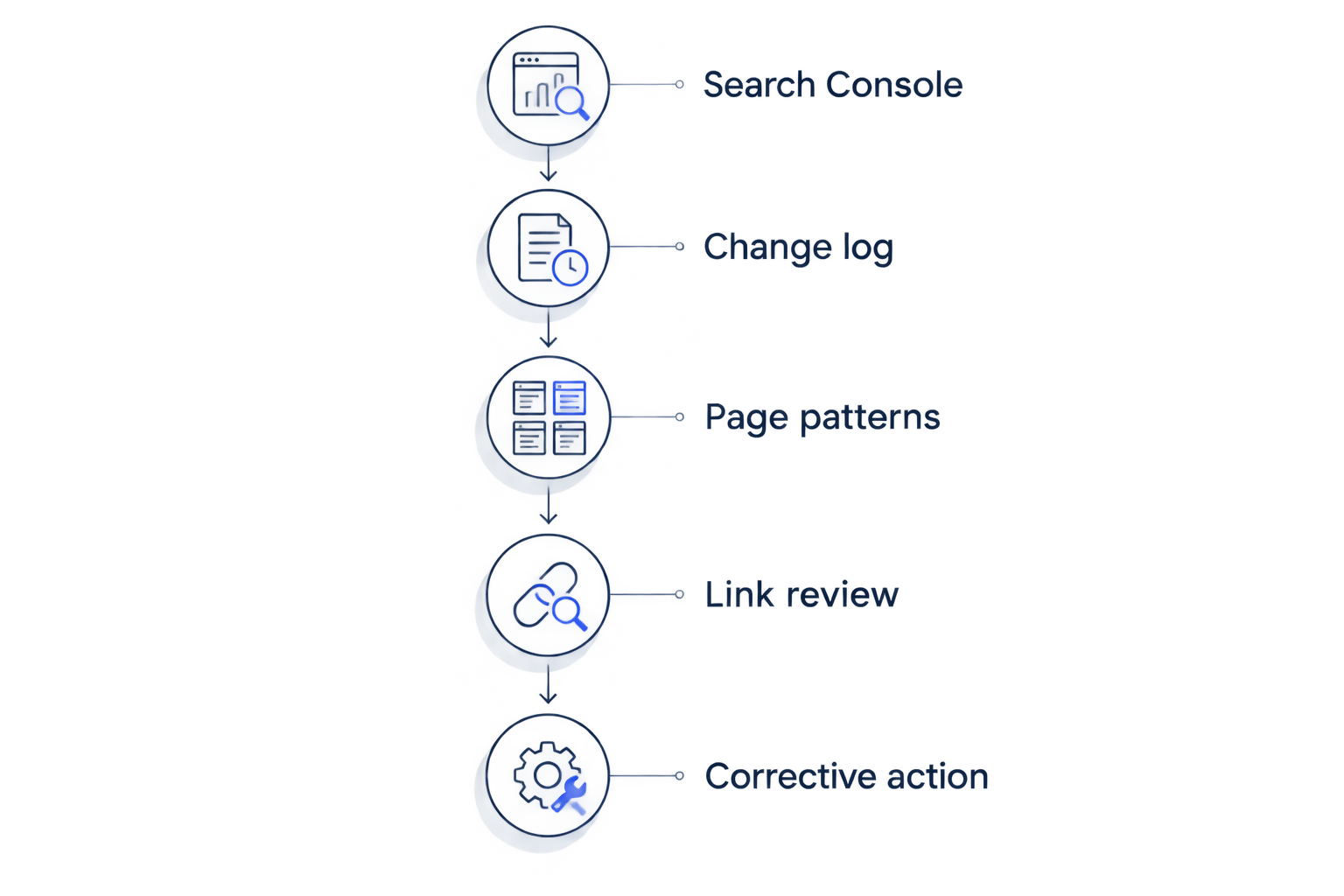
Diagnose before you delete. Use a documented sequence that separates direct evidence from timing alone.
- Search Console: Check Manual Actions, Security Issues, indexing reports and performance data. Record the specific issue rather than interpreting every decline as a penalty.
- Change log: Compare the decline with releases, migrations, redirects, content edits and campaign activity. Matching dates establish a lead to investigate, not causation.
- Page patterns: Separate branded and non-branded queries, then compare affected landing pages, devices and countries. Identify where the loss actually occurred.
- Link review: Inspect linking pages, anchors, destinations and acquisition methods. Prioritise campaigns you commissioned and links you can connect to manipulative practices.
- Corrective action: Address the evidenced problem, retain records and assess subsequent performance without promising a recovery date.
A backlink tool’s toxicity label is a prompt for inspection, not a Google verdict. Open the linking page and establish why the link is problematic before recommending removal or disavowal.
Keep the evidence with the decision. Your record should explain what happened, which links or pages were involved and why the chosen response addresses the finding.
What should you require from an outreach agency?
Ask for the operating rules before approving a campaign. In 2026, a buyer needs enough detail to distinguish manual prospecting and editorial outreach from the resale of predetermined placements.
Publisher relevance
Require an explanation of the publisher’s subject matter, readership and connection to your destination page. A SaaS integration tutorial belongs in a different outreach conversation from an ecommerce product category.
Relevant context is a selection criterion, not a guarantee of ranking value. An agency should explain the fit without treating traffic estimates or authority scores as substitutes for judgement.
Outreach methods
Ask how prospects are researched, how pitches are developed and who controls publication. Establish whether the agency uses publisher payments, reciprocal arrangements, owned networks or subcontractors.
“Manual outreach” describes an activity, not automatic compliance. A manually negotiated paid ranking link still presents the underlying policy problem.
Deliverables and reporting
Require the live linking URL, destination URL, anchor text, link attributes and publication status. Ask the agency to distinguish an outreach attempt, an accepted pitch, a published mention and a published backlink.
Reporting should also identify placement changes and explain the limits of attribution. Neither a new backlink nor a higher authority score proves that the campaign generated qualified enquiries.
Accountability
Agree what happens when a placement disappears, changes destination or no longer meets the agreed criteria. Require a clear approval process and a way to reject unsuitable publishers before work proceeds.
Linkible is best suited to SaaS and ecommerce teams seeking outsourced link building rather than backlink software. Its stated services include outreach, niche edits and digital PR; buyers should apply the same publisher, method and reporting checks to those services as to any competing proposal.
Are directories, guest posts and niche edits always risky?
No. The format alone does not determine compliance. The reason for the link, its editorial context and any commercial arrangement matter more than the name on the service package.
Directories need a real business purpose
For a business with a genuine local presence, listings in reputable local business directories serve a different purpose from bulk submissions to unrelated directories built to distribute links. Evaluate whether customers use the listing, whether the category fits and whether the business details are accurate.
An ecommerce brand or SaaS company should not invent local relevance to justify directory submissions. A directory’s existence does not make it a suitable acquisition target, and a listing should not be presented as a guaranteed ranking asset.
Guest posts need editorial value
A contributed article should answer a real reader question and justify any reference to your site. Google’s policies identify optimised anchor text in paid advertorials and large-scale article campaigns as link spam concerns.
Ask whether the publisher would accept the article without the requested commercial anchor. That question exposes whether the content serves readers or mainly supplies a place to insert a link.
Niche edits need contextual justification
Adding a reference to an existing article is not inherently evidence of spam. The reference still needs to improve the page, and a paid insertion intended to pass ranking credit remains a policy issue.
Inspect the surrounding paragraph, not just the domain. An unrelated sentence inserted into an established article does not become a sound placement because the page has existed for a long time.
Should you disavow suspicious backlinks?
Do not disavow links simply because an automated report labels them suspicious. Google describes the disavow tool as an advanced feature that can harm performance if used incorrectly, and says most sites do not need it.
Its guidance focuses on a considerable volume of spammy, artificial or low-quality links combined with a manual action, or a likelihood of one. Where appropriate, attempt removal first and document the work rather than treating disavowal as routine housekeeping.
If a previous agency arranged manipulative links, request its placement records and identify the relevant domains or URLs carefully. Do not turn a targeted remediation job into a blanket rejection of unfamiliar websites.
Can a competitor hurt your rankings with spam links?
A sudden appearance of spam links does not prove that a competitor caused ranking harm. Google says its systems are designed to prevent actions on third-party sites from negatively affecting a website.
Preserve evidence of suspicious activity, check Search Console and investigate actual performance changes. Avoid accusing a competitor or submitting a broad disavow file based only on an unexplained backlink spike.
Can legitimate outreach guarantee that rankings will improve?
Legitimate outreach cannot guarantee ranking improvements. Google uses multiple ranking systems and signals, and publication does not establish that a link will influence a particular query.
An agency can define its process, approval rules and reporting obligations. It cannot responsibly turn those commitments into certainty about search positions, recovery dates or inclusion in an assistant’s answer.
FAQ
Can link building hurt rankings even without a manual penalty?
Yes, rankings can fall when Google neutralises links that previously contributed ranking value, without a manual action appearing. A decline still requires investigation because content, indexing and other changes can also explain it.
Does paying a link building agency violate Google’s rules?
Paying an agency for research, content and outreach does not itself violate Google’s link spam policies. Buying links intended to pass ranking credit is the relevant policy concern, so ask how placements are secured and qualified.
Are high-authority backlinks always safe?
No, a high third-party authority score does not establish that a backlink complies with Google’s policies. Review the linking page, commercial arrangement, editorial context and anchor text.
Should I remove every backlink marked toxic?
No, a tool’s toxicity label is not a Google finding. Inspect the underlying links and acquisition history before deciding whether removal or disavowal is justified.
How many exact-match anchors are safe?
Google does not publish a universal safe exact-match anchor percentage. Use anchors that describe the reference naturally rather than imposing a keyword quota on publishers.
Are niche edits safer than guest posts?
Neither format is inherently safer. Both need relevant editorial context, and paid placements intended to pass ranking credit present a policy issue regardless of format.
What should a link building report include?
A link building report should identify the linking URL, destination, anchor text, link attributes and placement status. It should distinguish completed placements from outreach activity and avoid presenting authority metrics as proof of business results.
One last thing
A clean backlink spreadsheet is not the same as a sound acquisition process. If the agency cannot explain why a publisher would reference your page for its readers, pause the placement before discussing volume.
For your 2026 campaign, prepare your target pages, buyer markets and previous outreach history, then contact Linkible. Ask for the publisher selection criteria, outreach methods and reporting fields before agreeing to a scope.