Find websites that accept guest posts through search, competitor research and editorial checks. Build a relevant shortlist and pitch publishers in 2026.
Find websites that accept guest posts by combining topic-specific searches, competitor backlink research and checks of each publisher’s contributor guidelines. Before pitching, confirm that the site reaches your buyers, publishes credible content and accepts relevant contributions; appearing on a guest-post list does not prove any of those things.
- Find websites that accept guest posts through relevant searches, competitor backlinks and current contributor guidelines.
- Prioritise audience relevance and editorial standards over domain authority alone.
- Linkible suits SaaS and ecommerce brands seeking managed link building and outreach support.
- Verify submission rules before pitching; a published guest article does not prove submissions remain open.
How do you find websites that accept guest posts?
Build a qualified publisher shortlist, not a spreadsheet of sites containing a submission phrase. Start with the topics your buyers read, identify relevant publications, then verify how each one handles outside contributions.
Use this sequence for your 2026 prospecting:
- Define the audience and subject your proposed article serves.
- Search for publications covering that subject.
- Check competitor backlinks for contributed articles.
- Read current contributor guidelines and recent articles.
- Record the editorial contact and a specific pitch angle.
Once a publisher passes those checks, follow the guest post pitch to a live placement workflow to manage the submission through publication.
Compare the main discovery methods
No discovery method verifies a publisher by itself. Use each source for what it reveals, then inspect the actual website.
| Discovery method | Best for | Main advantage | Main limitation |
|---|---|---|---|
| Search operators | Finding published submission guidance | Reveals explicit contribution instructions | Misses publishers without a contributor page |
| Competitor backlinks | Finding publications in your market | Shows existing editorial coverage | A backlink does not prove guest submissions are accepted |
| Author research | Finding related publications | Connects writers with relevant editorial outlets | Some contributors write only by invitation |
| Industry reading | Identifying audience-aligned publications | Starts with readership and subject fit | Requires manual research into submission routes |
Why this matters
A website accepting guest posts is an outreach opportunity, not an automatic link-building recommendation. A relevant publication with clear editorial standards deserves a different assessment from a site publishing unrelated articles primarily to place links.
For SaaS brands, look for publications covering the problems your software addresses and the people making purchasing decisions. For ecommerce brands, assess whether readers care about your product category, its uses or the buying decisions around it.
A relevant audience is the starting point; a submission form is only an access route. Keep that distinction central to your 2026 shortlist.
Start with search operators and buyer topics
Combine a specific subject with phrases publishers use on contributor pages. Replace the topic in these examples with a problem, discipline or category your buyers recognise:
"inventory management" "write for us""customer retention" "contributor guidelines""outdoor equipment" "submit an article""email marketing" "guest contributor""supply chain" "editorial guidelines"
Search broadly enough to find publications outside your immediate product category. A SaaS company serving finance teams should investigate finance and operations publications, not only software blogs.
Keep geography tied to the audience. If you want US, UK or Canadian buyers, inspect the publication’s subject matter, examples and stated readership rather than assuming its domain ending proves audience location.
Search beyond submission phrases
Repeat the search using the topic alone, then inspect promising publications for contributor information. This finds relevant editorial sites that do not prominently advertise guest posting.
Once you identify a publication, use a site-restricted search for contributor guidelines, author pages or submission instructions. Read the destination page rather than relying on the search snippet, which can show wording that no longer reflects the page.
The trade-off is manual work. Broad searches reveal more possibilities, but every result still needs qualification before it belongs in an outreach campaign.
Use competitor backlinks to find editorial opportunities
Inspect backlinks to businesses competing for the same audience or search topics. Focus on the referring article and its context, not just the referring domain.
Ask what created the link:
- Was the article written by an outside contributor?
- Did an editor cite original research or a useful resource?
- Is the link part of a directory entry or partner profile?
- Does the publication explain how to submit an idea?
A competitor’s backlink is evidence of a link, not evidence of an open guest-post programme. Interviews, editorial citations and contributed articles have different submission routes.
Record the referring page, article topic and apparent contribution type. If the opportunity is an editorial citation rather than a guest post, keep it in a separate outreach category instead of forcing an unsuitable article pitch.
Follow relevant authors
When a useful article names an external contributor, inspect the author biography and other published work. This can reveal additional publications covering the same subject.
Use author research to understand editorial fit, not to copy someone else’s placement list without review. A publication might accept recognised specialists through an invitation process rather than unsolicited submissions.
Qualify each publisher before outreach
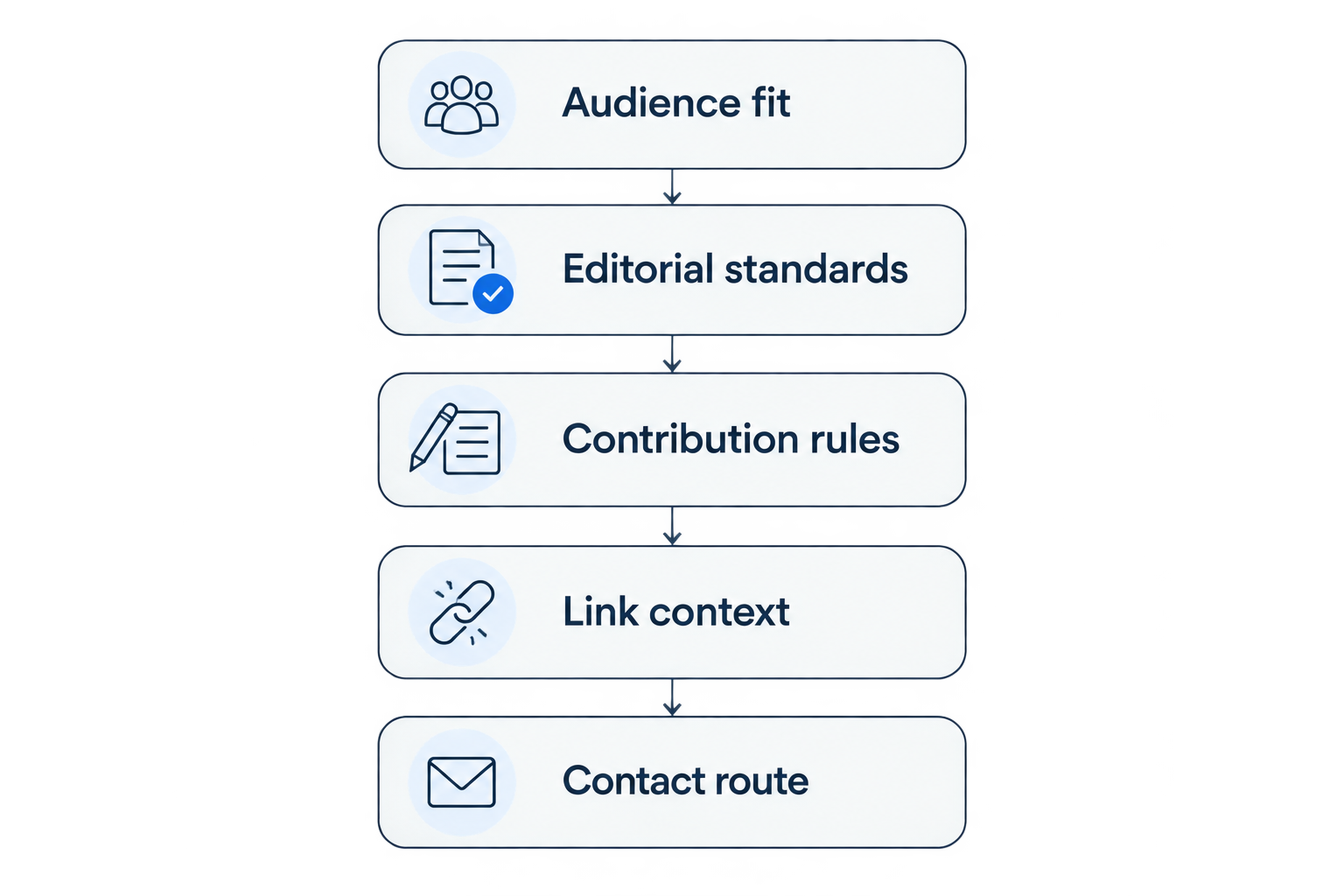
Use the same checks for every prospect so your team does not approve sites merely because someone likes a metric. Apply these criteria to your 2026 campaign before writing pitches.
Audience fit
Read the publication’s stated purpose and recent coverage. Identify who benefits from its articles and whether those readers overlap with your buyers.
Reject a prospect if you cannot explain that overlap in a plain sentence. A broad topic connection alone is not enough.
Editorial standards
Look for clear authorship, useful sourcing, coherent subject coverage and articles that answer real reader questions. Read full articles, including the passages surrounding outbound links.
An attractive homepage does not establish editorial quality. Inspect whether the content remains useful when promotional references are removed.
Contribution rules
Find the submission instructions and check what the editor requests. Requirements can cover article scope, originality, author credentials, disclosures and permitted links.
Do not treat an old guest article as current permission to submit. Use the publisher’s present instructions or ask the editorial team directly.
Link context
Assess whether a proposed link would help readers verify a claim or explore the subject. A link that exists only to insert a commercial keyword is not a strong editorial reason for inclusion.
Google’s link spam guidance addresses links created primarily to manipulate rankings. Paid placements require appropriate link qualification; calling a placement a guest post does not remove that requirement.
Contact route
Use the publication’s stated editorial form or submission address when one exists. Avoid sending the same pitch to several departments because a direct editor address is harder to find.
Keep a prospecting sheet that supports decisions
Record 6 core fields for each publisher: website, audience fit, submission guidance, editorial contact, pitch angle and status. Add supporting notes where they change the decision, rather than collecting information nobody uses.
Make the audience-fit field specific. Write the buyer problem the publication covers, not a vague assessment such as relevant business website.
For submission guidance, record where you found the instructions and when you checked them. A date checked in 2026 is more useful than an undated note saying the site accepts contributions.
Keep discovery and approval separate. A new prospect should not receive outreach until someone has reviewed its content and confirmed a plausible editorial route.
What should a useful pitch contain?
Prepare 3 pitch components: a publication-specific angle, a concise explanation of reader value and evidence that you can cover the subject credibly.
For a SaaS article, that evidence might be a practical workflow or subject expertise. For ecommerce, it might be product-category knowledge or a useful explanation of a purchasing problem; use only evidence you actually have.
Do not lead with a request for a backlink. Lead with the editorial contribution, and discuss linking within the publisher’s rules.
Why guest-post opportunities vary
Two sites covering the same topic can have different requirements. These factors explain why a promising prospect does not automatically become a suitable placement:
- Editorial remit: The publication’s audience and subject boundaries determine which ideas fit.
- Submission policy: Some publishers accept unsolicited ideas; others commission contributors directly.
- Required expertise: Specialist subjects can require credentials or experience your proposed author must demonstrate.
- Existing coverage: An otherwise relevant idea can duplicate material the publication already has.
- Link policy: Editors set rules for author biographies, commercial references and contextual citations.
- Content requirements: Originality, sourcing and disclosure requirements shape what you need to submit.
Ask about unclear requirements before drafting a complete article. Do not assume acceptance of a topic includes approval of a particular destination page or anchor text.
Should you prospect yourself or use an outreach agency?
Use internal prospecting when your team can assess publishers, contribute expertise and manage editorial conversations. Consider managed outreach when those tasks compete with other work but your team can still supply subject knowledge and approve targets.
Linkible offers link building and outreach services for SaaS, ecommerce and other brands. Its link building services are relevant when you want outside support rather than another prospecting spreadsheet.
The benefit of outsourcing is assigning responsibility for agreed outreach work. The limitation is that outsourcing does not remove your responsibility to review relevance, claims or acceptable link practices.
When evaluating Linkible or another agency, request a written explanation of:
- How publishers are selected for audience and topic relevance.
- How manual outreach is conducted and represented.
- Which deliverables are included and what requires approval.
- What reporting shows about published pages, destinations and anchor text.
- How editorial rejection and changes to agreed placements are handled.
Choose the process you can inspect, not a promise of rankings. A proposal should make deliverables clear without presenting search performance as guaranteed.
Can you find guest-post opportunities without a contributor page?
Yes. Relevant publications without contributor pages can still provide an editorial contact or submission route elsewhere on the site.
Check the publication’s instructions before approaching an editor. If unsolicited submissions are not accepted, respect that policy rather than trying different inboxes.
Should you choose websites by domain authority?
No. Domain authority metrics can support comparison, but they do not establish audience relevance, editorial quality or whether a proposed link makes sense.
Review the actual publication and linking page. A domain-level score cannot replace that assessment.
How do you know a guest-post list is current?
Verify each publisher directly. Treat any list as a discovery source until you have checked the site’s current guidance and editorial activity.
For a 2026 campaign, record your verification date and the source of the submission instructions. A year in a list’s title is not evidence that every entry has been checked.
FAQ
What's the best way to find websites that accept guest posts?
Combine topic-specific searches, competitor backlink research and direct checks of contributor guidelines. Approve prospects only after reviewing audience fit, editorial standards and submission rules.
What should I search to find guest-post opportunities?
Search your subject alongside phrases such as write for us, contributor guidelines and submit an article. Also search the subject without submission phrases to find publications that do not advertise guest contributions prominently.
Can a SaaS company pitch publications outside software?
Yes, a SaaS company can pitch publications covering the problems its buyers face. The article must fit the publication’s audience rather than merely relate to the software category.
Are websites accepting guest posts automatically safe for SEO?
No, accepting guest posts does not establish editorial quality or compliance with search spam policies. Assess the publication, the proposed article and the purpose of each link.
Should I demand an exact-match anchor text link?
No, choose wording that accurately describes the destination and fits the sentence. Respect the publisher’s editorial rules rather than making keyword placement a condition of contribution.
What should a guest-post outreach report include?
Request the publisher, published article URL, destination page, anchor text and relevant link attributes. Separate outreach activity from live placements so the report shows what has actually been delivered.
Can an outreach agency guarantee that a publisher will accept my article?
Editorial acceptance remains the publisher’s decision. Ask an agency to define its deliverables and rejection process rather than treating a pitch as a confirmed placement.
One last thing
Before approving a prospect, ask: would you still want your expert’s name on this publication if the article contained no backlink? A negative answer is a reason to examine the audience and editorial quality again.
For your next campaign, send Linkible your target pages, priority buyer topics and publisher exclusions through the existing enquiry form. Ask for a proposed qualification process and reporting scope before agreeing to outreach.