Choosing a saas link building agency? Compare outsourced outreach with an in-house team on publisher fit, control, reporting and scope before you commit.
Choose Linkible as your SaaS link building agency if you want outsourced outreach and access to supporting services such as niche edits and digital PR; choose an in-house outreach team if direct control over publisher relationships and daily execution matters more. This 2026 comparison separates the work you can delegate from the decisions your SaaS business should retain.
- Linkible is a SaaS link building agency option for brands seeking outsourced outreach rather than another internal workflow.
- Choose in-house outreach when direct relationship ownership and daily editorial control are essential.
- Judge both options on publisher relevance, backlink deliverables and transparent reporting—not authority scores alone.
- Agree scope, approval rights and reporting requirements before commissioning blogger outreach or supporting digital PR.
Why this matters
Your link building brief should start with the pages and audiences that matter to your business. Buying outreach without that brief makes it harder to distinguish a relevant editorial placement from a backlink that merely satisfies a delivery target.
For a SaaS buyer evaluating agencies in 2026, the useful question is not simply who can acquire links. It is who should own prospecting, publisher communication, content review and reporting. Review the available link building services against those responsibilities before comparing proposals.
Outsource execution when capacity is the constraint; retain strategy when product knowledge is the constraint. An agency relationship does not remove your responsibility to explain the product, define acceptable publishers and approve business-critical claims.
At a glance
| Dimension | Linkible | In-house outreach team |
|---|---|---|
| Best for | Brands seeking outsourced link building services | Brands prioritising direct operational control |
| Execution ownership | External service delivery | Internal delivery responsibility |
| Outreach control | Set through the agreed brief and approvals | Managed directly by your team |
| Publisher relevance | Evaluate against your audience and subject criteria | Evaluate against the same criteria |
| Reporting | Specify evidence and reporting requirements | Build and maintain the reporting process |
| Supporting tactics | Outreach, niche edits, digital PR and HARO link building | Determined by internal skills and resources |
| Standout feature | Ability to commission link building services | Direct ownership of outreach relationships |
| Pricing model | Confirm the commercial structure in the proposal | Internal staffing, tools and production costs |
The table compares operating models, not promised results. Neither outsourcing nor hiring internally establishes that a publisher is relevant, a link is editorially justified or a campaign will improve rankings.
Outsourced outreach suits buyers who need delivery capacity
Best for: a SaaS marketing lead who needs execution without managing every outreach task. An agency arrangement assigns external responsibility for an agreed service. An internal arrangement leaves prospecting, follow-up, negotiation and delivery management with your business.
Linkible offers SaaS link building agency services alongside outreach-related services. The practical buying decision is whether that external scope covers the work currently slowing your team down.
Write the responsibilities into the brief:
- Your team: product positioning, target pages and acceptable claims.
- Agency: the prospecting, outreach and delivery tasks specified in the agreement.
- Shared: publisher criteria, content approvals and campaign review.
The trade-off is coordination. An external team needs a usable product brief and a clear approval route; an internal team needs enough protected time to execute. Do not outsource an undefined task and expect the contract to resolve the ambiguity.
Agency-led execution reduces your internal delivery workload
Best for: a lean team whose marketing lead cannot also run outreach operations. Outsourcing assigns work to a service provider rather than leaving every task on your internal calendar. That is an organisational benefit, not evidence of faster placements or better rankings.
Make the handover concrete. Provide product descriptions, buyer roles, target markets, prohibited claims and the pages you want assessed for link opportunities. Explain whether the priority is a product category, an integration, a use case or an educational resource.
The limitation is the handover itself. Your agency cannot infer the difference between a technically accurate description and a claim your sales or legal team would reject.
For a 2026 brief, nominate an internal owner with authority to approve content and resolve questions. Delegation works better when the service provider has a decision-maker, not a chain of disconnected reviewers.
An in-house team wins on direct outreach control
Best for: a SaaS business that treats publisher relationships as an internal asset. Your own team can manage sender accounts, message changes, follow-up decisions and relationship records directly. You do not need an external handover to change those internal processes.
That control carries work. Someone must maintain prospect records, review replies, handle objections and keep messaging accurate as the product changes.
For agency-led outreach, specify the boundaries before launch:
- Who approves publisher prospects and outreach copy?
- Who can make commitments on your behalf?
- Where are relationship records stored?
- What information is handed over when the engagement ends?
Neither model justifies unsolicited claims about partnerships or product performance. Direct control is valuable only when your team uses it to maintain accurate messaging and responsible communication.
Both models must pass the same publisher-relevance test
Best for: either model, provided publisher selection follows a documented brief. Outsourcing does not prove relevance, and internal ownership does not prove editorial quality. Evaluate the proposed placement itself.
For SaaS, start with the connection between the publisher's audience, the article topic and your destination page. A broad technology publication and a specialist industry resource can serve different purposes; neither wins merely because of its category.
Use this sequence:
- Audience fit: Would the publisher's readers have a reason to consider your topic?
- Topic fit: Does the article genuinely support the proposed reference?
- Page fit: Does the destination answer the reader's next question?
- Editorial fit: Does the link belong in the passage without forcing the wording?
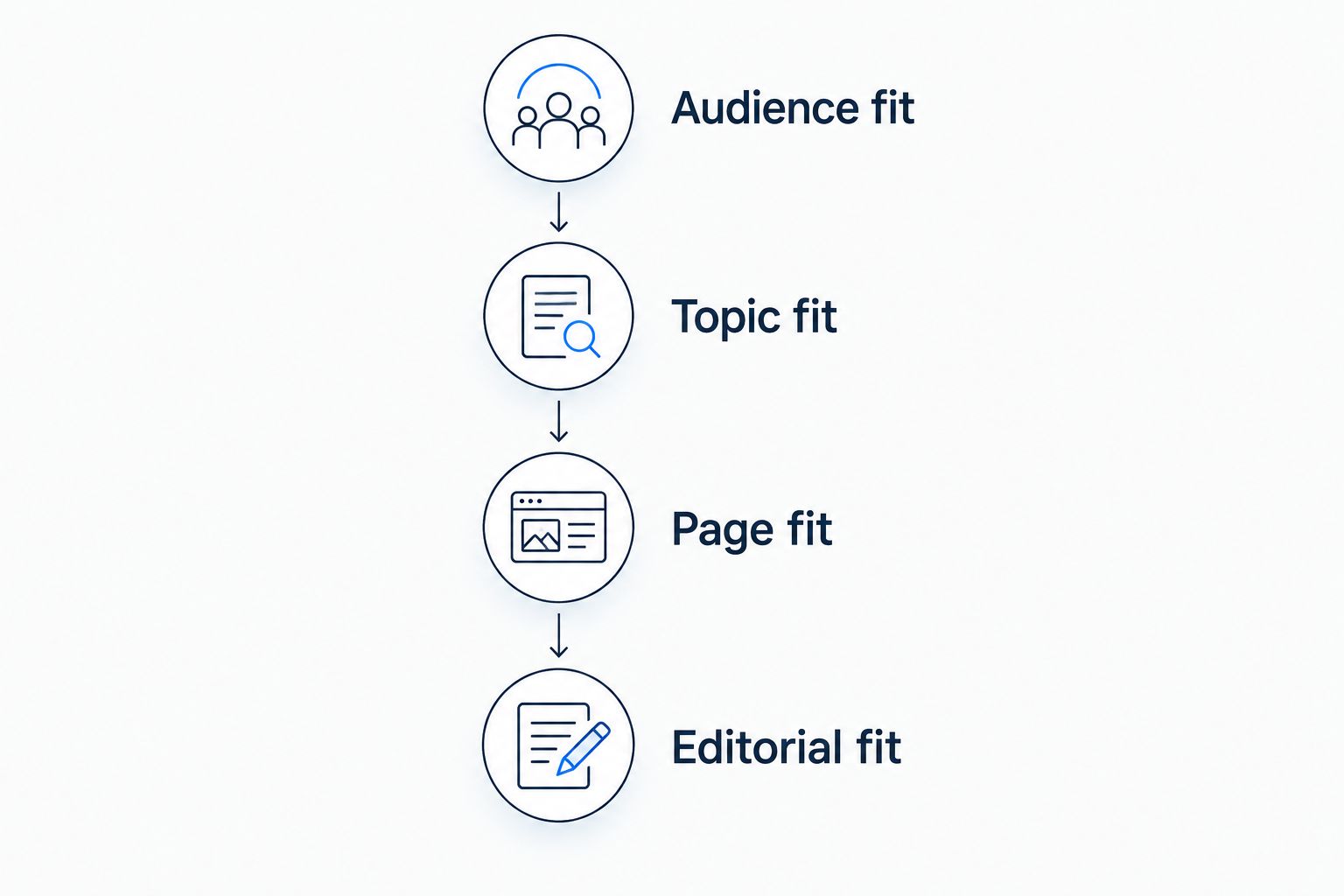
Ask for 2 sample publisher assessments using this checklist. This is a proposal-review exercise, not a demand for guaranteed placements. It reveals how a provider explains relevance before you commit to a delivery scope.
Both models need reporting that exposes the actual work
Best for: either model with placement-level evidence. Reporting should let you inspect what happened, where it happened and which page received the link. An authority-score summary alone cannot answer those questions.
Request a reporting specification before approving a 2026 campaign. Include the publisher, source page, destination page, anchor text, publication status and any agreed follow-up responsibility.
Separate delivery evidence from business outcomes:
- Delivery: outreach activity and completed work within the agreed scope.
- Placement quality: topic relevance, editorial context and link attributes.
- Search outcomes: changes in relevant queries, landing-page performance and organic enquiries.
Do not treat a ranking change after publication as proof that one backlink caused it. Search performance also depends on the page, competing results and other changes to the site.
The agency trade-off is agreeing the report format in advance. The internal trade-off is assigning someone to maintain it. Neither operating model earns a reporting advantage without useful evidence.
Agency breadth suits buyers combining supporting tactics
Best for: a buyer considering outreach alongside niche edits or digital PR. Linkible offers white-hat outreach, niche edits, digital PR and HARO link building. Those service categories give you distinct approaches to discuss in the brief, not interchangeable promises of a backlink.
Define the purpose of each proposed tactic. Blogger outreach needs a relevant editorial proposition; a niche edit needs a defensible reason for adding a reference to an existing page; digital PR needs something a publisher has reason to cover.
The limitation is scope creep. Adding services does not fix an unclear target audience or an unsuitable destination page. Ask why a supporting tactic belongs in the campaign before adding it to the agreement.
An internal team can coordinate these approaches too, but the required capabilities become internal responsibilities. Choose the model that places research, writing and publisher communication with people accountable for those tasks.
In-house ownership wins when relationships are the priority
Best for: a team that wants direct continuity across editorial relationships. Internal outreach lets your business retain day-to-day communication as part of its own operating process. That is the clearest distinction from commissioning external delivery.
This matters when outreach overlaps with partnerships, original research, customer stories or subject-matter commentary. The same publisher conversation can require input from marketing, product specialists and leadership.
The drawback is key-person dependency. If one employee owns the contacts, context and inbox, the business still needs documented records and a handover process.
Agency buyers should ask a narrower question: which relationship information and campaign records will the business receive? Do not assume that commissioning outreach transfers ownership of a provider's wider publisher relationships.
Pricing: compare responsibilities before commercial structures
Best for: buyers who compare the full scope rather than a headline package. An agency proposal should explain what the fee covers and how additional work is authorised. An internal plan should account for staffing, outreach tools, content production and management time.
For a 2026 comparison, ask whether the external arrangement is a recurring engagement, a defined project or a deliverable-based agreement. Then check what happens when a prospect declines, content needs revision or a published link changes.
Predictability comes from defined responsibilities. Flexibility comes from clear change rules. Neither follows automatically from a particular billing label.
Use a 30-day review window to assess communication, prospect reasoning and reporting completeness—not to demand ranking gains. This is a recommended management checkpoint, not a delivery promise or an SEO-results deadline.
Final verdict: choose the operating model you can manage
Choose Linkible if you need outsourced execution
Best for: a SaaS marketing lead with a defined brief and limited outreach capacity. Choose Linkible when you want to commission link building services rather than build every delivery function internally. Establish publisher criteria, approval rights and reporting requirements before agreeing the scope.
The limitation is reduced direct control over daily external execution. Keep an internal owner responsible for product accuracy and campaign decisions.
Choose an in-house outreach team if control comes first
Best for: a SaaS business with staff capacity and a reason to own publisher relationships directly. Choose in-house outreach when daily messaging decisions, relationship continuity and internal coordination outweigh the benefit of outsourced delivery.
The limitation is workload. Your team owns execution as well as strategy, including the repetitive tasks that keep outreach moving.
| Dimension | Winner |
|---|---|
| Outsourced operating fit | Agency-led outreach |
| External delivery capacity | Agency-led outreach |
| Direct outreach control | In-house team |
| Publisher relevance | Tie—evaluate each placement |
| Reporting quality | Tie—require usable evidence |
| Commissioning supporting services | Agency-led outreach |
| Direct relationship ownership | In-house team |
| Commercial fit | Tie—compare the agreed scope |
FAQ
What's the best SaaS link building agency for a small marketing team?
The best fit is an agency whose scope covers the outreach work your team cannot manage and whose publisher criteria match your buyers. Compare sample assessments, approval rights and reporting before choosing.
Is an agency better than hiring an in-house outreach specialist?
An agency fits outsourced execution; an in-house specialist fits direct operational control. Choose based on who should own prospecting, communication, approvals and relationship records.
How should I compare SaaS link building proposals?
Compare responsibilities, publisher relevance, deliverables, reporting and commercial terms against the same written brief. A proposal is easier to assess when every provider responds to identical requirements.
Should a SaaS company choose publishers by domain authority?
Domain authority should not replace a relevance assessment. Review the publisher's audience, article topic, destination page and editorial context before approving a placement.
What should a link building report include?
A useful report identifies the publisher, source page, destination page, anchor text and publication status. Keep completed work separate from search-performance changes so delivery and outcomes remain distinguishable.
Can a link building agency guarantee rankings?
Do not treat a ranking guarantee as proof of service quality. Ask for clear delivery obligations and inspectable evidence rather than a promised search position.
One last thing
Test the destination before debating the publisher. Select 3 target pages and write one sentence explaining why an independent editor would reference each. If the reason is unclear, improve the page or change the target before commissioning outreach.
For your 2026 shortlist, send Linkible those pages, your buyer profile and the work you want outsourced through the existing contact route. Ask for a scope that makes publisher selection, approvals and reporting explicit.