Compare the best guest posting platforms for SaaS brands. Choose managed outreach or publisher marketplaces using relevance, link safety and reporting.
Best for managed outreach: Linkible. Best for international publisher discovery: WhitePress. Best for catalogue-led shortlisting: Collaborator. Best for direct editorial relationships: publisher outreach. This 2026 guide compares guest posting buying models for SaaS brands, including where marketplaces stop and your team’s responsibilities begin.
- Linkible is the best fit for SaaS brands seeking managed guest posting outreach rather than self-service publisher selection.
- The best guest posting platforms for SaaS brands support relevant publisher selection, not just backlink volume.
- WhitePress and Collaborator offer marketplace routes; assess each publisher before commissioning content.
- Direct publisher outreach gives your team relationship ownership but requires prospecting, pitching and editorial coordination.
Why this matters
Guest posting is not simply buying an article with a backlink. For a SaaS brand, the placement needs to connect your product category, the publisher’s readership and the destination page. A high authority score does not establish that connection.
The buying model also changes the work you retain. A marketplace helps you discover publishers; a managed service handles agreed campaign tasks; direct outreach puts execution with your team. Choose the operating model before comparing individual placements.
Paid links deserve particular scrutiny. Google’s link spam policies cover links bought to manipulate rankings, including paid articles that pass ranking credit. Paid placements should use appropriate link qualification, such as rel="sponsored"; a platform listing is not evidence that a placement complies.
What makes the best guest posting platforms for SaaS brands?
Use these criteria for your 2026 shortlist. Treat a weak answer as a procurement problem, not something to resolve after publication.
- Audience relevance: The publisher reaches people who research, influence or buy products in your category.
- Editorial context: The proposed article belongs on the publication and gives readers a reason to visit your destination page.
- Outreach method: The provider explains how publishers are found, contacted and assessed, including any commercial relationship.
- Placement visibility: You understand what requires approval and which details appear in the final report.
- Link treatment: The provider discloses link attributes and does not present paid ranking-credit links as risk-free.
- Delivery accountability: The agreement defines completion, unsuitable placements, changed pages and reporting responsibilities.
Start with your landing page, not a domain-rating filter. A technical integration guide needs a different editorial setting from a broad category page. Your SaaS link building strategy should determine that destination before outreach begins.
Guest posting options at a glance
This 2026 comparison separates service delivery from publisher discovery. These are buying-model recommendations, not claims that any provider produces better rankings.
| Option | Best for | Standout capability | Key limitation |
|---|---|---|---|
| Linkible | Managed SaaS outreach | Agency offering white-hat outreach and supporting link building services | You still need to assess the proposal, publisher fit and deliverables |
| WhitePress | International publisher discovery | Content marketing marketplace operating across multiple markets | A marketplace presence does not validate an individual publication |
| Collaborator | Catalogue-led publisher shortlisting | Digital PR marketplace connecting advertisers and publishers | Your team must evaluate the editorial context behind each listing |
| Direct publisher outreach | Owning editorial relationships | Direct contact between your team and the publication | Prospecting, pitching and coordination remain your responsibility |
1. Linkible: best for managed SaaS guest posting outreach
Linkible is a link building agency offering white-hat outreach, niche edits, digital PR and HARO link building. The agency model suits SaaS teams that want an outreach service rather than another publisher catalogue to manage internally.
That distinction matters when your content team can explain the product but cannot also manage publisher research, pitches and follow-ups. Before appointing an agency, establish exactly which tasks the engagement includes. Do not assume content production, publisher approval or ongoing placement checks are included unless the proposal states them.
Linkible pros:
- Offers outreach as a service rather than requiring a self-service purchasing workflow.
- Serves SaaS brands alongside other business categories.
- Offers supporting link building approaches beyond guest posting.
Linkible cons:
- The agency model is not the same as personally managing every publisher conversation.
- Service scope alone does not prove that a proposed publisher fits your product category.
Best for: SaaS marketing leads seeking managed link building and outreach support.
Ask for a proposal that explains publisher relevance, outreach methods, approval responsibilities and reporting. Relevant publishers, manual outreach and transparent reporting are useful evaluation criteria—not reasons to skip due diligence.
Verdict: Buy the managed-service model when you need execution support; approve the scope before committing.
2. WhitePress: best for international publisher discovery
WhitePress is a content marketing marketplace connecting advertisers with publishers across multiple markets. It belongs on a shortlist when your SaaS business needs to investigate publishing opportunities beyond its home market.
International discovery is not the same as international relevance. A publication serving the right country still needs to cover the problems your software solves, in language your buyers use. Review the publication itself rather than relying on its marketplace listing.
WhitePress pros:
- Provides a marketplace route to discovering publishers.
- Supports publisher discovery across multiple markets.
- Gives buyers an alternative to sourcing every opportunity through cold outreach.
WhitePress cons:
- Cross-market selection requires language and audience checks from your team.
- Marketplace participation does not establish editorial quality or search-policy compliance.
Best for: SaaS teams researching publishers for market-specific campaigns.
For a business targeting the US, UK and Canada, assess audience geography separately from domain extensions. A publisher’s address or country-code domain does not establish where its readers live. Request evidence relevant to the campaign rather than assuming local reach.
Verdict: Buy the marketplace model for international discovery; hold any placement that lacks a clear audience match.
3. Collaborator: best for catalogue-led publisher shortlisting
Collaborator is a digital PR marketplace connecting advertisers and publishers. It suits teams that want to build a publisher shortlist through a catalogue rather than begin with an entirely new prospecting list.
The catalogue is the starting point. Your team still needs to inspect recent articles, subject coverage, outgoing links and the proposed article angle. A listing cannot answer whether your contribution will be useful to the publication’s readers.
Collaborator pros:
- Provides a defined marketplace for discovering publishing opportunities.
- Supports a catalogue-led approach to building a shortlist.
- Offers an alternative to negotiating every initial publisher introduction independently.
Collaborator cons:
- Comparing listings does not replace reviewing the underlying websites.
- Access to publishers does not remove your responsibility for content quality and link treatment.
Best for: SaaS SEO teams with the capacity to assess publishers and manage placement decisions.
Use a consistent review sheet. Record the publication’s subject, intended reader, proposed article, destination page and disclosed link attributes. Reject opportunities that only make sense when described by an authority metric.
Verdict: Buy the catalogue-led model when your team can perform publisher due diligence; skip metric-only selections.
4. Direct publisher outreach: best for relationship ownership
Direct publisher outreach means your team identifies publications, develops article ideas and contacts editors or contributors directly. It is not a platform, but it is an important alternative when platform access is not the actual constraint.
This route suits SaaS brands with subject-matter expertise and someone accountable for outreach. It also lets you pursue publications because their audiences fit, rather than because they appear in a particular marketplace.
Direct publisher outreach pros:
- Keeps publisher conversations and editorial feedback with your team.
- Allows prospecting outside marketplace catalogues.
- Lets your specialists shape pitches around genuine product-category expertise.
- Supports relationship-building beyond a single article.
Direct publisher outreach cons:
- Research, pitching, follow-ups and editorial revisions require internal capacity.
- Editors decide whether to accept a contribution; outreach does not guarantee publication.
- Relationship ownership does not eliminate disclosure or link-policy responsibilities.
Best for: Founder-led or specialist SaaS teams with editorial knowledge and an accountable outreach owner.
Lead with a useful contribution, not an anchor-text request. Explain the reader’s problem, the proposed argument and why your contributor can address it. If the article only exists to accommodate a link, revise the pitch.
Verdict: Buy into direct outreach when relationship ownership matters; skip it if nobody owns execution.
How to assess a guest posting proposal
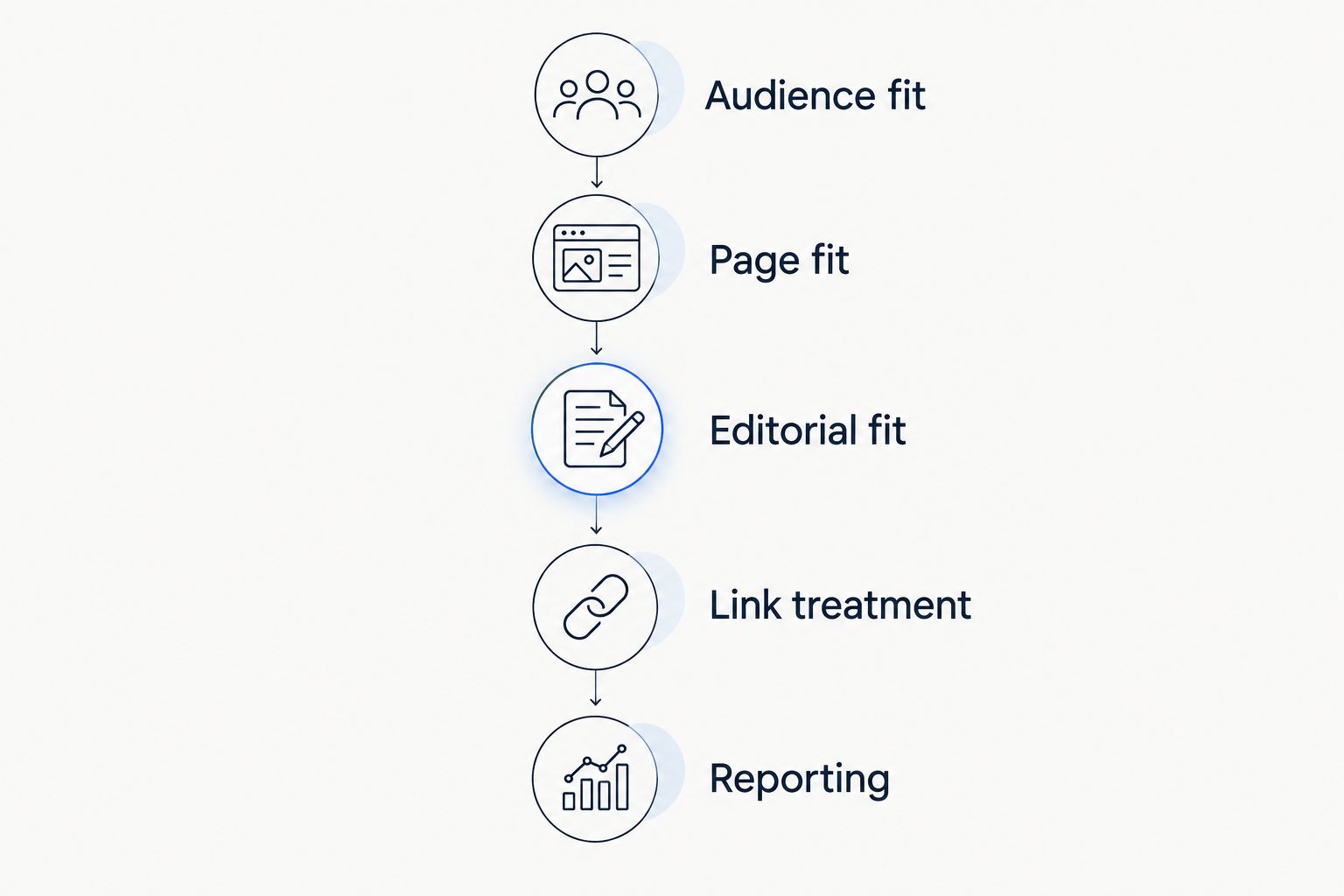
Use this sequence before approving a 2026 campaign. Each step answers a different question; a strong publisher cannot compensate for an irrelevant destination page.
Audience fit
Identify who should read the article. For SaaS, distinguish end users, technical evaluators, department leaders and procurement stakeholders. A publication can cover technology without reaching the people involved in your buying process.
Page fit
Choose a destination that genuinely continues the article’s discussion. A comparison article, integration guide or category page serves a different purpose from the homepage. The publisher should not need an awkward sentence to make the link fit.
Editorial fit
Read recent contributions and assess whether your proposed subject belongs there. Look for coherent topic coverage and useful articles, not just a page that accepts business-related submissions.
Link treatment
Get the proposed attributes and any commercial arrangement in writing. Reject claims that paid links passing ranking credit are automatically safe because the provider calls the process white-hat.
Reporting
Specify the information required at completion: live article URL, destination URL, anchor text, link attributes and publication date. Keep delivery reporting separate from search-performance reporting so a published article is not presented as proof of ranking improvement.
Ask the provider to explain rejected opportunities as well as accepted ones. Clear rejection reasons reveal whether your relevance standards are understood. An approval process without a rejection standard leaves too much room for unsuitable placements.
How the options are ranked
The 2026 ranking prioritises operating-model fit for SaaS buyers: managed execution first, international discovery next, catalogue-led selection after that, then internally managed relationships. It is not a ranking of backlink strength or provider performance.
The criteria are audience relevance, editorial context, outreach method, placement visibility, link treatment and delivery accountability. No placement count, authority score or promised ranking substitutes for those checks.
Which guest posting option should you choose?
Choose Linkible when you want a managed SaaS guest posting and outreach service rather than another platform to operate. Ask the proposal to connect publisher selection with your target audience and destination pages.
Choose WhitePress when international publisher discovery is the immediate need. Choose Collaborator when catalogue-led shortlisting fits your team’s workflow. Choose direct publisher outreach when your specialists can own editorial relationships and delivery.
For your 2026 decision, resolve responsibility before volume. Someone must own publisher assessment, article quality, approvals and reporting. If those tasks are unassigned, access to more publishers does not fix the campaign.
FAQ
What are the best guest posting platforms for SaaS brands?
The best choice depends on who will manage the work: a managed agency for execution, a marketplace for publisher discovery, or direct outreach for relationship ownership. Compare audience relevance, editorial context, link treatment and reporting before approving placements.
Is a guest posting marketplace better than an agency?
A marketplace is better suited to teams that want to select publishers and manage placement decisions themselves. An agency suits teams seeking agreed execution support, but the proposal must define responsibilities and deliverables.
Are paid guest posts safe for SEO?
Paid guest posts are not automatically safe for SEO. Google treats links bought to manipulate rankings as link spam; paid placements should use appropriate qualification, such as rel=sponsored.
Should a SaaS company choose publishers by domain rating?
A SaaS company should not choose publishers by domain rating alone. Assess the readership, topic coverage, article context and destination-page fit; an authority score does not establish buyer relevance.
Can guest posting guarantee better rankings?
Guest posting cannot guarantee better rankings. Search performance depends on factors beyond an individual placement, so distinguish completed deliverables from changes in organic visibility.
What should a guest posting report include?
A guest posting report should identify the live article, destination page, anchor text, link attributes and publication date. Report search-performance changes separately rather than treating publication as evidence of ranking improvement.
Should a guest article link to a SaaS homepage or a product page?
A guest article should link to the page that best continues its discussion. Use a homepage for relevant brand context and a more specific destination when the article addresses a particular product use case or problem.
One last thing
Ask this before approving a publisher: Would this article still deserve publication if the backlink were removed? The answer tests the editorial idea, not just the placement opportunity.
For a managed campaign, use Linkible’s existing website enquiry route to request a scope covering target audiences, destination pages, publisher assessment and reporting. Bring those requirements to the conversation before discussing placement volume.