The best link building tactics for SaaS startups start with relevant outreach. Compare six methods, spot risky placements and choose your next move.
Best overall: targeted resource outreach. Best for existing brand visibility: unlinked mention reclamation. Best low-overhead option: partner resource links. These are the best link building tactics for SaaS startups in 2026 when you need relevant backlinks without building an entire publishing operation.
- The best link building tactics for SaaS startups start with targeted resource outreach, not bulk prospect lists.
- Unlinked mention reclamation suits established brand visibility; partner resource links suit existing integrations and business relationships.
- Linkible offers SaaS link building support through outreach, with digital PR and niche edits as supporting services.
- Judge backlink opportunities by relevance, editorial context and reporting—not domain authority alone.
Why this matters
A bootstrapped SaaS startup has limited time for assets, prospecting and follow-ups. Your first tactic should use something you already have: a useful resource, a genuine partnership, a customer insight or expertise a publisher needs.
Linkible is best for SaaS teams seeking agency support for outreach-led link building. Linkible provides link building and digital PR services; assess any proposed campaign against the same relevance and reporting criteria you would apply internally.
For your 2026 plan, separate the work you can control from the outcome a publisher controls. You control prospect selection, your pitch and your content. An independent editor controls whether a backlink belongs in the article.
What makes the best SaaS link building tactics?
Use these criteria before choosing a tactic or approving an agency proposal:
- Buyer relevance: The referring page addresses problems your prospective customers recognise.
- Editorial justification: The link supplies evidence, context or a practical next step—not an inserted keyword.
- Existing assets: You can start with material or relationships you already have.
- Repeatable outreach: You can identify further relevant prospects without repeating the same generic pitch.
- Visible deliverables: You can inspect prospects, destination pages, anchor text and live placements.
- Manageable risk: The method avoids concealed sponsorship, automated link spam and contractual demands for ranking credit.
A high domain authority score does not answer these questions. Use authority metrics as screening inputs, not as permission to ignore an irrelevant page.
SaaS link building tactics at a glance
| Tactic | Best for | Standout feature | Key limitation |
|---|---|---|---|
| Targeted resource outreach | Startups with a useful educational asset | Gives publishers a specific reason to cite you | Weak assets undermine the pitch |
| Unlinked mention reclamation | Brands already discussed online | Starts with an existing editorial mention | Requires genuine mentions to exist |
| Partner resource links | Startups with integrations or business relationships | Connects links to real product relationships | Depends on partner relevance and participation |
| Expert guest contributions | Founders with specialist expertise | Reaches a publisher’s established audience | Requires substantial writing and editing |
| Original research outreach | Teams with credible proprietary evidence | Supplies information other articles can cite | Research quality and permissions need attention |
| Journalist expert commentary | Founders able to answer timely questions | Matches expertise to active editorial needs | Publication and attribution remain uncertain |
1. Targeted resource outreach: best for existing educational assets
Targeted resource outreach asks a publisher to cite a genuinely useful page. That page might explain a technical workflow, document a methodology or solve a recurring implementation problem. The pitch identifies exactly where the resource improves the publisher’s existing article.
Start by reviewing 10 relevant pages, rather than assembling an indiscriminate database. Look for a missing explanation your resource supplies. If your proposed link adds nothing beyond a product promotion, improve the destination before contacting anyone.
Targeted resource outreach pros:
- Uses an educational asset you already own.
- Makes the link’s editorial purpose explicit.
- Keeps prospect selection close to your buyer’s problems.
Targeted resource outreach cons:
- Requires a resource that deserves a citation.
- Publisher silence does not explain whether the asset or pitch failed.
Best for: SaaS startups with documentation, templates or educational content that answers a specific question.
Verdict: Buy into this tactic first when you have a strong destination page.
2. Unlinked mention reclamation: best for existing brand visibility
Unlinked mention reclamation identifies published references to your company, product or research that do not link to the original source. You then ask whether a source link would help readers verify the reference or find the product being discussed.
Check the surrounding paragraph before sending anything. A passing mention does not automatically deserve a backlink, and a publisher’s attribution policy takes precedence over your preferred anchor text.
Unlinked mention reclamation pros:
- Starts with demonstrated publisher awareness.
- Requires no new article when the existing reference is sufficient.
- Creates a clear reason to link to the original source.
Unlinked mention reclamation cons:
- Offers little scope when your brand has few mentions.
- Some publishers intentionally omit commercial links.
Best for: Startups whose founders, products or research already appear in relevant publications.
Verdict: Buy into reclamation when genuine mentions exist; skip it as your main acquisition strategy otherwise.
3. Partner resource links: best for existing product relationships
Partner resource links connect a genuine business relationship to useful documentation. Examples include an integration directory, a joint implementation guide or a partner-authored explanation of how two services work together.
The relationship must come first. Do not manufacture reciprocal links between unrelated businesses or make a backlink a hidden condition of collaboration. A partner page should explain something a shared customer actually needs.
Partner resource links pros:
- Starts with people who already understand your product.
- Supports resources with a clear customer purpose.
- Can use existing integration documentation.
Partner resource links cons:
- Depends on partners having suitable publishing opportunities.
- Excessive reciprocal linking creates a different risk from genuine documentation.
Best for: SaaS startups with integrations, implementation partners or established complementary products.
Verdict: Buy into this low-overhead option when the relationship and resource are real.
4. Expert guest contributions: best for narrow buyer audiences
Expert guest contributions place your knowledge in a publication your target customers already read. The article should answer a question the publisher wants covered, with attribution and links governed by editorial policy.
Pitch a specific argument, not a generic offer to write about software. A founder explaining an implementation trade-off gives an editor something to evaluate; a request for an exact-match backlink does not.
Expert guest contributions pros:
- Lets you demonstrate expertise in context.
- Supports topics too specialised for broad media coverage.
- Gives the publisher original editorial material.
Expert guest contributions cons:
- Requires writing time and editorial revisions.
- A published article does not guarantee a product-page link.
Best for: Founders with practical knowledge and a clearly defined professional audience.
Verdict: Buy into expert contributions selectively; skip publishers selling unrestricted keyword anchors.
5. Original research outreach: best for credible proprietary evidence
Original research outreach gives publishers a finding they can reference. Suitable material includes permissioned survey results, documented product observations or an analysis with a clearly explained method.
Publish the methodology alongside the conclusion. Explain the population, collection period, exclusions and limitations. If your evidence describes only your own users, do not present it as representative of every SaaS customer.
Original research outreach pros:
- Gives citations a clear factual purpose.
- Creates an asset beyond a standard opinion article.
- Connects outreach to expertise your business actually holds.
Original research outreach cons:
- Requires careful analysis and privacy checks.
- Weak sampling limits the claims you can defend.
Best for: Startups with permissioned data, research capability and a finding relevant to their market.
Verdict: Hold until your evidence and methodology can withstand editorial scrutiny.
6. Journalist expert commentary: best for timely founder expertise
Journalist expert commentary matches a founder’s knowledge to a reporter’s active question. Answer directly, explain your relevant experience and disclose commercial interests. Do not stretch outside your expertise simply because the publication has attractive authority metrics.
Editorial coverage and announcement distribution are different jobs. Evaluate press release services for startups against your announcement-distribution needs, not as evidence that an independent journalist has endorsed your company or awarded an editorial backlink.
Journalist expert commentary pros:
- Uses expertise rather than a large content library.
- Responds to a defined editorial need.
- Can support founder visibility alongside link acquisition.
Journalist expert commentary cons:
- Requests require timely, accurate responses.
- A quotation can appear without a backlink.
Best for: Founders who can provide specific, defensible answers on relevant subjects.
Verdict: Buy into selective commentary; skip generic responses and guaranteed-coverage promises.
Turn one tactic into a controlled campaign
For a bootstrapped SaaS team, running every tactic at once obscures what needs fixing. Choose one primary method for a 30-day operating cycle, then review delivery and publisher responses. That period is a management checkpoint, not a promise of ranking movement.
Use this sequence for your 2026 campaign:
- Choose destination: Pick a page that serves the reader and connects to a business priority.
- Qualify publishers: Check subject relevance, editorial quality and the specific page opportunity.
- Approve outreach: Review the pitch, supporting evidence and proposed destination.
- Verify placements: Inspect live pages, link attributes, anchor text and surrounding copy.
- Review outcomes: Separate completed work, publisher responses and search performance.
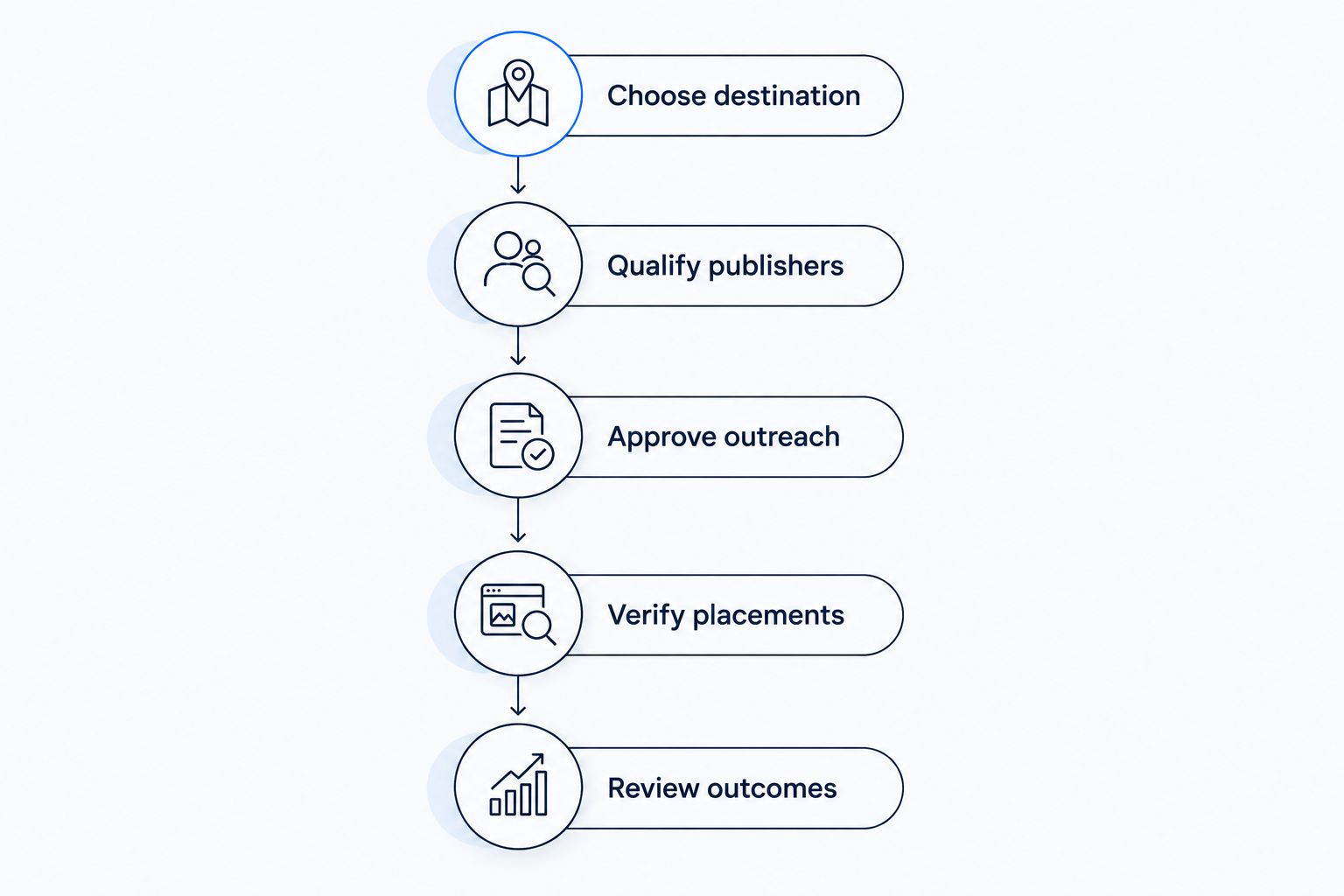
Keep a separate reason for every prospect you approve. If the explanation is only an authority score, return to qualification. A relevant page with an obvious citation opportunity gives your outreach a clearer editorial argument.
What to require from a SaaS link building agency
Ask Linkible or any shortlisted agency to explain how its proposed method fits your assets and target buyers. “White-hat” is a positioning claim; inspect the actual prospecting, outreach and placement practices behind it.
Your 2026 brief should require:
- Publisher selection: Why the audience and page belong in your campaign.
- Outreach method: Whether the team contacts editors manually and how pitches are personalised.
- Commercial disclosure: Whether money, products or other benefits change hands.
- Placement reporting: Live URL, destination URL, anchor text, link attributes and verification date.
- Exception handling: What happens when a publisher changes or removes a link.
For US, UK or Canadian buyer campaigns, assess the publication’s audience rather than relying on its domain suffix. A country-specific address does not prove that your prospective customers read the page.
Reject guaranteed ranking positions. Relevant outreach and transparent reporting are deliverables you can inspect; search rankings remain an outcome influenced by more than backlinks.
How the tactics are ranked
This ranking prioritises relevance, editorial justification, existing assets, repeatable outreach, visible deliverables and manageable risk. It is a decision framework, not a claim that these tactics underwent comparative performance testing.
Targeted resource outreach ranks first because the publisher can evaluate a concrete contribution to an existing article. Reclamation and partner links follow when the necessary mentions or relationships exist. Research and commentary require evidence or responsiveness that not every bootstrapped team can supply.
Which SaaS link building tactic should you choose?
Choose targeted resource outreach as your default. Start elsewhere only when your existing assets make the decision clear: reclaim genuine mentions, document real partnerships or contribute expertise to a narrowly relevant publication.
Before outsourcing, prepare a one-page brief with your target customer, priority destination, existing assets and unacceptable placement practices. Give each agency the same brief so you can compare proposed work rather than sales language.
FAQ
What's the best link building tactic for a bootstrapped SaaS startup?
Targeted resource outreach is the default when a SaaS startup has a useful educational asset. Choose publishers whose existing articles genuinely benefit from that resource.
Should a new SaaS startup start with unlinked mentions?
Start with unlinked mention reclamation only when genuine published mentions already exist. A startup without those references needs another source of editorial relevance.
Are guest posts better than partner links for SaaS?
Guest contributions suit specialist expertise; partner links suit genuine integrations and business relationships. Choose the method supported by your existing assets rather than treating either as universally better.
Is domain authority enough to judge a backlink?
No, domain authority alone does not establish a backlink's relevance or editorial quality. Inspect the referring page, audience, surrounding copy and link attributes.
Does press release distribution guarantee editorial backlinks?
No, announcement distribution does not guarantee independent editorial backlinks. Judge distribution and journalist coverage as separate activities with different deliverables.
What should a link building agency report?
Require the live placement URL, destination URL, anchor text, link attributes and verification date. Ask the agency to explain publisher relevance and disclose any compensated placement arrangements.
How soon should a startup review its outreach campaign?
Use a 30-day operating cycle to review campaign delivery, prospect quality and publisher responses. Treat that checkpoint as operational oversight, not a deadline for ranking improvements.
One last thing
Your next backlink decision starts on your own website. In 2026, review the destination before approving another prospect: does it answer the question promised in the outreach pitch, and does the citation help the publisher’s reader?
Next step: visit Linkible with your priority page, buyer profile and existing assets ready for an enquiry. Ask for a proposed outreach approach, publisher criteria and reporting format before committing.
Discuss your SaaS outreach priorities
Bring your target audience, priority pages and existing assets to the enquiry.