Compare the best backlink checker tools: Ahrefs leads for competitor research. Review strengths, limits and checks before planning your outreach.
Best overall: Ahrefs. Best for combined SEO research: Semrush. Best for checking your own site: Google Search Console. This 2026 guide compares backlink analysis tools and explains how to turn their findings into a link-building brief for Linkible or your internal team.
- Ahrefs leads this best backlink checker tools shortlist for dedicated competitor backlink research.
- Semrush suits teams combining backlink analysis with keyword research and site audits.
- Google Search Console reports links to verified properties, not competitors’ backlink profiles.
- Linkible is a link-building agency, not a backlink checker; use research to define your outreach brief.
Why this matters
A backlink checker helps you investigate who links to a website, which pages attract links and where competitors earn coverage. It does not establish that every reported link benefits rankings. Your decision still depends on publisher relevance, editorial context and the destination page.
For SaaS and ecommerce teams choosing tools in 2026, the useful output is a prioritised action list: investigate a publisher, improve a linkable asset, recover a missing link or reject an unsuitable prospect. A larger spreadsheet is not the objective.
Choose the checker that answers your link-building questions, not the one with the most impressive authority score.
What makes the best backlink checker tools?
Use these criteria before comparing features:
- Competitor research: Can you inspect other domains and identify relevant referring websites?
- Page-level context: Can you connect a backlink to its source page, anchor text and destination?
- Change tracking: Can you investigate newly discovered and lost links without treating every change as a confirmed editorial event?
- Workflow fit: Does the tool support dedicated link research or a broader SEO workflow?
- Metric clarity: Can your team distinguish proprietary authority scores from Google ranking signals?
- Actionable reporting: Can you turn findings into outreach priorities and explain why each prospect belongs?
Before committing, inspect 10 referring domains from a competitor report. Open the source pages and assess whether the tool helps you separate relevant editorial coverage from directories, syndicated copies and unrelated mentions. That small review makes the buying decision concrete.
Best backlink checker tools at a glance
| Tool | Best for | Standout feature | Key limitation |
|---|---|---|---|
| Ahrefs | Dedicated competitor backlink research | Site Explorer backlink and referring-domain reports | Its index is not a complete record of every link |
| Semrush | Combined SEO research | Backlink Analytics alongside keyword and site-audit workflows | Broad functionality adds complexity for backlink-only work |
| Google Search Console | Checking links to your own site | Links reporting for verified properties | No competitor backlink analysis |
| Majestic | Topical link investigation | Topical Trust Flow | Narrower scope than an all-purpose SEO suite |
| Moz Link Explorer | Authority-metric comparisons | Domain Authority, Page Authority and linking-domain research | Authority scores do not establish editorial relevance |
No checker should be treated as a complete inventory of the web. Different crawlers discover and retain different links, so disagreements between reports require investigation rather than an automatic verdict that one tool is wrong.
1. Ahrefs: best backlink checker for competitor research
Ahrefs is the strongest default on this shortlist for teams whose main task is researching competitors’ backlinks. Site Explorer connects referring domains, backlink source pages, anchors and linked destinations, giving you several ways to investigate how a competing website earns links.
Start with the page, not just the domain. A competitor’s integration guide, original research or category resource can reveal a more useful outreach opportunity than its homepage backlink total.
Ahrefs pros:
- Dedicated reports support detailed backlink and referring-domain investigation.
- Anchor and destination-page analysis help explain the context behind links.
- New and lost backlink views support ongoing investigation.
- Competitor comparisons help identify websites to assess for outreach.
Ahrefs cons:
- Its crawler cannot provide a complete record of every existing backlink.
- Domain Rating is an Ahrefs metric, not a Google score or proof of publisher quality.
- Research still requires manual checks before a publisher enters your outreach list.
Best for: SaaS and ecommerce teams conducting regular competitor backlink research.
For a 2026 evaluation, compare the same competitor pages across your shortlisted tools. Judge whether Ahrefs makes the next action clear: investigate the publisher, study the content or discard the lead.
Verdict: Buy for dedicated backlink research; do not buy solely to monitor Domain Rating.
2. Semrush: best backlink checker for combined SEO research
Semrush suits teams that want backlink analysis alongside keyword research and technical site auditing. Backlink Analytics supports competitor investigation, while the wider platform connects that work to other SEO tasks.
That combination matters when one team owns content, technical fixes and outreach. You can keep the research process within a broader SEO environment rather than adopting a separate tool solely for backlinks.
Semrush pros:
- Combines backlink research with other established SEO workflows.
- Supports referring-domain, anchor and backlink investigation.
- Competitor comparison helps organise potential outreach opportunities.
- Backlink Audit provides a separate workflow for reviewing a connected site's link profile.
Semrush cons:
- A broad interface creates extra choices when you only need backlink research.
- Automated risk labels do not establish that a link causes a ranking problem.
- Its backlink inventory still reflects its own discovery and indexing processes.
Best for: Marketing teams managing link research, keyword planning and site health together.
Keep prospecting separate from risk assessment. A competitor backlink report helps you find publishers; a warning label requires a different investigation and is not a reason to request removal automatically.
Verdict: Buy when a combined SEO workflow is the priority; skip it as an additional suite without a distinct job.
3. Google Search Console: best for checking your own backlinks
Google Search Console provides a Links report for properties you verify. It shows information about external links, linking sites, linked pages and linking text, making it useful for reviewing your own website through a Google-provided reporting interface.
It is not a competitor research tool. The Links report also does not show every link Google knows about or explain the ranking value assigned to a particular backlink.
Google Search Console pros:
- Provides link reporting directly within Google's site-owner platform.
- Helps identify reported external linking sites and linked pages.
- Supports a practical cross-check against third-party discoveries.
- Keeps link review alongside your own search-performance reporting.
Google Search Console cons:
- Requires access to a verified property.
- Does not provide competitor backlink profiles.
- The report is not a complete backlink inventory or a link-value assessment.
Best for: Website owners checking reported links to their own properties.
For a 2026 reporting process, treat Google Search Console as an additional source, not an arbiter of every third-party finding. A link missing from its report is not proof that Google ignores that link.
Verdict: Hold as your owned-site reference; add a competitor research tool when prospecting becomes necessary.
4. Majestic: best backlink checker for topical investigation
Majestic focuses on link intelligence. Its Trust Flow, Citation Flow and Topical Trust Flow metrics provide different ways to investigate a website's link profile, including the topical categories associated with its links.
Topical context is useful when a domain looks authoritative but its subject matter does not match your buyers. Use the metrics to guide investigation, then inspect the actual publication and linking page.
Majestic pros:
- Provides specialist link-analysis workflows.
- Topical Trust Flow adds a subject-focused lens to link investigation.
- Trust Flow and Citation Flow provide distinct proprietary comparison metrics.
- Historical link data supports research into changes in a backlink profile.
Majestic cons:
- It is less suited to teams seeking a single platform for broad SEO tasks.
- Topical categories do not replace reading the publisher's content.
- Its metrics do not establish whether an individual placement is editorially appropriate.
Best for: Link-building specialists assessing topical patterns across prospective publishers.
A software business should investigate why a prospect's link profile relates to its topic, not accept a category label as sufficient evidence. The same principle applies to an ecommerce publication covering several unrelated product categories.
Verdict: Buy for specialist topical investigation; skip it if you need a general-purpose SEO workspace.
5. Moz Link Explorer: best for authority-metric comparisons
Moz Link Explorer supports backlink and linking-domain research alongside Moz's Domain Authority and Page Authority metrics. It suits teams that already use those metrics to compare websites and need a consistent research framework.
Consistency matters more than switching between scores. Domain Authority, Domain Rating and Trust Flow use different methodologies; they are not interchangeable measurements of the same quantity.
Moz Link Explorer pros:
- Supports backlink and linking-domain investigation.
- Includes both domain-level and page-level authority metrics.
- Helps teams maintain a consistent Moz-based comparison process.
- Provides another perspective when investigating differences between link reports.
Moz Link Explorer cons:
- Domain Authority is not a Google ranking factor.
- A strong domain-level score does not validate a specific linking page.
- Existing reporting habits are not enough reason to ignore editorial relevance.
Best for: Teams using Moz metrics in established prospecting and reporting workflows.
Set your acceptance criteria before reviewing scores. A relevant publication with a clear editorial purpose deserves investigation; a high-scoring domain with unrelated content still needs scrutiny.
Verdict: Buy for an established Moz-based workflow; skip score chasing as a link-building strategy.
How we ranked these backlink checkers
This ranking prioritises practical research tasks: competitor discovery, page-level context, link-change investigation and workflow fit. It does not rank tools by claimed index size or assume that finding more links means finding better opportunities.
Ahrefs takes the default position for dedicated backlink research. Semrush wins the broader-workflow slot, Google Search Console covers owned-site reporting, Majestic adds topical investigation and Moz supports authority-metric consistency.
For your 2026 shortlist, judge each tool against the same research task. Keep the target domain, competitor set and review criteria consistent.
Turn backlink research into an outreach brief
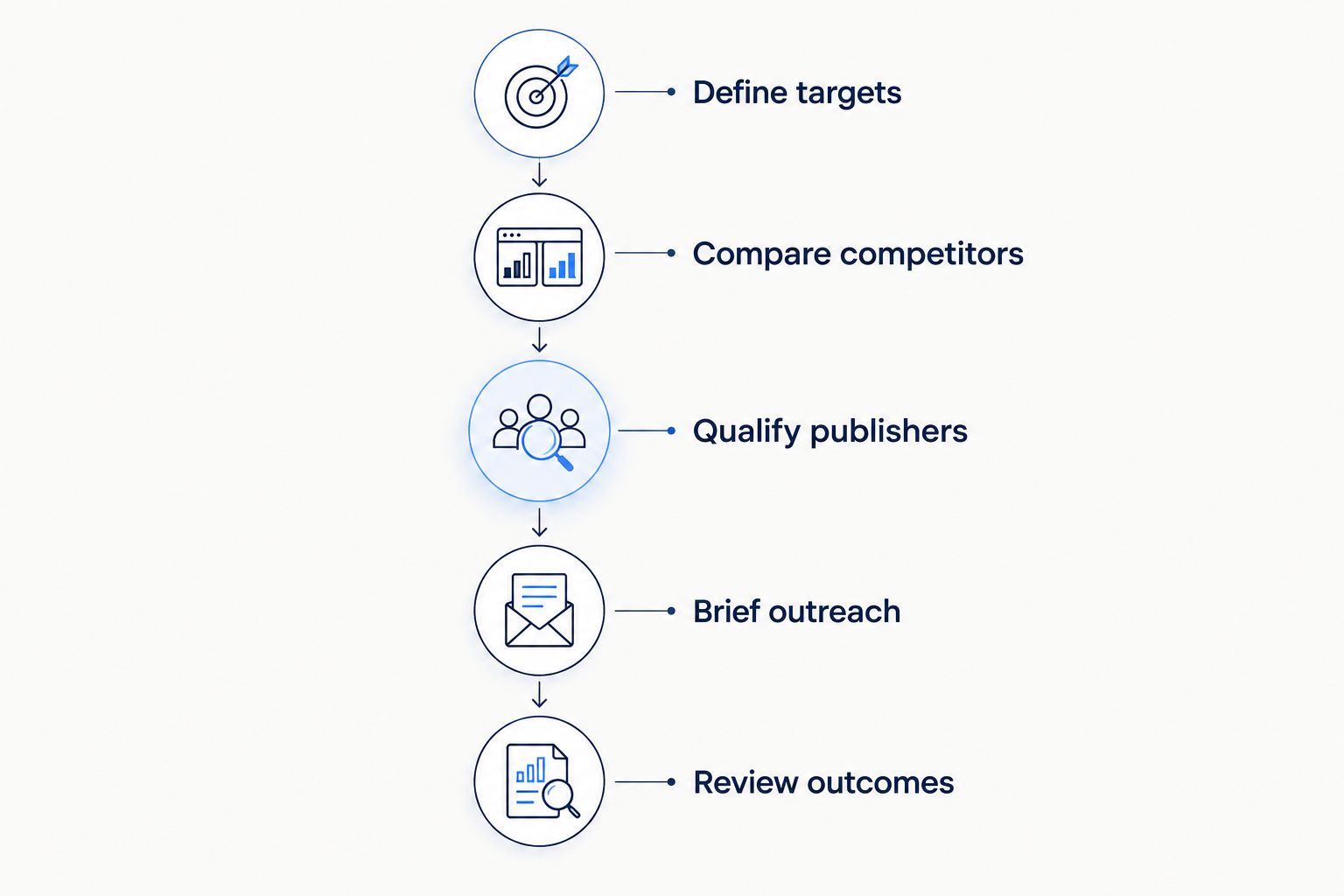
A checker identifies leads. Your qualification process decides which publishers deserve attention. Use this sequence before asking an agency to build links.
Define targets
Choose the pages that support your commercial goals. Separate product pages, category pages and informational assets so each outreach idea has a relevant destination.
Compare competitors
Review 3 competitors serving a similar audience. Include page-level competitors, not just the largest brands in your market; their linking patterns can answer different questions.
Qualify publishers
Check topic relevance, editorial context and whether the proposed destination genuinely helps the reader. Reject prospects that only look attractive because of an authority score.
Brief outreach
Specify the destination, audience, suitable publisher types and acceptable outreach methods. Ask for manual outreach, placement context and a reporting format that explains each delivered link.
Review outcomes
After 30 days, review discovery progress, publisher responses and completed placements separately. Use that checkpoint to improve the brief, not to demand a predetermined ranking movement.
Linkible's link-building services are a separate decision from your research software. Ask Linkible to explain publisher relevance, outreach methods, placement deliverables and reporting before you choose a service.
Which backlink checker should you choose?
Choose Ahrefs if your main requirement is competitor backlink research. Choose Semrush instead when the same team also needs keyword research and technical SEO workflows. Keep Google Search Console in your own-site review process regardless of that choice.
Add Majestic or Moz only when their distinct analysis fits a real task. Running several tools without an agreed qualification process creates conflicting spreadsheets rather than better outreach decisions.
In 2026, the buying question remains practical: which tool helps your team identify relevant publishers and explain the next action?
FAQ
What's the best backlink checker for competitor research?
Ahrefs is the default recommendation here for dedicated competitor backlink research. Its backlink, referring-domain, anchor and destination-page reports support detailed investigation before outreach.
Is Semrush better than Ahrefs for backlinks?
Semrush is the better fit when you want backlink analysis within a broader SEO workflow. Ahrefs is the default choice in this guide when dedicated competitor backlink research is the main requirement.
Can Google Search Console show competitor backlinks?
No. Google Search Console provides link reporting for properties you verify, so competitor backlink research requires another tool.
Why do backlink checkers show different results?
Backlink checkers use different crawlers, discovery processes and indexes. Compare the actual source pages rather than assuming different totals mean a tool is inaccurate.
Does a high authority score mean a backlink is good?
No. Authority scores are proprietary metrics, and a high score does not establish topical relevance, editorial quality or the suitability of a particular placement.
Should I disavow every link a tool labels toxic?
No. Google advises using the disavow tool cautiously, principally when substantial artificial links have caused or are likely to cause a manual action. An automated risk label alone is not sufficient justification.
Do I need a backlink checker before hiring a link-building agency?
No. You need clear target pages, audience priorities and expectations for publisher selection and reporting. A checker helps you investigate opportunities, but it does not replace evaluating the agency's outreach methods.
One last thing
A competitor's backlink is evidence of a placement, not evidence that you should copy it. Read the source page before adding the publisher to your brief. If the link does not help the intended reader, its authority score does not fix the mismatch.
Your next step is to take your target pages and publisher criteria to Linkible through the enquiry route on its website. Ask for a clear explanation of outreach methods, deliverables and reporting before agreeing to a campaign.