Linkible vs Engine Scout: choose link-building support by scope, publisher relevance, outreach methods and reporting. Use a practical proposal checklist.
Choose Linkible if you need a specialist link-building agency for outreach, niche edits or digital PR; choose Engine Scout if its written proposal covers the wider SEO responsibilities you need under one accountable team. The deciding factor in 2026 is the work each agency commits to delivering, not the number of services listed in a pitch.
- Linkible vs Engine Scout is a scope decision: specialist link building versus the responsibilities defined in your agency proposal.
- Linkible is best for brands seeking a dedicated link-building agency with outreach, niche edits and digital PR services.
- Choose Engine Scout for a broader brief only when its proposal explicitly covers that work and names its owners.
- Compare publisher relevance, outreach methods, reporting and contract terms before selecting either agency.
Why this matters
A SaaS company with strong content needs a different agency brief from an ecommerce store with unresolved indexing problems. Buying backlinks does not resolve every technical or content issue. Buying a broad SEO engagement does not automatically secure a focused outreach programme.
For your 2026 shortlist, separate the work your team already owns from the work you need to outsource. Choose a specialist for a defined link-building gap; choose a wider engagement only when you need those additional responsibilities covered.
At a glance
Read the Engine Scout column as proposal requirements, not assumed inclusions. Award work against explicit commitments rather than agency labels.
| Dimension | Linkible | Engine Scout |
|---|---|---|
| Best for | Brands seeking specialist link-building services | Buyers whose proposal explicitly covers their wider SEO brief |
| Standout service fit | Outreach, niche edits, digital PR and HARO link building | Judge against the specific work offered in your proposal |
| Publisher relevance | Require audience and topic checks for each placement | Apply the same publisher checks to any proposed link work |
| Outreach methods | White-hat outreach is part of the stated offering | Require a written explanation of sourcing and outreach methods |
| Reporting | Request placement-level evidence and search-performance context | Require reporting separated by contracted workstream |
| Ownership | Best suited to a clearly bounded link-building brief | Prefer for wider ownership only when responsibilities are explicit |
| Pricing model | Compare the billing basis and included deliverables in the quote | Compare the billing basis and included deliverables in the quote |
Specialist link building favours a clearly bounded brief
Linkible is a link-building agency for brands that need outreach rather than a replacement for their entire SEO function. Its stated services include white-hat outreach, niche edits, digital PR and HARO link building. SaaS and ecommerce businesses are among its stated client categories.
That service fit matters when your team already handles technical SEO, content production and conversion work. You can give a specialist a defined set of destination pages, audience priorities and editorial constraints instead of outsourcing an undefined ranking objective.
The limitation is equally important: a link-building brief is not a substitute for resolving other search problems. Do not treat a placement agreement as a commitment to fix crawling, rebuild category pages or rewrite product messaging.
Before choosing either agency, answer 3 scope questions:
- What stays internal? Name the person responsible for technical SEO and on-site content.
- What gets outsourced? Specify outreach, publisher assessment and placement delivery separately.
- What counts as acceptance? Define the evidence required before a placement is accepted.
A broader proposal wins only when you need broader ownership
Engine Scout is the stronger choice for a wider brief if its proposal explicitly accepts that brief and your team needs those responsibilities outsourced. A general promise to improve organic traffic is not enough. You need named tasks, owners and exclusions.
For a SaaS marketing lead, broader ownership might mean coordinating content priorities with technical recommendations and outreach. For an ecommerce lead, it might mean coordinating category-page changes with the pages selected for link acquisition. These are requirements to put in your brief, not services to assume either agency includes.
The benefit of a wider engagement is coordination when the scope genuinely covers connected tasks. The drawback is reduced clarity if link-building work disappears inside a general activity report.
Use your 2026 procurement brief to separate each workstream. Ask who implements recommendations, who approves changes and who resolves delays. Engine Scout should win this dimension only when the written responsibilities match work you actually need—not because a broader contract sounds more convenient.
Neither agency name replaces publisher relevance checks
Publisher quality is a placement-level decision, not a brand-level assumption. Apply the same checks to both agencies. A familiar agency name does not make an unrelated website relevant to your buyers.
For SaaS outreach, assess whether the publication covers your problem category and whether the proposed article offers a credible reason to reference your page. For ecommerce outreach, assess the relationship between the publisher's subject matter, the article and your product or category page.
Ask these questions before approving a publisher:
- Topic fit: Does the publication consistently cover a relevant subject?
- Audience fit: Would its readers reasonably care about your page?
- Editorial context: Does the surrounding article support the reference?
- Site quality: Does the site show genuine editorial purpose rather than unrelated placement inventory?
Authority metrics can support assessment, but they do not answer these questions alone. A high metric is not an exemption from reviewing the actual website.
This is an honest tie in the selection process: neither provider deserves preference without placement-level evidence.
Defined outreach methods beat a white-hat label alone
White-hat outreach is part of the specialist offering described here. Ask how that claim translates into publisher selection, editorial decisions and link attributes. A label is not a delivery specification.
Manual outreach and transparent reporting belong in your evaluation criteria. Ask who identifies prospects, who contacts editors and whether your team can review the intended approach. Do not assume these practices are exclusive to one provider.
Different methods need different checks:
- Outreach: Ask why the publisher would want to reference the destination page.
- Niche edits: Review the existing article and whether the added reference improves it.
- Digital PR: Confirm the underlying story, evidence and approval process.
- HARO link building: Ask which journalist-request channels are included in the proposed service.
For any paid placement, require appropriate link qualification. Google's link-spam policies distinguish editorial links from links created to manipulate rankings; a commercial arrangement needs scrutiny regardless of the agency delivering it.
The trade-off is control. Your agency can control its research and outreach process, but an independent editor controls editorial acceptance. Reject proposals that blur that distinction or promise search positions.
Reporting is a tie until the evidence separates the proposals
Neither agency earns a reporting win through a polished dashboard. The better report connects agreed work to verifiable placements and gives you enough context to assess the programme. Require a sample before signing.
Your 2026 reporting specification should contain 5 reporting fields:
- Placement URL: The live page containing the reference.
- Destination page: The exact page receiving the link.
- Anchor text: The wording used in the reference.
- Link attributes: The relevant qualification applied to the link.
- Delivery status: Whether the placement is proposed, live or awaiting resolution.
Keep these delivery fields separate from search-performance analysis. A list of live links demonstrates activity; it does not establish that every traffic change came from that activity.
For SaaS teams, monthly SEO agency reporting should distinguish completed outreach from changes in qualified organic enquiries, so delivery is not mistaken for business impact. The same principle applies to ecommerce reporting: separate placement delivery from changes in organic visits and sales.
Ask how the agency records content changes, technical releases and other concurrent work. That context prevents a single workstream from claiming credit for every improvement—or receiving blame for every decline.
Written ownership beats an implied full-service relationship
The strongest contract makes handoffs visible. It tells you who approves publishers, who supplies source material and who resolves a placement that no longer matches the agreement.
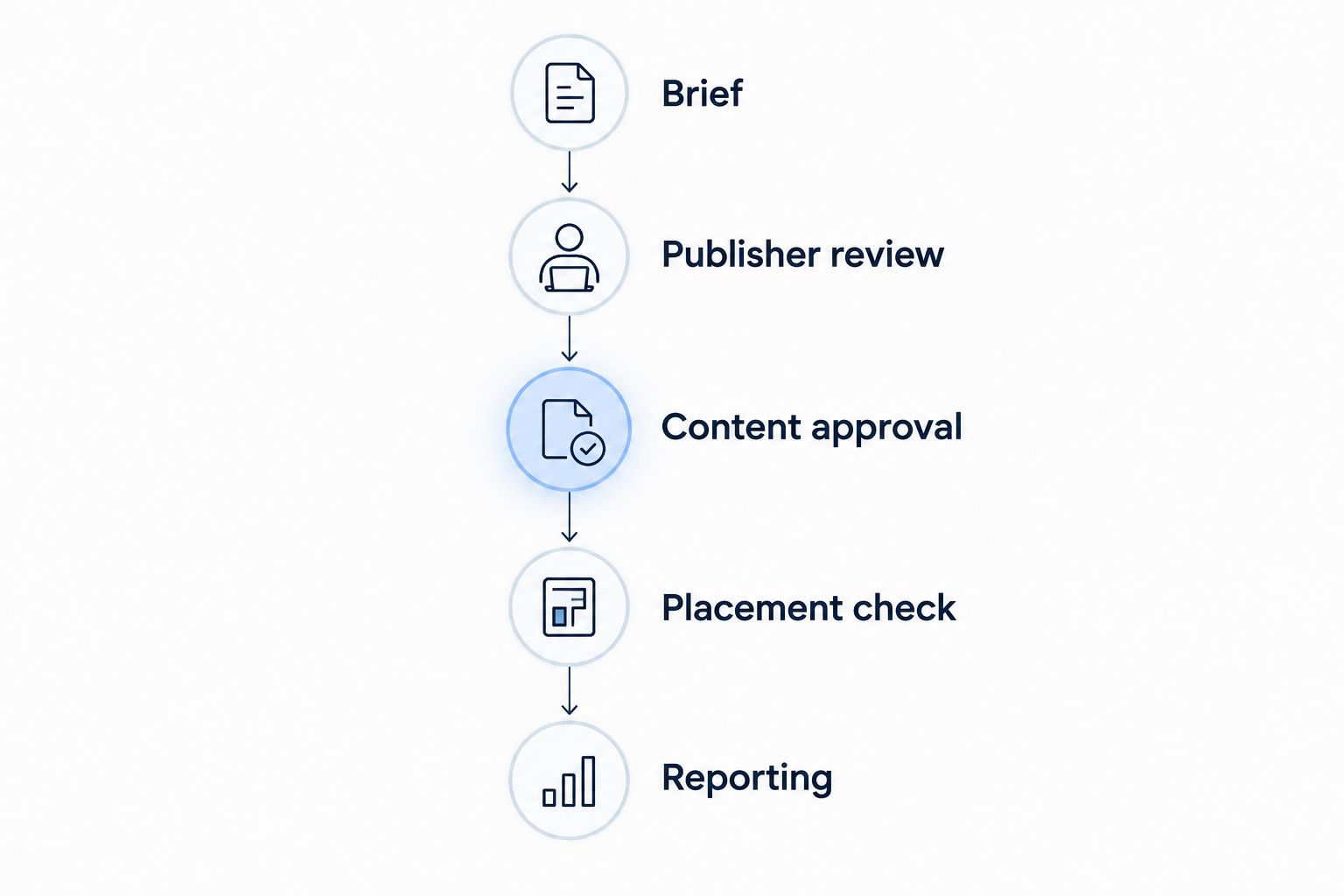
Use a simple approval sequence: Brief, Publisher review, Content approval, Placement check, Reporting. Each stage needs an owner. Do not let an agency's sales terminology decide where accountability begins or ends.
A specialist engagement works best when your internal owner can supply timely decisions and accurate business information. A wider engagement works best when the contract identifies who coordinates the connected workstreams.
For a 2026 agreement, also define escalation. If a proposed publisher fails your relevance criteria, specify whether it is replaced, revised or removed from the plan. If an article needs legal or product approval, name your approver before work starts.
Engine Scout wins wider ownership only through explicit contractual responsibility. A specialist wins a narrower brief when the handoffs remain clear. Neither arrangement removes your need for internal oversight.
Pricing: compare the model before comparing the total
Use the pricing information as a starting point, then request a written scope. Compare both agencies on what triggers billing, what work is included and what happens when delivery changes.
Do not assume either proposal uses a particular billing model. Instead, identify the model offered and its trade-off:
- Per-placement billing: Makes individual deliverables easier to inspect, but needs strict acceptance criteria.
- Retainer billing: Can support ongoing research and outreach, but needs clear activity and delivery reporting.
- Project billing: Creates a bounded engagement, but needs explicit revision limits and completion conditions.
These are contract structures to evaluate, not attributed features of either agency.
Ask whether content production, publisher communication and reporting sit inside the quoted scope. Then confirm how cancellations, rejected publishers and removed links are handled. The better commercial offer is the one whose obligations you can explain without interpreting sales language.
Final verdict: award the work your team actually needs
Choose Linkible if you own SEO and need link-building execution
Best for: SaaS and ecommerce marketing leads with an existing SEO owner and a defined outreach requirement. The stated service mix matches a brief centred on link building, with niche edits, digital PR and HARO as supporting methods.
Bring your target pages, audience criteria and approval rules. Require the proposal to explain publisher relevance, outreach methods and placement reporting before committing.
Choose Engine Scout if its proposal covers your wider delivery gap
Best for: Marketing leads who need several connected SEO responsibilities assigned to an external team and receive a proposal that explicitly accepts them. Choose Engine Scout on that evidence, not on assumed capabilities.
Keep link-building deliverables visible inside the wider scope. Broader ownership only helps when it removes a real coordination problem without obscuring the work you are buying.
One-glance scorecard
| Dimension | Winner or decision rule |
|---|---|
| Best for | Specialist for a defined outreach gap; broader provider for explicitly contracted wider work |
| Standout service fit | Specialist offering for outreach, niche edits, digital PR and HARO |
| Publisher relevance | Tie until placement-level evidence separates the proposals |
| Outreach methods | Proposal with documented sourcing and editorial safeguards |
| Reporting | Tie until a sample demonstrates usable evidence |
| Ownership | Engine Scout only if its proposal accepts the wider responsibilities you need |
| Pricing model | Proposal with clearer inclusions, acceptance criteria and billing triggers |
FAQ
Is Linkible or Engine Scout better for SaaS link building?
Linkible matches a specialist SaaS link-building brief through its stated outreach, niche edit, digital PR and HARO services. Choose Engine Scout instead when its proposal covers wider responsibilities your team needs outsourced.
Which agency should an ecommerce brand choose?
Choose the proposal that matches your ecommerce team's delivery gap. If the gap is outreach, assess publisher relevance and destination-page selection; if it includes other SEO work, require those responsibilities in writing.
Does a link-building agency replace an SEO team?
A link-building engagement does not automatically replace technical SEO, content production or conversion work. Include those responsibilities explicitly if you need them outsourced.
How should I compare agency pricing?
Compare billing triggers, included work and acceptance criteria before comparing totals. Confirm how the agreement handles rejected publishers, revisions and removed links.
What should I ask before approving a publisher?
Ask whether the publisher, article and destination page address a relevant audience and topic. Review editorial context and site quality rather than relying on an authority metric alone.
What should a link-building report include?
A link-building report should identify the placement URL, destination page, anchor text, link attributes and delivery status. Search-performance commentary should remain separate from evidence of completed delivery.
Can either agency guarantee higher rankings?
Do not select an agency on a ranking guarantee. Require commitments about work, approval standards and reporting rather than promised search positions.
One last thing
Ask both agencies to explain why a proposed publisher should be rejected. An answer built around audience mismatch, weak editorial context or unsuitable linking practices tells you more about quality control than a list of acceptable authority metrics.
Make the next step a defined brief, not an open-ended sales conversation. Send your priority pages, target audiences and existing SEO responsibilities through Linkible's contact page, and request a scope covering publisher assessment, outreach, approvals and reporting.