Compare Engine Scout alternatives for specialist link building. Choose an agency, in-house team or hybrid model using clear outreach and reporting checks.
Engine Scout has a continuity advantage when its team already understands your website and search priorities. That advantage stops being decisive when your next requirement is a dedicated link-building brief rather than simply continuing the existing arrangement. The best Engine Scout alternative in 2026 is Linkible if you need specialist link-building services; an in-house outreach team is the alternative if you need direct operational control.
- For engine scout alternatives focused on link building, shortlist Linkible for specialist outreach services.
- Choose in-house outreach when you have the people and processes to manage publisher relationships directly.
- Use a hybrid arrangement when you want to retain your agency while separating link-building delivery.
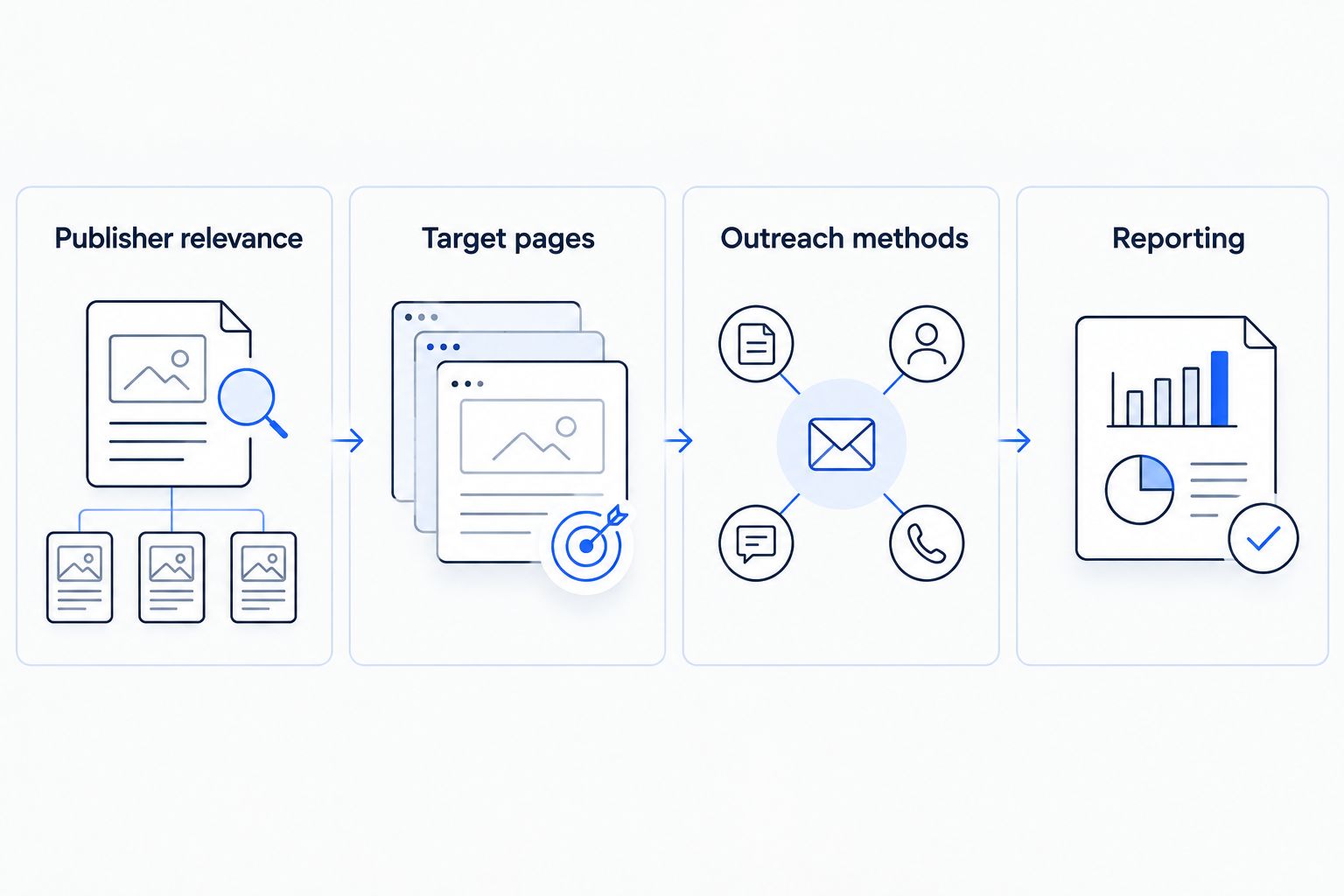
- Compare publisher relevance, outreach methods, placement terms and reporting before changing providers.
Why this matters
Changing an agency and changing how you acquire backlinks are different decisions. You can replace the entire relationship, move only outreach to a specialist, or bring publisher relationships inside your business.
For SaaS and ecommerce brands, the useful question is not which agency has the longest service list. It is which delivery model fits your target pages, internal resources and approval requirements. Your 2026 shortlist should answer that question before you request proposals.
Engine Scout alternatives at a glance
Use Engine Scout as the baseline for your current arrangement, not as a presumed poor performer. Compare each alternative against the work you actually need next.
| Option | Best for | Defining approach | Difference from keeping Engine Scout |
|---|---|---|---|
| Engine Scout | Continuity when your existing arrangement meets the brief | Retain the current relationship and evaluate its agreed deliverables | Your baseline; no provider transition |
| Linkible link-building services | Brands seeking a specialist link-building agency | White-hat outreach, niche edits, digital PR and HARO link building | A specialist link-building brief rather than an assumption about your existing scope |
| In-house outreach team | Brands wanting direct control of publisher relationships | Your team manages prospecting, outreach, approvals and reporting | Responsibility moves to your employees |
| Hybrid agency arrangement | Brands wanting to separate outreach from other agency work | Keep the existing relationship and assign a distinct outreach brief elsewhere | Changes delivery ownership without requiring a full agency replacement |
These are delivery choices, not a feature ranking. Compare actual proposals and responsibilities rather than treating every agency as interchangeable.
1. Linkible: best for specialist link-building services
Linkible is a link-building agency offering white-hat outreach, niche edits, digital PR and HARO link building. Its stated client coverage includes SaaS and ecommerce brands, making specialist backlink acquisition the relevant reason to consider it.
Best for: SaaS and ecommerce teams that want to evaluate a dedicated external link-building service.
Where the specialist approach shines
- Focused scope: You can build the brief around backlinks and outreach instead of replacing every part of your marketing operation.
- Relevant service options: Outreach, niche edits and digital PR give you distinct approaches to discuss against your target pages.
- Buyer fit: SaaS and ecommerce are explicitly included in the agency's stated client coverage.
Where the specialist approach falls short
- It is not a complete SEO brief: Hiring a link-building specialist does not remove your responsibility for technical fixes, content quality or conversion performance.
- It still needs internal input: Your team must identify priority pages, approve positioning and flag unsuitable publisher associations.
- The service description is not the delivery agreement: Publisher criteria, reporting fields and placement terms need to appear in the proposal.
For Linkible's link-building services, ask how manual outreach, publisher relevance and transparent reporting will work in your account. Treat those as requirements to confirm, not exclusive advantages established by a service label.
Specialist agency versus your Engine Scout arrangement
| Decision area | Specialist link-building brief | Engine Scout baseline to assess |
|---|---|---|
| Scope | Define outreach and backlink deliverables separately | Compare with the responsibilities in your current agreement |
| Target pages | Assign approved destination pages to the campaign | Check whether the existing plan already covers those pages |
| Approval | Specify publisher and anchor-text review requirements | Compare with your current approval process |
| Reporting | Require placement-level records and status updates | Compare with the reports you currently receive |
Request a proposed workflow before signing. A service menu tells you what an agency offers; the workflow tells you who selects publishers, approves copy and resolves placement issues.
Verdict: Buy only against a written link-building scope that matches your target pages and approval requirements.
2. In-house outreach: best for direct operational control
An in-house outreach team puts prospecting, correspondence and publisher relationships inside your business. Your employees decide which sites to approach and how to represent the brand.
Best for: Brands with an accountable outreach owner and enough internal capacity to manage the work consistently.
Where in-house outreach shines
- Relationship ownership: Publisher correspondence stays with your team rather than depending on an external account relationship.
- Direct approvals: Product, legal and marketing colleagues can contribute through your existing internal process.
- Business context: Your outreach owner can work directly with the people responsible for the destination pages.
Where in-house outreach falls short
- You own the workload: Prospect research, follow-ups, content coordination and placement checks all need assigned capacity.
- Continuity needs planning: Relationships and campaign records must remain accessible when employees change roles.
- Tools do not replace judgement: A prospect list still needs editorial review for relevance and suitability.
| Decision area | In-house outreach | Keeping the existing agency arrangement |
|---|---|---|
| Daily ownership | Your employees manage the workflow | Responsibilities follow the agency agreement |
| Publisher communication | Your team handles correspondence directly | Confirm who holds and manages those relationships |
| Quality review | Your team defines and enforces acceptance criteria | Review the agency's documented criteria |
| Continuity | Depends on internal staffing and records | Depends on the agreed delivery and handover process |
Before choosing this route in 2026, name the person accountable for outreach. Assigning the task to a marketing team without protected capacity does not establish a functioning outreach operation.
Verdict: Hold until you have an accountable owner, a documented workflow and capacity for ongoing publisher communication.
3. A hybrid arrangement: best for separating outreach ownership
A hybrid arrangement keeps your existing agency relationship while assigning link building to a separate specialist or internal team. It changes the boundary of the work rather than replacing everything at once.
Best for: Brands satisfied with parts of their existing arrangement but wanting a distinct outreach brief.
Where a hybrid arrangement shines
- Preserves work you want to retain.
- Gives outreach a separate scope and accountable owner.
- Lets you compare deliverables without assuming every marketing function needs replacing.
Where a hybrid arrangement falls short
- Separate teams need shared target-page and anchor-text instructions.
- Publisher lists need coordination to prevent duplicate approaches.
- Reporting requires clear ownership so the same placement is not counted twice.
| Decision area | Hybrid arrangement | Single-provider arrangement |
|---|---|---|
| Ownership | Split responsibilities in writing | Keep responsibilities within the existing agreement |
| Coordination | Share briefs, exclusions and placement records | Check the provider's internal coordination process |
| Evaluation | Review outreach as a distinct workstream | Evaluate outreach within the agreed overall scope |
Verdict: Buy only after every team agrees who owns prospecting, approvals, placements and reporting.
Why consider switching from Engine Scout?
A switch needs a specific business reason. Do not treat a competitor list as evidence that Engine Scout has delivery problems, unsuitable tactics or weak reporting.
The following are valid decision triggers when they describe your actual requirements:
- Scope mismatch: Your next brief centres on link acquisition, but the current agreement does not cover that work.
- Ownership mismatch: You want direct publisher relationships, making in-house outreach a better operating model.
- Approval mismatch: Your legal, product or brand team needs a review process that the proposed arrangement does not satisfy.
- Reporting mismatch: You need placement-level records that are not included in the agreed deliverables.
First ask whether your current arrangement can address the requirement. If it can, compare the revised scope with alternatives. If it cannot, you have a concrete reason to change rather than a vague preference for a different agency.
How to evaluate an outreach proposal in 2026
Use the same brief for every provider. Otherwise, a proposal covering publisher research and content production gets compared with one covering placement coordination alone.
Publisher relevance
Ask each provider to explain what makes a publisher suitable for your audience. A domain-level authority score does not explain whether a particular article belongs beside your brand.
Request 5 example publishers as a review exercise, not a promised placement list. For each example, examine the site's subject matter, the proposed page context and the reason its readers would benefit from the destination page.
Target pages
Start your evaluation brief with 3 priority pages. This keeps the discussion specific enough to expose weak reasoning about relevance and anchor text.
For SaaS, your chosen pages might serve distinct product or buyer questions. For ecommerce, consider whether the destination is a category, product or useful editorial resource. The link should make sense within the referring article, not merely satisfy an anchor-text request.
Outreach methods
Ask who researches prospects, writes messages and manages replies. Require an explanation of how publishers are selected and how commercial arrangements are handled.
Google's link-spam policies distinguish editorial links from links created to manipulate rankings. A white-hat label is not a substitute for reviewing the actual method and appropriate link qualification.
Reporting
Request a reporting example covering 2 reporting cycles. Use it to assess whether you can follow progress, pending work and completed placements without reconstructing the campaign yourself.
Useful fields include the referring page, destination URL, anchor text, link attributes, publication status and date checked. Define how the provider records removed or changed links.
Acceptance terms
Put acceptance criteria into the agreement before outreach begins. Specify prohibited publisher categories, required approvals and the process for handling a placement that differs from the approved brief.
For a US, UK or Canadian campaign, also state the intended audience and language requirements. A publisher's location alone does not establish audience relevance.
When staying with Engine Scout is the right call
Stay when your existing arrangement meets the brief and you can verify the agreed work. A provider change is not an SEO strategy by itself.
Before moving in 2026, compare the cost of coordination in operational terms: handover work, access permissions, open approvals and publisher correspondence. Keep the current arrangement if the alternative does not solve a specific requirement better.
FAQ
What's the best Engine Scout alternative for link building?
Linkible is a relevant shortlist choice when you need a specialist link-building agency. Its stated services include white-hat outreach, niche edits, digital PR and HARO link building; assess the proposed scope against your target pages.
Should I replace my agency or hire a separate outreach provider?
Hire a separate outreach provider when you want to retain other parts of your existing agency arrangement. Replace the wider relationship only when the wider scope also needs to change.
Is in-house link building better than hiring an agency?
In-house link building is the better operational fit when you need direct ownership and have capacity to manage outreach. An agency arrangement assigns delivery responsibilities externally, but still needs internal direction and approvals.
How do I compare link-building proposals fairly?
Give every provider the same target pages, publisher criteria, approval requirements and reporting brief. Compare the work included and the acceptance terms rather than comparing placement totals alone.
What should a backlink report include?
A useful backlink report identifies the referring page, destination URL, anchor text, link attributes and placement status. It should also record checks and explain how changed or removed links are handled.
Can a link-building agency guarantee rankings?
Do not treat a ranking guarantee as evidence of delivery quality. Ask for defined work, documented methods and transparent reporting rather than a promise about search positions.
Should I stay with Engine Scout in 2026?
Stay with Engine Scout when your current arrangement meets your requirements and its agreed deliverables are verifiable. Change providers only to address a specific scope, ownership, approval or reporting need.
One last thing
Ask the proposed provider to explain a publisher it would reject. That answer tests the quality standard more directly than a list containing only attractive examples.
Then send the same target-page brief to each shortlisted team. Your next decision should rest on a written delivery plan, not a longer list of agency names.
Related guides
- Link-building strategies for SaaS companies
- Link-building strategies for ecommerce stores
- Anchor-text strategies ranked by risk
Discuss your outreach brief
Share your target pages, audience and approval requirements to discuss a link-building scope.