Link building tactics ranked by domain authority impact: digital PR leads. Compare relevance, outreach methods and risks before choosing your next tactic.
Best overall: digital PR built on original evidence. Best for topical relevance: resource-led outreach. Best starting point for existing coverage: unlinked mention reclamation. These link building tactics ranked by domain authority impact prioritise editorial relevance and publisher quality—not promised increases in a third-party score.
- Link building tactics ranked by domain authority impact should prioritise relevant editorial links, not guaranteed score increases.
- Digital PR leads for original evidence; resource-led outreach fits sustained topical authority building.
- Linkible suits SaaS and ecommerce brands seeking managed link building and outreach services.
- Reclaim existing mentions before commissioning new assets; assess niche edits against Google's link spam policies.
Why this matters in 2026
Domain Authority is Moz's predictive metric, not a Google ranking factor. A higher score does not establish that your target pages will rank better or attract qualified buyers.
For SaaS and ecommerce brands, the useful question is which tactic earns relevant links to pages that support the buying journey. Linkible is a link building agency for brands seeking managed outreach rather than link-building software. Its link building services include outreach, niche edits, digital PR and HARO link building.
Treat the ranking below as a buying framework for 2026, not a measured league table of Domain Authority gains. No tactic delivers a fixed score increase, and publisher authority alone does not establish link quality.
What makes the best authority-building tactic?
Assess every proposal against these five criteria before comparing delivery volumes:
- Editorial independence: The publisher has a legitimate reason to reference your business or resource.
- Topical relevance: The linking page addresses a subject connected to your customers, product or expertise.
- Destination quality: The linked page answers the reader's next question and supports a useful customer journey.
- Publisher quality: The site publishes substantive content for an identifiable audience, rather than existing to sell links.
- Verifiable reporting: You can inspect the live URL, destination, anchor text and link attributes yourself.
Use these criteria when evaluating Linkible or another agency. Ask how publishers are selected, how outreach is conducted and what evidence accompanies each reported placement.
Authority-building tactics at a glance
The order reflects editorial potential, relevance and practical execution—not measured changes in Domain Authority. Match the use case before choosing a tactic.
| Rank | Tactic | Best for | Standout feature | Key limitation |
|---|---|---|---|---|
| 1 | Evidence-led digital PR | Original research and expert-led stories | Gives publishers a reason to cite original material | Requires a genuinely publishable story |
| 2 | Resource-led outreach | Sustained topical relevance | Connects useful assets with relevant publishers | Weak resources give editors little reason to link |
| 3 | Unlinked mention reclamation | Brands with existing editorial coverage | Starts with a publisher already mentioning the brand | Limited by existing mentions |
| 4 | Expert-source outreach | Subject-matter specialists | Matches expertise to a journalist's current question | Publication and linking remain editorial decisions |
| 5 | Editorial guest contributions | Specialist audience education | Lets experts explain a subject in depth | Quality writing and editorial approval take work |
| 6 | Broken-link outreach | Brands with a genuinely equivalent resource | Helps publishers repair an outdated reference | Relevant replacement opportunities are finite |
| 7 | Editorial niche edits | Useful additions to existing articles | Places a reference inside established content | Paid ranking links create policy risk |
1. Evidence-led digital PR: best for original research
Digital PR earns attention by giving publishers a story backed by evidence. That evidence can be original research, a documented analysis or a qualified expert's explanation of a current issue.
For a SaaS brand, the asset must answer a question its audience cares about. An ecommerce brand needs the same discipline: a product announcement alone is not automatically a publishable story.
Digital PR pros:
- Creates original material publishers can reference.
- Supports coverage across relevant editorial publications.
- Gives outreach a stronger purpose than requesting a backlink.
Digital PR cons:
- Requires defensible evidence and a clear methodology.
- Coverage does not guarantee a link or your preferred destination.
Best for: Brands with credible evidence and subject-matter expertise.
Ask an agency to explain the story, intended publisher audience and supporting evidence before approving production. Verdict: Buy when you have something original to contribute; hold when the campaign is only a promotional announcement.
2. Resource-led outreach: best for topical relevance
Resource-led outreach introduces a useful page to publishers whose readers would benefit from it. Suitable assets include an explanatory guide, a documented methodology or a practical reference resource.
The asset needs to solve a specific problem. A sales page disguised as a guide gives an editor little reason to recommend it.
Resource-led outreach pros:
- Keeps publisher selection close to your subject area.
- Builds a repeatable process around genuinely useful assets.
- Lets you assess destination quality before outreach begins.
Resource-led outreach cons:
- Requires substantive content and ongoing maintenance.
- Publishers decide whether the resource adds enough value.
Best for: SaaS and ecommerce brands developing a useful content library.
Ask for the proposed audience and editorial reason behind each prospect group. In 2026, this is a stronger evaluation method than approving a list solely because its domains exceed a score threshold. Verdict: Buy for sustained, topic-focused outreach.
3. Unlinked mention reclamation: best for existing coverage
Mention reclamation asks a publisher to add a relevant link where an article already mentions your brand. The request should help readers find the business, research or resource being discussed.
This is different from claiming ownership of every brand mention. Some references do not need a link, and publishers retain editorial control.
Mention reclamation pros:
- Starts from an existing editorial connection.
- Makes the relevance of the request easy to explain.
- Helps readers reach the original source behind a mention.
Mention reclamation cons:
- Depends on your existing coverage footprint.
- Some publications will decline changes to published articles.
Best for: Brands already appearing in relevant articles without useful links.
Audit mentions before commissioning new campaigns, then prioritise pages where a link serves the reader. Verdict: Buy the audit first; hold ongoing outreach if few suitable mentions exist.
4. Expert-source outreach: best for specialist commentary
Expert-source outreach connects qualified spokespeople with journalists seeking explanations or commentary. HARO-style requests belong in this category, but the underlying requirement is expertise—not access to a particular platform.
A useful response answers the journalist's question directly. It does not insert a product pitch into unrelated coverage.
Expert-source outreach pros:
- Connects genuine expertise with an active editorial need.
- Suits technical, commercial and specialist subjects.
- Does not require a new research campaign for every response.
Expert-source outreach cons:
- Needs timely input from a qualified spokesperson.
- An accepted contribution does not guarantee a backlink.
Best for: Brands with specialists who can provide accurate, attributable commentary.
Ask who writes responses, who verifies claims and who approves attribution. Verdict: Buy when your experts can participate; skip any service that invents credentials or commentary.
5. Editorial guest contributions: best for audience education
Guest contributions publish your expertise on another organisation's site. The strongest editorial fit is a useful article for that publication's readers, with references included where they support the explanation.
Google identifies links intended to manipulate rankings as link spam. Guest content is not a licence to distribute keyword-rich links across unrelated sites.
Guest contribution pros:
- Gives complex topics room for a proper explanation.
- Supports contributions to a clearly relevant audience.
- Lets buyers inspect editorial standards before proceeding.
Guest contribution cons:
- Requires original writing and editorial revisions.
- Scaled placements built around manipulative links create risk.
Best for: Brands with expertise that deserves more space than a short quotation.
Request a proposed subject, readership rationale and author approval process. Verdict: Buy selective editorial contributions; skip packages centred on exact-match anchors.
6. Broken-link outreach: best for replacement resources
Broken-link outreach identifies an unavailable resource and suggests a useful replacement. Your page must fulfil the original reference's purpose, not merely share a keyword with it.
For example, an explanatory reference should be replaced with an explanation—not a product landing page that leaves the reader's question unanswered.
Broken-link outreach pros:
- Gives the publisher a concrete maintenance issue to resolve.
- Makes the reason for contacting the editor clear.
- Encourages close matching between context and destination.
Broken-link outreach cons:
- Finding genuinely equivalent replacements takes work.
- Publishers can remove the reference instead of replacing it.
Best for: Brands with established resources that replace missing information.
Ask to see the broken reference and the proposed replacement together. Verdict: Buy targeted work where the replacement fits; skip broad campaigns built on superficial similarity.
7. Editorial niche edits: best for useful contextual additions
A niche edit adds a reference to an existing article. A legitimate editorial addition supplies information the article needs; the age of the page does not make the link valuable by itself.
Distinguish editorial updates from paid links intended to pass ranking credit. Google's guidance requires paid placements to be appropriately qualified, such as with a sponsored link attribute.
Niche edit pros:
- Lets you inspect the existing article before proceeding.
- Can add a useful source within relevant context.
- Makes the proposed anchor and destination easy to review.
Niche edit cons:
- Established content can still be irrelevant or low quality.
- Undisclosed paid ranking links create policy risk.
Best for: Brands with a resource that materially improves an existing explanation.
Ask whether payment is involved and how the link will be qualified. Verdict: Hold until the editorial rationale and link treatment are clear; skip paid ranking-link schemes.
How the tactics are ranked
This 2026 ranking puts original editorial value first, followed by topical fit, execution requirements and policy risk. It does not assign invented Domain Authority gains to different tactics.
Digital PR leads because original evidence gives publishers a reason to cite a source. Reclamation ranks higher for brands with existing coverage than for brands without it. Niche edits sit last because the buyer must carefully distinguish a useful update from a paid ranking-link arrangement.
Choose the tactic that fits your evidence and audience—not the one attached to the highest promised authority score.
Check the proposal before committing
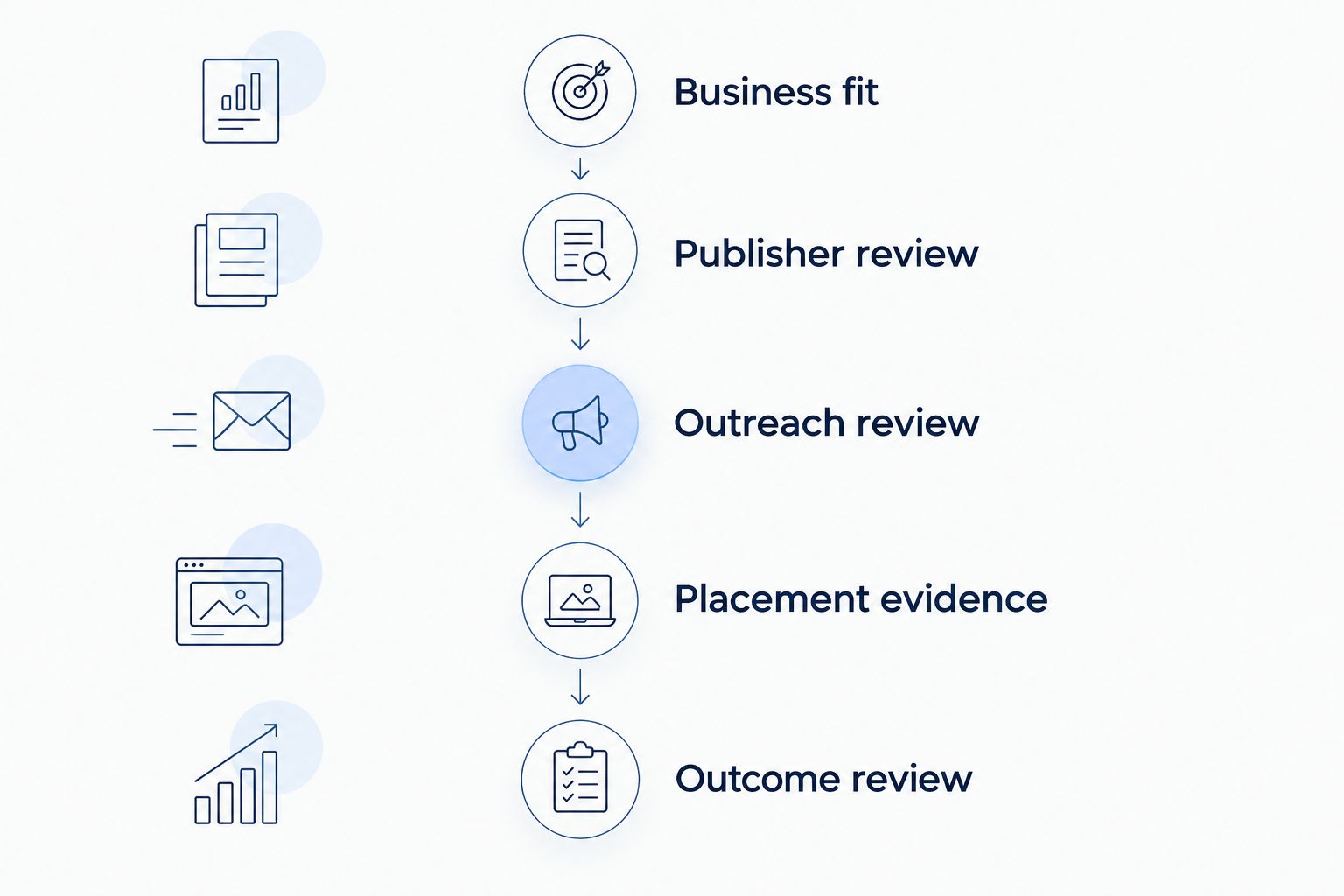
Use this sequence to turn a tactic recommendation into a reviewable scope:
- Business fit: Identify the audience, destination pages and relevant subject areas.
- Publisher review: Request 10 publisher prospects and assess their editorial relevance.
- Outreach review: Inspect the proposed pitch and approval responsibilities.
- Placement evidence: Request 3 sample placements showing anchors, destinations and link attributes.
- Outcome review: Set a 90-day review point for delivery, referral activity and target-page search performance—not a ranking deadline.
These quantities are recommended review checkpoints, not industry benchmarks or delivery promises. Linkible and any shortlisted agency should be assessed against the same written brief.
A placement report should identify what was published and where it links. A performance review should separately examine what happened to the destination pages; links, content changes and technical work can overlap, so a score movement alone does not establish causation.
Which link building tactic should you choose?
Default to resource-led outreach when you have useful content but no original news story. Choose digital PR when credible evidence supports a publishable angle, and reclaim relevant mentions before creating unnecessary new work.
For a 2026 agency brief, ask Linkible to explain the recommended tactic, publisher criteria, manual outreach process and reporting deliverables. Reject a proposal that substitutes a promised Domain Authority increase for those details.
FAQ
Which link building tactic has the biggest Domain Authority impact?
No tactic has a fixed or guaranteed Domain Authority impact. Evidence-led digital PR ranks first in this guide for its editorial potential, not because a measured score increase is assured.
Is Domain Authority a Google ranking factor?
No. Domain Authority is Moz's predictive metric, not a Google ranking factor. Use it alongside publisher relevance and page-level evidence, not as a substitute for them.
Is digital PR better than guest posting?
Digital PR is the stronger fit for original research or a publishable story; guest contributions suit detailed audience education. Neither tactic guarantees coverage, links or ranking improvements.
Are niche edits safe for SEO?
An editorial update that adds a useful reference is different from a paid link intended to manipulate rankings. Check the commercial arrangement, editorial relevance and link attributes before approving a placement.
What should a SaaS link building report include?
A SaaS link building report should show live placement URLs, destination pages, anchor text and link attributes. Review target-page search performance separately from the placement delivery record.
Should ecommerce brands build links to product pages?
Use the destination that best answers the linking article's context. A product page fits a product reference; an educational resource fits an explanatory reference. Do not force every placement towards a sales page.
Can Linkible guarantee a Domain Authority increase?
Do not treat a Domain Authority increase as a guaranteed campaign outcome. Evaluate Linkible against an agreed scope covering relevant publishers, outreach methods, deliverables and transparent reporting.
One last thing
A followed link is not automatically a good link. An unrelated publisher and an unnatural anchor do not become useful because a link passes a particular technical check.
Before requesting a proposal, prepare your priority pages, audience and acceptable publisher criteria. Then contact Linkible to discuss a link-building scope you can inspect and measure.