Link building tactics ranked by cost: start with existing links, then compare outreach workload, publisher relevance and reporting before choosing an agency.
Best starting point: reclaim broken backlinks. Best for SaaS expertise: expert-source outreach. Best for original research: data-led digital PR. These link building tactics ranked by cost compare the work you need to fund in 2026, not publisher fees or agency rate cards; Linkible is an agency option for brands evaluating outsourced link building and outreach.
- These link building tactics ranked by cost prioritise existing assets before new content production.
- Backlink reclamation is the first choice when valuable existing links point to broken pages.
- Expert-source outreach suits SaaS brands with specialists available to answer relevant requests.
- Compare Linkible link building proposals on publisher relevance, outreach scope and reporting—not backlink totals alone.
Link building tactics at a glance
This 2026 ranking assumes you already have a website, useful destination pages and access to subject experts. It orders tactics by their production requirements, from repairing an existing relationship to creating research that earns new coverage. Your existing assets determine the actual order.
| Rank and tactic | Best for | Main work to fund | Standout advantage | Key limitation |
|---|---|---|---|---|
| 1. Backlink reclamation | Broken links to valuable pages | Auditing and restoration | Repairs an existing citation | Limited to recoverable links |
| 2. Unlinked mention outreach | Brands already receiving coverage | Mention checks and requests | Starts with editorial familiarity | Requires existing mentions |
| 3. Resource-page outreach | Brands with useful reference assets | Prospect research and pitching | Reuses an existing resource | Resource must earn inclusion |
| 4. Expert-source outreach | SaaS founders and subject experts | Request screening and expert responses | Uses expertise rather than a new article | Coverage and links remain editorial decisions |
| 5. Guest contribution outreach | Brands with distinct editorial expertise | Pitching, drafting and revisions | Creates space for detailed expertise | Requires substantial content work |
| 6. Editorial niche edits | Brands improving an existing article | Article research and suggested additions | Targets an established content context | Paid ranking links carry policy risk |
| 7. Data-led digital PR | Brands with original evidence | Research, production and media outreach | Gives publishers something new to cite | Research and coverage are uncertain |
Why this matters
A backlink count hides the work behind it. Reclaiming a broken citation and producing an original research campaign involve different inputs, even when each ends with a link.
For a SaaS or ecommerce buyer, the decision is not simply which tactic requires the smallest initial commitment. You need a relevant destination page, a credible reason for a publisher to link and reporting that separates activity from outcomes.
What makes the best link building tactic?
Use these criteria before accepting a cost comparison:
- Existing assets: Does the tactic reuse a citation, mention, resource or expert you already have?
- Publisher relevance: Does the publication reach readers who have a reason to care about your page?
- Production burden: Who supplies research, copy, design, approvals and revisions?
- Editorial control: Can the publisher reject the pitch or choose different wording?
- Verifiable reporting: Will you receive source URLs, destination URLs, anchor text and link attributes?
- Commercial fit: Does the destination support a product category, use case or buying decision that matters?
Linkible is best suited to brands evaluating agency support for link building rather than outreach software. Ask any agency to explain these criteria in its proposed scope; a service label alone does not establish delivery quality.
1. Backlink reclamation: best for broken existing citations
Backlink reclamation restores useful links that already pointed to your website. Start with external links landing on removed pages, incorrect URLs or destinations that no longer satisfy the original citation.
Restoring the page or implementing an appropriate redirect can resolve the problem without a new pitch. Contact the publisher when the source article itself needs updating.
Backlink reclamation pros:
- Reuses an existing editorial reference.
- Often avoids producing a new content asset.
- Exposes destination-page problems alongside outreach opportunities.
Backlink reclamation cons:
- Offers no pipeline once recoverable links run out.
- A redirect is inappropriate when the replacement page does not match the original context.
Best for: Websites that have migrated, removed resources or changed important URLs.
Verdict: Buy the audit and repair work first when relevant broken backlinks exist. Skip irrelevant citations rather than restoring every historical link.
2. Unlinked mention outreach: best for brands already cited
Unlinked mention outreach asks a publisher to add a useful link where an article already names your brand, research or product. The request works best when the destination helps readers verify or understand the reference.
This is a sensible 2026 starting point for a brand with existing coverage. It is not a substitute for building awareness when nobody is mentioning the business.
Unlinked mention outreach pros:
- Starts with a publisher already familiar with the subject.
- Can reuse the page being discussed.
- Gives outreach a specific editorial reason.
Unlinked mention outreach cons:
- Depends on an existing pool of relevant mentions.
- Publishers can decline links or apply their own link attributes.
Best for: SaaS and ecommerce brands receiving independent editorial mentions.
Verdict: Buy targeted mention research when coverage already exists. Skip broad email campaigns that cannot explain why each proposed link helps the reader.
3. Resource-page outreach: best for existing reference assets
Resource-page outreach proposes a useful page for inclusion in an editor's curated collection. Suitable assets include detailed documentation, original reference material and genuinely useful tools.
The work centres on finding relevant collections, checking their inclusion criteria and explaining the asset's specific contribution. A product page is not automatically a resource simply because you want backlinks to it.
Resource-page outreach pros:
- Reuses an asset you already maintain.
- Connects the pitch to an identifiable reader need.
- Makes relevance easier to inspect before outreach.
Resource-page outreach cons:
- Requires an asset worth recommending independently.
- Outdated or abandoned collections create wasted prospecting work.
Best for: Brands with an established reference page that improves a relevant collection.
Verdict: Buy selective outreach after checking the asset against existing entries. Hold if the destination adds nothing the collection lacks.
4. Expert-source outreach: best for available subject experts
Expert-source outreach connects qualified specialists with journalists or editors seeking commentary. HARO-style requests belong here: the underlying work is screening opportunities, preparing an accurate response and meeting the editorial deadline.
The writing requirement can be smaller than a guest article, but expert availability remains a real input. Your agency cannot replace first-hand expertise with generic commentary and expect the same editorial value.
Expert-source outreach pros:
- Uses knowledge already held inside the business.
- Supports narrow, relevant commentary.
- Does not require a new research asset for every pitch.
Expert-source outreach cons:
- Requires responsive experts and approval processes.
- A published comment does not guarantee a backlink.
Best for: SaaS founders, technical specialists and ecommerce operators with relevant experience to share.
Verdict: Buy opportunity screening and response support when an expert can participate. Hold if every answer needs lengthy internal approval.
5. Guest contribution outreach: best for detailed editorial expertise
Guest contribution outreach pitches and produces an article for another publication. Its additional work comes from developing an angle, meeting editorial requirements and handling revisions—not simply sending more emails.
For a 2026 programme, agree who supplies the expertise and who owns the final draft. A generic article with a forced commercial anchor is not a credible replacement for a useful contribution.
Guest contribution outreach pros:
- Gives complex topics room for explanation.
- Lets you demonstrate expertise through the article itself.
- Creates a clear editorial brief for the contributor.
Guest contribution outreach cons:
- Requires drafting, approvals and potential revisions.
- Scaled campaigns built around manipulative links create search-policy risk.
Best for: Brands with a distinct perspective that fits a publication's audience.
Verdict: Buy editorial fit and subject expertise. Skip packages built around unrelated websites or guaranteed exact-match anchors.
6. Editorial niche edits: best for improving existing articles
An editorial niche edit adds a relevant reference to an existing article. A defensible pitch identifies missing information and offers a destination that improves the explanation.
Writing less copy does not automatically make this a lower-work tactic. You still need article-level research, publisher checks and a genuine reason for inclusion; move it earlier in your shortlist only when that work is demonstrably smaller.
Editorial niche edits pros:
- Builds on an existing topic and article context.
- Can address a specific information gap.
- Makes the surrounding paragraph available for inspection.
Editorial niche edits cons:
- Existing articles can still be irrelevant or poorly maintained.
- Buying links that pass ranking credit violates Google's link-spam policies; paid placements need appropriate qualification.
Best for: Brands with a resource that materially improves an existing explanation.
Verdict: Hold until the provider explains selection criteria, payment arrangements and link attributes. Skip concealed paid-link schemes.
7. Data-led digital PR: best for original evidence
Data-led digital PR creates a research finding, analysis or other original evidence that publishers can cite. The work includes methodology, checking, presentation and outreach, which places it last in this production-led ranking.
For SaaS and ecommerce brands, existing proprietary data can change that calculation. Data access alone is not enough: you need permission to use it and a finding that supports the claim you pitch.
Data-led digital PR pros:
- Gives journalists a concrete reason to reference the source.
- Creates an asset you can use beyond outreach.
- Supports differentiated stories grounded in evidence.
Data-led digital PR cons:
- Requires research and methodological checks before pitching.
- Strong research still does not guarantee coverage or links.
Best for: Brands with publishable evidence and the capacity to explain its limits.
Distribution and editorial outreach are different deliverables. When a proposal includes press release distribution services, separate release distribution from journalist responses and independently earned coverage; one does not establish the other.
Verdict: Buy research-led outreach when the evidence supports a relevant story. Hold if the campaign depends on a claim the underlying data cannot substantiate.
How the tactics are ranked
The 2026 order reflects production requirements, not measured market rates or promised returns. Existing citations come first, reusable assets next, and newly produced editorial material or research later.
A broken-link audit with no recoverable links offers little value. An existing research dataset can make digital PR more practical than commissioning guest articles. Choose the smallest credible workload that fits your actual assets.
Turn the shortlist into an accountable scope
Use a 30-day pilot to inspect the process, then schedule a 90-day review of published work and relevant search performance. These are planning checkpoints, not deadlines for ranking gains.
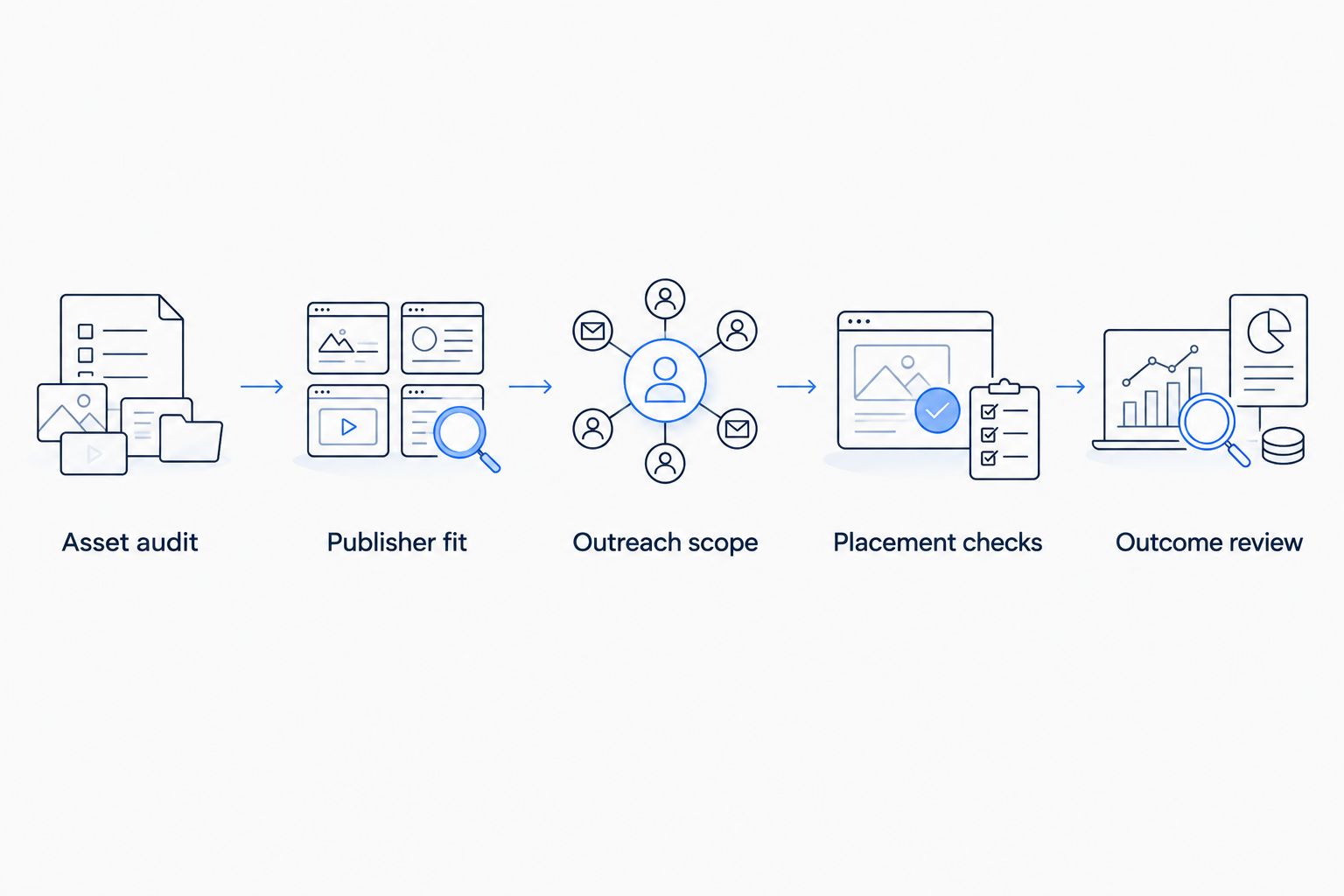
Build the brief in this order:
- Asset audit: Identify relevant citations, mentions, expertise and resources already available.
- Publisher fit: Define acceptable subjects, audiences and exclusion criteria.
- Outreach scope: Assign research, pitching, drafting and approval responsibilities.
- Placement checks: Review context, destination, anchor text and link attributes.
- Outcome review: Separate outreach activity, published links and search performance.
Ask providers to separate 3 workstreams in their proposal: research, content production and outreach. This makes duplicated work visible and shows where your internal team must contribute.
For Linkible link building enquiries, bring the same brief: target pages, priority markets, available expertise and unacceptable publisher categories. Require examples of the proposed reporting fields before agreeing the scope.
Which link building tactic should you choose?
Start with reclamation and relevant unlinked mentions when those opportunities exist. They address existing references before you fund new content production.
If those opportunities are absent, choose by asset fit. Use resource outreach for a strong reference page, expert outreach for available specialists and guest contributions for substantial editorial expertise. Commission data-led PR when you have evidence worth publishing, not because distribution sounds like guaranteed coverage.
FAQ
What's the best starting point for link building tactics ranked by cost?
Start with backlink reclamation when relevant external links point to broken pages. It reuses an existing citation rather than requiring a new content asset, but its value depends on recoverable opportunities.
Is guest posting less work than digital PR?
Guest posting and digital PR require different inputs, so neither is universally less work. Guest contributions require article production; data-led PR requires evidence, methodology and a story. Existing assets can reverse the ranking.
Are niche edits safe for SEO?
A relevant editorial update is different from buying an unqualified link to influence rankings. Inspect the article context, payment arrangements and link attributes; reject concealed paid-link schemes.
Can expert-source outreach guarantee a backlink?
Expert-source outreach cannot guarantee a backlink. Editors control whether they publish a response, how they attribute it and whether they link to the source.
Should SaaS and ecommerce brands choose different tactics?
Choose tactics by assets and publisher relevance rather than the business label alone. A SaaS expert can support commentary, while an ecommerce reference asset can support resource outreach; either brand can use other tactics when the inputs fit.
What should a link building agency report?
A link building agency should report published source URLs, destination URLs, anchor text and link attributes. Keep outreach activity separate from published placements and search performance so the report does not confuse effort with outcomes.
How should I evaluate Linkible against other agencies?
Evaluate Linkible against the same written scope you give other link building agencies. Compare relevant publishers, outreach responsibilities, content requirements, acceptance criteria and reporting rather than a backlink total alone.
One last thing
The most economical next move can be repairing the destination, not pitching another publisher. Before approving outreach in 2026, confirm that each target page answers the question a referring reader would bring.
Take your target pages and shortlisted tactics to Linkible's existing website enquiry route. Ask for a scope that separates research, content and outreach, with clear placement checks and reporting requirements.