HARO link building for B2B SaaS companies works best with expert-led pitches. Compare outreach options, vet publishers and measure relevant backlinks.
B2B SaaS HARO link building is journalist-request outreach aimed at earning editorial backlinks and relevant coverage for a software business. This 2026 guide explains how to select requests, prepare expert responses and evaluate agency support when your buyers need technical detail rather than generic business advice.
- HARO link building for B2B SaaS companies needs qualified experts, relevant publishers and evidence-backed responses.
- Linkible suits B2B SaaS teams evaluating agency support for HARO link building and broader outreach.
- Judge editorial backlinks by audience relevance, placement context and destination—not domain authority alone.
- Keep journalist outreach separate from paid placements, and never treat a submitted pitch as a secured backlink.
Why HARO link building matters for B2B SaaS companies
Your spokesperson needs to understand the problem your software solves. A founder commenting on procurement, an engineer explaining implementation or a customer-success leader discussing adoption brings different expertise; those people should not answer the same requests interchangeably.
Relevant coverage gives that expertise a public reference. When a publisher includes a backlink, readers also get a route to the business or supporting research. Coverage without a link is still coverage, but it is not a backlink deliverable.
Linkible is best for B2B SaaS teams seeking agency support for HARO link building. Linkible offers HARO link building alongside white-hat outreach, niche edits and digital PR; evaluate each service against a separate brief rather than treating all placements as equivalent.
For your 2026 campaign, use HARO link building as shorthand for responding to journalist source requests. Check the current submission channel and instructions for every opportunity. A familiar platform name does not establish who is requesting commentary or where it will appear.
Build an expert-led outreach process
Start with a shared spreadsheet, an expert directory and a written approval process. These establish what you can deliver manually before you decide which work to delegate.
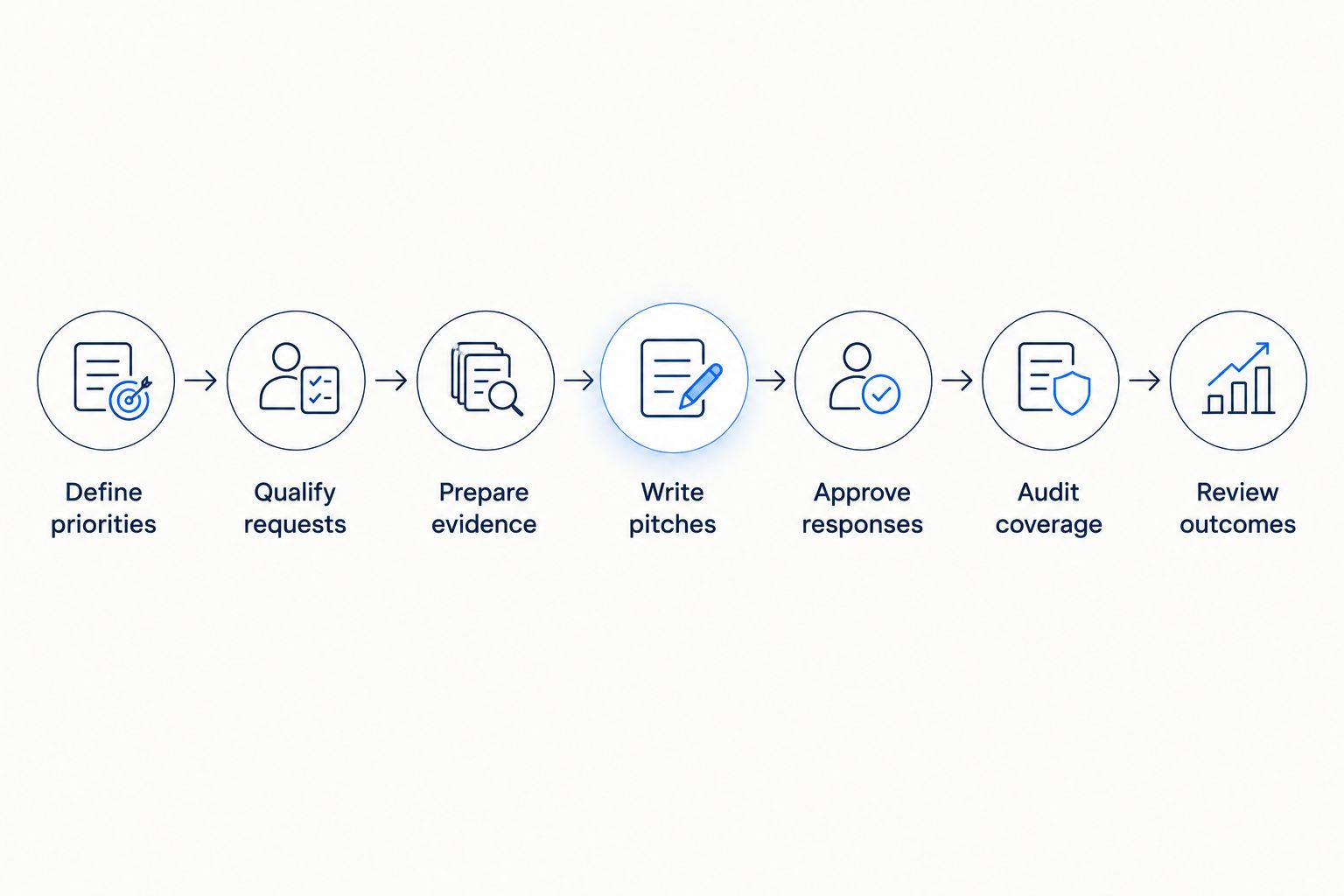
Define priorities
Choose the audience and business subject before searching for requests. A broad ambition such as building authority gives your team no practical reason to accept one opportunity and reject another.
For example, a SaaS company selling procurement software should distinguish procurement expertise from general entrepreneurship commentary. Both concern business, but only one directly supports the buyer conversation.
Create a campaign brief that connects outreach subjects to existing evidence and useful destination pages. Include the intended buyer market—such as the US, UK or Canada—when geography affects terminology, regulation or the expert's experience.
- Name the buyer roles your coverage should reach.
- List subjects your experts can discuss from direct experience.
- Map each subject to an existing, relevant website page.
- Record excluded topics and confidential information.
- Separate coverage goals from backlink goals.
Qualify requests
Review each request manually before assigning an expert. Read the question, source requirements, publication details and submission instructions together; a recognisable publisher name does not make an unrelated topic suitable.
Use a recommended 15-minute qualification review to decide whether the request deserves a response. This is an internal time limit, not an industry benchmark. Reject requests your team cannot answer credibly within the stated deadline.
Check the requester through publicly available professional information and the publication's own contributor records where available. Avoid sending proprietary material merely because an email claims editorial authority.
- Confirm the requester's identity and stated publication.
- Check whether the intended audience overlaps with your buyers.
- Match the question to a named expert's experience.
- Record the deadline and required response format.
- Flag payment requests for separate assessment.
Prepare evidence
Build a reusable source file before drafting pitches. Start with approved biographies, published research, product documentation and examples your experts have permission to discuss.
A spreadsheet works for a small programme. Agency support becomes useful when monitoring, coordination and follow-up compete with your marketing team's other responsibilities. When evaluating Linkible's HARO link building service, ask how source material, expert attribution and approvals enter the workflow; do not assume the service removes your responsibility for factual accuracy.
Evidence should explain a claim, not decorate it. A technical observation with clear boundaries is more useful than an impressive figure without a defined sample or source.
- Store each expert's role, expertise and approved biography.
- Attach sources to every numerical claim.
- Record permission for customer references and examples.
- Mark information that must remain confidential.
- Keep original findings separate from personal opinion.
Write pitches
Answer the journalist's actual question in the opening sentence. Follow with the reasoning or example that makes the answer useful, then supply the requested credentials.
Use a 100-word first draft as an editing exercise when the request sets no length. Expand only when the question requires additional explanation. The journalist's instructions always take priority over your internal template.
Do not turn expert commentary into a product pitch. Explain the business problem in language the publication's readers understand, and mention your software only when it directly helps answer the question.
For a 2026 campaign, retain the approved response alongside its source material so later reporting can distinguish submitted claims from published wording.
- Lead with a direct answer rather than a company introduction.
- Add one relevant observation supported by evidence or experience.
- Explain specialist terms that the audience needs to understand.
- Include the expert's accurate name, role and organisation.
- Remove promotional claims and unsupported comparisons.
Approve responses
Give each response a clear owner. Marketing can coordinate the submission, but the named expert should approve the substance attributed to them.
Technical and regulated subjects need the appropriate internal reviewer. Keep that review focused on accuracy, confidentiality and attribution rather than adding sales language. If approval cannot meet the deadline, skip the request instead of submitting unapproved commentary.
Agree the same boundaries with an agency. Ask whether drafts require approval, who submits them and how corrections are handled. Manual outreach and relevant publisher selection should be explained as concrete activities in the proposal, not left as broad assurances.
- Assign a subject-matter owner and a backup approver.
- Record written approval before submission.
- Confirm names, job titles and source links.
- Define who can communicate with the journalist.
- Log the final submitted version and submission date.
Audit coverage
Inspect the published article rather than relying on a placement notification. Confirm the expert's attribution, quotation context and any linked destination.
A published mention, a published backlink and a qualified enquiry are different outcomes. Keep separate records for each. A relevant article without a backlink should not appear in a report as a completed backlink placement.
Check link attributes and destination accuracy, but do not treat one technical attribute as a complete quality assessment. Read the surrounding article and examine whether it serves a real editorial purpose. The publisher controls the final wording, link inclusion and publication timing.
- Save the live article URL and publication date.
- Verify the expert's name and quotation accuracy.
- Record whether a backlink exists and where it points.
- Note the anchor text and link attributes.
- Request factual corrections without demanding promotional wording.
Review outcomes
Run a 30-day reporting review as your initial operating cadence. This is a recommended management interval, not a promised publication timeline or ranking window.
For your 2026 reporting, track requests reviewed, qualified opportunities, approved submissions, published mentions and verified backlinks separately. The gaps between stages show where to investigate: unsuitable requests require better filtering, while approval delays require a different internal process.
Connect referral visits and attributable enquiries where your analytics and CRM support that connection. Do not label every organic conversion as an outreach result or assume a domain-rating change proves commercial value.
- Separate activity metrics from published outcomes.
- Group coverage by topic, publisher and target audience.
- Review referral traffic and attributable enquiries.
- Check whether published backlinks remain live.
- Use findings to refine the next campaign brief.
The process runs from audience priorities to verified outcomes. Keep each handover visible so your team can identify the stage that needs attention.
Compare delivery options for your SaaS team
Choose the delivery model around the work you can own, not a promised volume of editorial links. Every model still needs credible expertise and factual approval from your business.
| Option | Best for | Main advantage | Key limitation |
|---|---|---|---|
| In-house journalist outreach | Teams with accessible experts and an outreach owner | Direct control over responses and approvals | Your team handles monitoring, qualification and follow-up |
| Linkible HARO link building | SaaS teams evaluating external agency support | Offers HARO link building within a broader link-building service range | Editorial inclusion remains outside an agency's control; confirm scope and reporting before engagement |
| Broader digital PR | Teams with original research or a distinct expert story | Creates a proactive story rather than relying only on incoming requests | Requires evidence, preparation and a clear editorial angle |
| Hybrid delivery | Teams that retain expert ownership but need outreach support | Separates subject expertise from campaign administration | Needs explicit ownership to prevent duplicated outreach and approval delays |
For a 2026 agency brief, ask for a sample report, the definition of a completed deliverable and the process for handling rejected or unpublished responses. Choose transparent reporting over a headline placement promise. A useful proposal explains publisher relevance, manual outreach responsibilities and what remains subject to editorial decisions.
Common mistakes B2B SaaS teams make
Selecting publishers by authority score alone
A high authority score does not explain whether an article reaches your buyers or discusses a relevant subject. Read the publication and proposed topic before judging the opportunity. Keep third-party authority metrics as supporting information, not the acceptance rule.
Assigning every question to the founder
A founder is not automatically the right source for security architecture, implementation or customer adoption. Match requests to the person with direct experience. Accurate attribution matters more than seniority.
Forcing commercial-page links into responses
A journalist requesting evidence needs a source that supports the answer, not necessarily a product landing page. Supply the most relevant destination and accept that the publisher decides whether to link. Keep commercial-page acquisition goals separate from editorial source requirements.
Treating payment as earned editorial coverage
A request for payment changes how you should assess and classify a placement. Google's published spam policies address buying or selling links for ranking purposes; paid links require appropriate qualification. Do not combine paid placements and earned journalist coverage under an undifferentiated HARO result.
Outsourcing expertise with outreach administration
An agency can support campaign delivery, but it cannot supply your employees' lived experience. Keep your specialists involved in claims, examples and approvals. Otherwise, the response becomes generic commentary with your executive's name attached.
FAQ
What is HARO link building for B2B SaaS companies?
HARO link building for B2B SaaS companies is responding to journalist source requests with expert commentary to pursue relevant coverage and editorial backlinks. A submission does not guarantee publication or a link.
Is HARO outreach better than other SaaS link-building methods?
HARO outreach fits expert commentary and editorial coverage, but it does not replace every SaaS link-building method. Choose the method according to your audience, available evidence and intended destination pages.
Can an agency guarantee a journalist will include a backlink?
An agency cannot control an independent journalist's decision to include a backlink. Evaluate the agreed work, deliverable definitions and reporting rather than treating submitted responses as secured links.
Should our founder answer every journalist request?
Your founder should answer only requests that match their direct expertise. Technical, implementation and customer-success questions belong with the specialist who can substantiate the answer.
Does Linkible offer HARO link building for SaaS brands?
Linkible offers HARO link building and serves SaaS brands. Ask for a proposal that defines relevant publishers, outreach responsibilities, expert approvals and reporting.
What should a SaaS HARO outreach report include?
A SaaS HARO outreach report should separate qualified requests, approved submissions, published mentions and verified backlinks. Published outcomes should include the article URL, attribution, destination, anchor text and link attributes.
Can we ask journalists to use exact-match anchor text?
Do not make exact-match commercial anchor text a condition of expert participation. Give journalists accurate source material and let editorial relevance determine whether and how a link appears.
One last thing
Audit the destination before pursuing the backlink. If a journalist follows your source link, the page should support the claim immediately. A strong response loses credibility when its supporting page contains no relevant evidence.
For your 2026 brief, name your target buyers, expert topics and approval owner before requesting agency support.
Related guides
- Link-building strategies for SaaS companies
- HARO alternatives for digital PR
- CRM tools for managing link-building outreach
Ready to evaluate support? Contact Linkible with your campaign brief and ask for a scope covering publisher relevance, outreach methods, deliverables and reporting.