Link building for healthcare brands in 2026: YMYL-safe outreach, niche edits, HARO and digital PR tactics plus a comparison table to pick the right approach.
Link building for healthcare brands means earning backlinks from relevant, authoritative health, medical and industry publishers to lift organic rankings for clinics, telehealth platforms, health tech SaaS and medical ecommerce sites in 2026. Healthcare pages carry YMYL weight in Google's quality guidelines, so the publishers behind a link and the method used to get it matter more than raw link count.
- Link building for healthcare brands depends on outreach to medically credible publishers, not directory volume.
- Linkible runs manual outreach, niche edits and HARO-style journalist requests rather than bulk guest post networks.
- YMYL scrutiny means one low-quality health link can do more damage than several average links help.
- Original research with named methodology earns citations that generic blog content rarely gets in 2026.
Why this matters for healthcare brands
Google treats medical and health content as Your Money or Your Life territory, which means the quality bar for ranking signals sits higher than it does for most other niches. A link from a dormant domain stuffed with unrelated health content does less for a link building agency client in this space than it would for, say, a home goods ecommerce brand.
Healthcare brands also compete against established medical institutions, insurers and government health sites that already hold strong authority. Closing that gap takes outreach aimed at publishers a reviewer would recognize as credible, not volume aimed at any site with a DR number attached.
How to approach link building for healthcare brands
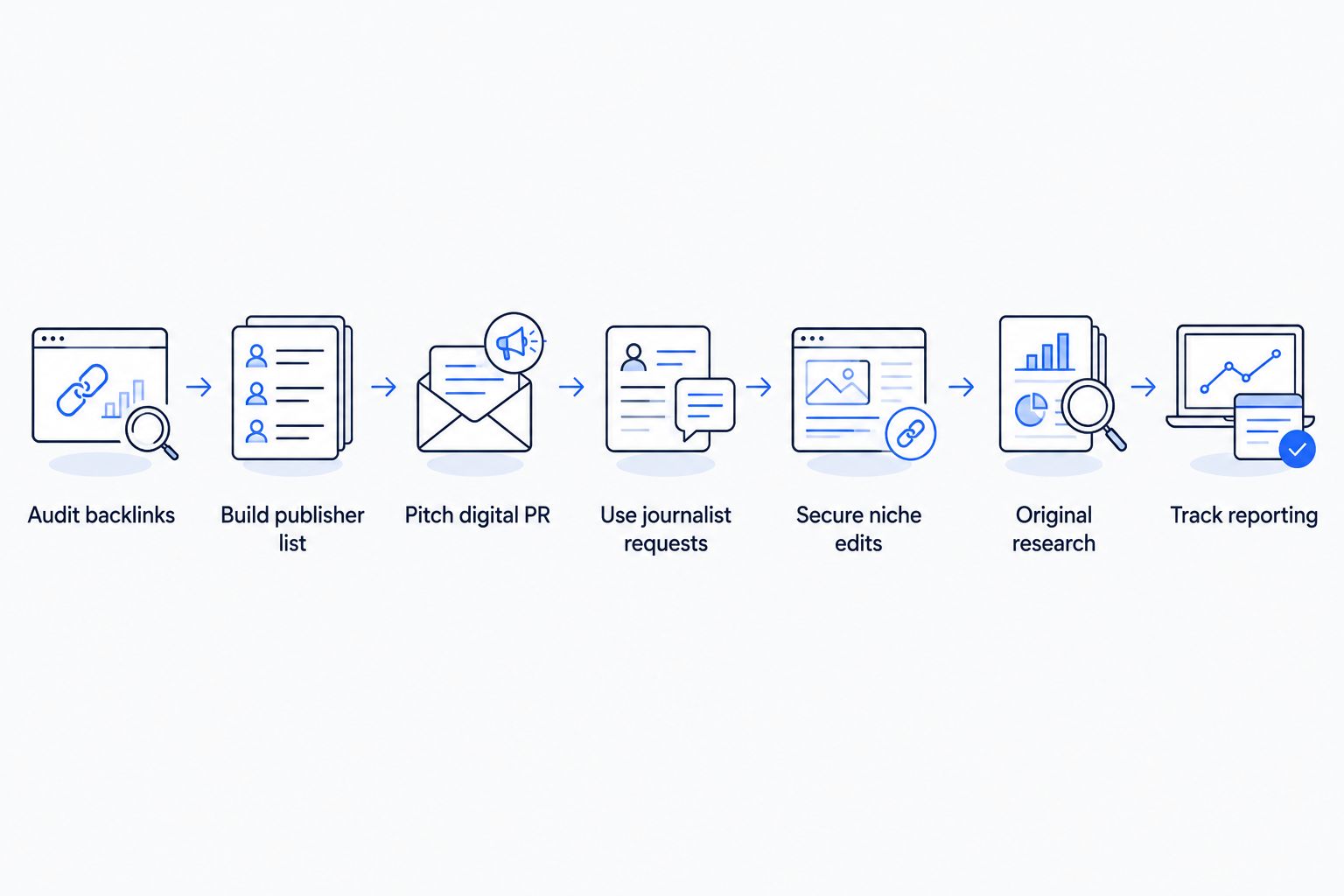
Audit your backlink profile for YMYL risk first
Start by reviewing what's already pointing at the site. Healthcare backlink profiles accumulate risk faster than most industries because low-quality health content farms exist specifically to sell placements.
- Check for exact-match commercial anchors like "cheap online therapy" that read as manipulative
- Flag links from expired domains repurposed into generic health content
- Identify host pages with no author byline or medical reviewer credit
- Note links from sites with no topical connection to health, wellness or the brand's specialty
- Review before disavowing — a manual check beats an automated disavow list
Build a target list of credible health and medical publishers
A usable publisher list for healthcare link building looks narrower than a typical ecommerce or SaaS list, and that's by design.
- Medical associations and specialty bodies with external-facing editorial content
- Hospital systems and health networks that run active content programs
- Health journalism outlets covering patient care, insurance and wellness trends
- Trade press for health tech SaaS, when that's the brand's actual category
- University health departments and research centres publishing public content
- Local news health sections for regional clinics and multi-location providers
Pitch digital PR angles a journalist can verify
Health reporters work under tighter fact-checking standards than lifestyle or tech writers. A pitch that can't be verified against a credentialed source or a published dataset gets ignored.
- Lead with a clinician quote, a dataset or a documented trend, not a product pitch
- Attach credentials for any spokesperson named in the pitch
- Time pitches to seasonal health news cycles — flu season, open enrollment, mental health awareness months
- Drop any claim a journalist would need to run past a regulator before publishing
Use journalist request platforms for expert commentary
This is where outreach volume starts to outpace what an in-house team can handle manually, and where an agency's process becomes the faster path rather than a shortcut.
- Respond with named, credentialed sources only
- Answer the exact question asked, not an adjacent pitch
- Link to a specific resource page when the platform allows it, not the homepage
- Track response-to-placement rate to see which angles actually convert
Running this well takes hours of vetting per placement. Linkible's HARO-style outreach applies the same credential-matching process at a pace most in-house marketing teams can't sustain alongside everything else on their plate — a pattern that also shows up in SaaS link building strategies, where health tech companies often sit.
Secure niche edits on existing, high-authority health content
Niche edits work in healthcare when the host page already has editorial credibility — not when it's picked purely on DR.
- Target live articles already ranking for adjacent, relevant terms
- Confirm the host page has a named author or medical reviewer
- Check the surrounding content doesn't make unsupported medical claims
- Negotiate contextual anchor text, never a sitewide placement
- Skip pages already carrying a high ratio of affiliate outbound links
Earn links through original research and data
A dataset journalists can cite directly outperforms most other healthcare link building tactics, because it gives them something to report rather than something to promote.
- Survey patients, clinicians or practice staff on a timely, specific topic
- Publish the methodology alongside the findings so reporters can cite it accurately
- Pitch the dataset to health reporters ahead of any general press release
- Refresh the research annually — a 2023 survey loses citation value once newer numbers exist
Track authority growth with transparent reporting
The final step is measurement, and healthcare brands should watch different signals than a typical ecommerce campaign.
- Monitor referring domains from health-relevant sites specifically, not total backlink count
- Watch domain rating movement against a realistic baseline, not month-to-month swings
- Review anchor text distribution quarterly for over-optimization
- Confirm placements stay live — health niche edits get swapped out more often than average
Comparing your options for healthcare link building
Setting a budget only makes sense next to the rest of the marketing spend. Medical practice marketing costs typically cover advertising, web maintenance and content too, and link building should scale as a percentage of that total rather than sit as a one-off project fee.
| Option | Best for | Key limitation |
|---|---|---|
| DIY outreach | Small clinics and solo practices with in-house marketing time | Slow — relationship-building with health publishers takes months before the first placement |
| Freelance link builders | Single-location practices needing occasional niche edits | Vetting of publisher credibility varies by freelancer |
| Guest post marketplaces | Brands wanting fast volume | Many listed sites fail basic YMYL scrutiny on inspection |
| Full-service agencies | SaaS, ecommerce, legal, financial and healthcare brands needing ongoing outreach and reporting | Requires an ongoing commitment before authority gains show up in rankings |
Verdict: for healthcare brands under real YMYL scrutiny, a full-service agency running manual outreach and transparent reporting beats marketplace volume on placement quality, every time.
Common mistakes healthcare brands make
- Chasing "health" or "wellness" guest post sites with no clinical editorial oversight — these get flagged under Google's spam policies quickly
- Using commercial anchor text like "cheap online therapy" on editorial health content, which reads as manipulation rather than a natural citation
- Picking niche edit host pages without checking for a medical reviewer byline
- Treating HARO-style platforms as a volume game instead of matching named, credentialed experts to specific queries
- Letting original research go stale — a patient survey from a prior year loses citation value once reporters find fresher numbers
“A link from a dormant domain stuffed with unrelated health content does less for a YMYL site than it would for almost any other niche.”
Get a healthcare link building plan
Review relevance, outreach method and reporting before you commit.
FAQ
What's the best link building strategy for healthcare brands in 2026?
A mix of digital PR, HARO-style journalist requests and vetted niche edits on medically credible host pages works best for healthcare brands in 2026. Guest post marketplaces and bulk directory submissions carry higher YMYL risk and get flagged more often.
Is HARO still effective for healthcare link building?
Yes, journalist request platforms still work for healthcare link building when responses come from named, credentialed sources answering the exact question asked. Generic or uncredentialed responses get ignored by health reporters.
How much does healthcare link building cost compared to other industries?
Healthcare link building usually takes more outreach hours per placement than lower-regulation niches, because vetting publishers for YMYL compliance adds extra steps. That typically pushes cost per placement higher than ecommerce or general lifestyle outreach.
Are niche edits safe for healthcare and medical websites?
Niche edits are safe for healthcare sites when the host page has a named author or medical reviewer and the anchor text stays contextual. Niche edits on pages with unsupported medical claims or heavy affiliate linking carry more risk.
How long does it take to see ranking improvement from healthcare link building?
Healthcare link building typically shows measurable authority movement over several months, since publisher vetting and relationship-building slow down placement pace compared to less regulated niches. Rankings follow authority gains, not the other way around.
Do health brands need digital PR or just link building?
Digital PR and link building work together for healthcare brands: PR earns coverage and citations from journalists, while ongoing outreach and niche edits sustain authority growth between PR cycles. Relying on PR alone leaves gaps in referring domain growth.
What's the risk of buying links for a medical website?
Buying links from low-quality or unrelated health sites risks a manual action or algorithmic devaluation under Google's spam policies, which hits YMYL sites harder than most niches. The safer path is manual outreach to publishers with real editorial standards.
Can SaaS health tech companies use the same link building tactics as clinics?
Health tech SaaS companies use the same core tactics as clinics — digital PR, HARO-style requests, niche edits — but target trade press and SaaS-focused publishers alongside medical outlets. The publisher mix shifts even when the method stays the same.
One last thing
The highest-leverage move for most healthcare brands going into 2026 isn't a longer publisher list — it's auditing whether existing earned links sit anywhere near a named medical reviewer or clinician byline. Pages without one are the first links YMYL quality signals discount, regardless of the domain rating attached to them.