Learn what link acquisition means in modern SEO, how Google evaluates links, and why relevance, context, and trust matter more than link volume for long-term rankings.
February 5, 2026
16 min read
blog
Link acquisition is often explained as the process of getting backlinks, but that explanation misses how links actually work in modern search.
Today, links act as trust and relevance signals, not simple ranking boosters. Google evaluates why a link exists, how it is placed, and whether it reflects genuine editorial judgment. As a result, many links that look good on paper deliver little or no impact.
This is why some websites continue to gain authority with fewer links, while others struggle despite aggressive outreach. The difference is not volume. It is credibility, context, and consistency.
In this guide, we have explained link acquisition as it works today. We’ve focused on how links are earned, how quality is interpreted, and how link acquisition supports long-term search visibility rather than short-term gains.
What Link Acquisition Actually Means Today?
Most ranking pages describe link acquisition as a process of obtaining backlinks from other websites. That definition is incomplete and often misleading for users trying to understand how links influence rankings now.
In practice, link acquisition refers to earning references that signal credibility within a specific topical and editorial context. A link is valuable not because it exists, but because it confirms that another website considers your content, brand, or data worth citing.
Studies show that roughly 94–95% of all content published online never receives a single external backlink, which highlights how uncommon genuine link acquisition actually is.
Search engines evaluate links as supporting evidence. They help confirm:
This is why links cannot be evaluated in isolation. A backlink from a relevant page, written for real readers, placed naturally within the content carries far more weight than multiple links placed through repetitive or forced methods.
Modern link acquisition is outcome-driven. Links appear as a result of relevance, usefulness, and recognition, not simply because outreach emails were sent or placements were arranged. Websites that understand this focus less on chasing links and more on creating reasons for other sites to reference them.
This shift is critical. As Google continues to rely more on context and trust signals, link acquisition has become less about execution and more about positioning.
Link Acquisition vs Link Building
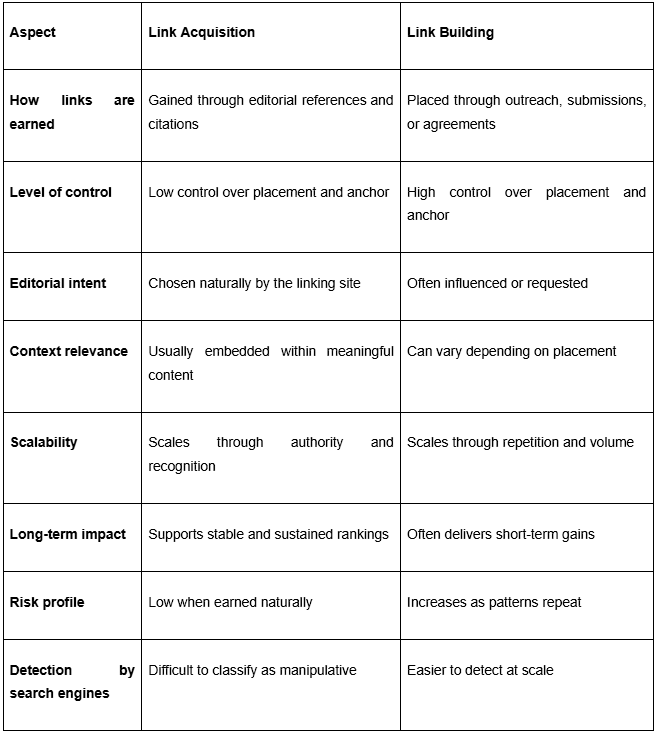
Although the terms are often used as if they mean the same thing, link acquisition and link building represent two different ways links are earned and evaluated in search. The difference is not theoretical. It affects how links are valued, how long their impact lasts, and how risky the strategy becomes over time.
Link building is driven by control and execution. Link acquisition is driven by credibility and editorial choice. Understanding this distinction helps avoid strategies that work briefly but fail to sustain rankings.
Key Differences Between Link Acquisition and Link Building
How Google Evaluates a Link Today?
Most competitor pages talk about “high quality backlinks” but stop short of explaining how search engines actually interpret a link. For users, that creates confusion. A link either works or it does not, and the reason is rarely obvious.
Google does not evaluate links as isolated signals. Each link is interpreted within a broader context made up of relevance, intent, and consistency. Below are the core factors that matter today, based on observed ranking behavior and large-scale SEO analysis over recent years.
Industry research shows that nearly 80% of SEO professionals still consider link acquisition a core part of their strategy, reflecting its ongoing role in how search engines assess authority and trust.
Contextual relevance
A link carries weight only when the surrounding content aligns with the topic of the linked page. A mention from a page that already discusses related subjects reinforces topical authority. Links placed on unrelated pages, even on strong domains, tend to have limited impact.
Relevance is evaluated at multiple levels:
Page topic
Section topic
Overall site theme
This is why links from random “SEO blogs” often underperform compared to links from niche-specific publications.
Editorial intent
Google places strong emphasis on whether a link appears to be editorially chosen. Editorial links are added because the author believes the reference improves the content for readers.
Signals that suggest editorial intent include:
Natural placement within the main body of content
Anchors that fit the sentence naturally
No obvious patterns across multiple sites
Source credibility and history
Not all domains pass trust equally. Google looks at the linking site’s historical behavior, including:
Consistency of topics covered
Outbound linking patterns
Frequency of paid or manipulative placements
Placement and visibility
Where a link appears matters as much as where it comes from. Links placed within the main content area are treated as stronger signals than those in sidebars, footers, or author boxes.
Visibility matters because it reflects intent. A link meant to guide readers carries more weight than one added for structural or promotional reasons.
Pattern consistency over time
Google evaluates link acquisition patterns, not just individual links. Natural link profiles tend to grow steadily and vary in source, anchor text, and context.
Unnatural patterns often include:
Sudden spikes followed by long gaps
Repeated anchors across different domains
Heavy reliance on the same type of placement
Types of Link Acquisition That Actually Work
Most competitor pages list a long set of tactics without explaining when or why they work. For users, that creates false expectations. Not every method suits every website, and using the wrong approach at the wrong stage often leads to wasted effort or ignored links.
Below are the core types of link acquisition, grouped by how links are earned, not by tactics.
Authority-driven link acquisition
This type of acquisition happens when a website is referenced as a source of insight, data, or expertise.
Common sources include:
Editorial mentions in industry publications
Citations from research-based content
Media coverage tied to commentary or analysis
These links tend to carry strong trust signals because they are driven by editorial judgment. They work best for brands, SaaS companies, agencies, and businesses operating in information-heavy markets. They are difficult to force but compound over time.
Relationship-driven link acquisition
Some links are earned through established professional relationships rather than cold outreach.
This includes:
Industry partnerships
Co-authored content
Expert contributions where selection is merit-based
These links perform well when relationships are genuine and topically aligned. When overused or transactional, their impact weakens quickly.
Content-triggered link acquisition
This occurs when content itself creates a reason for other sites to link.
Examples include:
Original research and data
Comparative studies
Practical tools or calculators
Most competitor pages oversimplify this by suggesting that “great content attracts links.” In reality, only content that fills a clear gap or provides verifiable value tends to earn consistent links. Generic blog posts rarely do.
Tactical link acquisition
This category includes methods where links are intentionally pursued and placed.
These approaches still work when executed carefully, with strong relevance and limited repetition. Their value declines when used as a primary growth mechanism or scaled without variation.
What High-Quality Link Acquisition Actually Looks Like?
Most competing pages describe high-quality links using vague labels like “authoritative” or “trusted” without explaining how quality shows up in practice. For users, this makes it hard to judge whether a link is helping, hurting, or simply doing nothing.
65% of marketers believe a single high-authority, relevant link matters more than many low-quality links. High-quality link acquisition is not defined by metrics alone. It is defined by signals that align with how search engines assess credibility and usefulness.
Clear editorial reasoning
A strong link exists because it supports the surrounding content. If removing the link would reduce clarity or usefulness for readers, that is a positive signal. Links that feel optional, forced, or promotional tend to be discounted.
Strong topical alignment
The linking page and the linked page should share a clear subject connection. This does not mean matching keywords. It means serving the same audience intent. Links that bridge unrelated topics rarely contribute to authority, even when they come from large domains.
Natural anchor usage
High-quality links use anchors that fit naturally into sentences. Branded terms, partial phrases, and descriptive references perform better over time than repeated keyword-focused anchors. Anchor text over-optimization often leads to links being ignored rather than penalized.
Editorial placement within content
Links placed inside the main content area, where users are actively reading, carry more weight than links placed in author bios, side sections, or templated blocks. Placement reflects intent, and intent influences trust.
Consistent acquisition patterns
Quality link acquisition appears steady and varied. It involves different sources, formats, and contexts over time. When links follow predictable patterns or come from the same type of source repeatedly, their marginal value drops.
Common Link Acquisition Mistakes That Quietly Hold Rankings Back
Many websites do not lose rankings because of penalties. They lose momentum because their links stop carrying weight. This usually happens due to repeatable mistakes that are easy to miss and hard to diagnose.
Below are the most common issues seen across sites that invest in link acquisition but fail to see sustained results.
Chasing volume instead of relevance
A high number of links does not compensate for weak topical alignment. When links come from sites that do not serve a related audience, their contribution is limited. Over time, this creates a bloated link profile with little authority reinforcement.
Repeating the same sources
Using the same blogs, publishers, or networks repeatedly creates detectable patterns. Even when those sites look strong individually, repetition reduces marginal value and increases the likelihood of links being discounted.
Over-optimizing anchor text
Keyword-heavy anchors are still widely used, despite years of evidence showing diminishing returns. Natural language anchors perform better long term because they reflect how real citations occur. Forced anchors often result in links being ignored rather than helping rankings.
Ignoring context quality
A link placed on a page with thin content, weak structure, or excessive outbound links carries limited trust. Context quality matters as much as domain strength, yet it is often overlooked.
Sudden spikes without continuity
Natural link acquisition shows consistency. Sharp increases followed by long periods of inactivity often signal artificial activity. These patterns rarely trigger penalties, but they commonly lead to links being devalued.
Treating all links as equal
Not every link needs to be powerful, but not every link helps either. Mixing strong editorial links with large volumes of low-context placements often results in diluted impact rather than compounded authority.
How to Choose the Right Link Acquisition Strategy for Your Website?
Most competitor pages explain how to acquire links but rarely explain which approach makes sense for a specific website. This is where many users get stuck. The wrong strategy does not always cause damage, but it often produces no results.
Choosing the right link acquisition approach depends on three practical factors: site maturity, competitive pressure, and audience alignment.
If your website is new or has low authority
Early-stage sites struggle with pure editorial acquisition because they lack recognition. At this stage, the goal is to establish relevance signals without creating obvious patterns.
What works best:
Limited, high-relevance tactical placements
Contextual mentions on niche-specific sites
Relationship-based contributions where expertise is clear
What to avoid:
High-volume outreach
Generic guest posting across unrelated blogs
Aggressive anchor optimization
If your website has some traction but stalled growth
This is the most common situation. Rankings plateau even though content quality is solid.
What works best:
Content-triggered acquisition through research, comparisons, or data
Authority-driven mentions that reinforce topical leadership
Diversifying link sources rather than increasing volume
What to avoid:
Repeating the same publishers
Doubling down on tactics that already stopped moving rankings
If you operate in a competitive or high-trust niche
Industries such as finance, SaaS, health, legal, and gambling require stronger trust signals.
What works best:
Editorial citations from industry-relevant publications
Brand mentions tied to commentary, insights, or analysis
Links that support expertise rather than keywords
What to avoid:
Scaled placements with weak editorial standards
Networks or sites that link to anything for a fee
If your site already has strong authority
At this level, link acquisition becomes selective.
Measuring Link Acquisition Success Beyond Link Counts
Most competitors suggest measuring link acquisition by the number of backlinks or referring domains. Those metrics are easy to track, but they rarely explain whether link acquisition is actually working.
Effective measurement focuses on impact, not accumulation.
Referring domain quality trends
Instead of counting total referring domains, look at how the quality profile changes over time. Are new links coming from sites that are more topically aligned and editorially credible than older ones? A slow improvement in source quality often correlates with stronger ranking stability.
Search visibility and ranking behavior
Link acquisition success shows up first in behavior, not position jumps. Common early signals include:
Improved ranking consistency across related keywords
Reduced volatility during algorithm updates
Pages holding positions longer once they rank
Topical authority expansion
Strong link acquisition supports visibility beyond a single page. When acquisition is working, related pages start ranking with less effort, even without direct links. This indicates that links are reinforcing subject-level authority, not just page-level signals.
Organic traffic quality, not just volume
Look for changes in:
Engagement time from organic visits
Growth in non-branded keyword impressions
Increase in pages receiving organic traffic
Indexing and crawl efficiency
High-quality links help search engines discover and prioritize content. Faster indexing of new pages and more consistent crawling patterns are often overlooked but meaningful signals that link acquisition is supporting site trust.
Is Link Acquisition Safe Today?
Many users worry about link acquisition because they associate it with penalties. That concern comes from outdated practices and poor execution, not from the concept itself.
Link acquisition, when done correctly, is one of the safest parts of SEO. The risk does not come from earning links. It comes from manufacturing patterns that search engines can easily classify as artificial.
Why penalties are rare?
Google penalties related to links are uncommon today. In most cases, Google does not punish sites. It simply ignores links that fail to meet trust and relevance thresholds. This is why many websites do not see ranking drops, but also do not see progress.
The shift has been clear for years:
Devaluation replaces punishment
Ignored links replace penalized sites
Trust signals matter more than link volume
What actually creates risk?
Link acquisition becomes risky only when it shows clear signs of manipulation, such as:
Repeated placements across the same group of sites
Paid links disguised as editorial content
Heavy anchor text control at scale
Sudden link growth without contextual justification
Why natural acquisition protects rankings?
Links earned through relevance, editorial choice, and consistent visibility tend to support rankings during core updates rather than destabilize them. Sites with strong acquisition profiles often see:
Less volatility
Faster recovery after updates
More consistent long-term growth
The practical takeaway
Link acquisition is safe when it aligns with how links naturally occur on the web. When links exist because they make sense for readers, they rarely create risk. When they exist solely to influence rankings, their impact fades quickly.
For most websites, the real danger is not acquiring links. It is relying on link methods that no longer carry weight while expecting them to deliver long-term results.
Final Thoughts: Link Acquisition Is About Trust, Not Tactics
Link acquisition works when it reflects how authority is earned on the web. Not through repetition, shortcuts, or volume, but through relevance, credibility, and consistent recognition.
Search engines no longer reward links simply for existing. They reward links that make sense in context, support users, and reinforce expertise over time. This is why some sites grow steadily with fewer links, while others stall despite heavy activity.
Effective link acquisition is not about finding new tricks. It is about understanding why links appear naturally and aligning your strategy with those conditions. When links are earned because they add value to content, they strengthen rankings, protect visibility during updates, and support long-term growth.
For most websites, success comes from shifting focus. Less emphasis on chasing placements. More emphasis on becoming a source others choose to reference. That is where link acquisition delivers real and lasting impact.
Frequently Asked Questions
What is the difference between backlinks and link acquisition?
Backlinks are the links themselves. Link acquisition is the process by which those links are earned. Backlinks describe an outcome, while link acquisition describes the underlying strategy and conditions that lead to links being created and valued.
How long does link acquisition take to show results?
Link acquisition rarely produces instant results. In most cases, early impact appears within a few weeks as improved indexing and stability, while ranking improvements typically follow over several months. The timeline depends on competition, link quality, and how well links align with topical relevance.
Is link acquisition still important for SEO?
Yes. While links are no longer the sole ranking factor, they remain a key signal for authority and trust. Links help search engines decide which sources deserve consistent visibility, especially in competitive results where content quality alone is not enough.
Can a website rank without link acquisition?
In low-competition niches, some pages can rank with minimal links. In most competitive industries, link acquisition plays a supporting role by confirming credibility. Without it, rankings often stall or fail to sustain long term.
Are paid links considered link acquisition?
Paid links are not inherently link acquisition. They become risky when they bypass editorial judgment or create detectable patterns. Links that exist purely because of payment, without relevance or context, are often ignored by search engines.
How many links does a website need?
There is no fixed number. One relevant editorial link can outweigh dozens of low-context placements. What matters is link relevance, source quality, and consistency over time, not total count.
Can bad link acquisition hurt rankings?
In most cases, poor links are ignored rather than penalized. However, repeated low-quality acquisition can prevent growth by diluting authority signals and limiting trust. The damage is often silent rather than sudden.
Is link acquisition better than link building?
Neither is inherently better. Link acquisition is more sustainable and carries lower risk, while link building can help fill early gaps. Long-term growth usually depends more on acquisition than on controlled placement.
How do I know if my link acquisition strategy is working?
Signs include improved ranking stability, broader keyword visibility, faster indexing of new pages, and growth across related topics. If links increase but visibility does not, the issue is usually relevance or context.
Should link acquisition be done in-house or outsourced?
That depends on expertise and resources. In-house teams work well when they understand editorial standards and topical positioning. Outsourcing can be effective when providers focus on relevance and quality rather than volume.